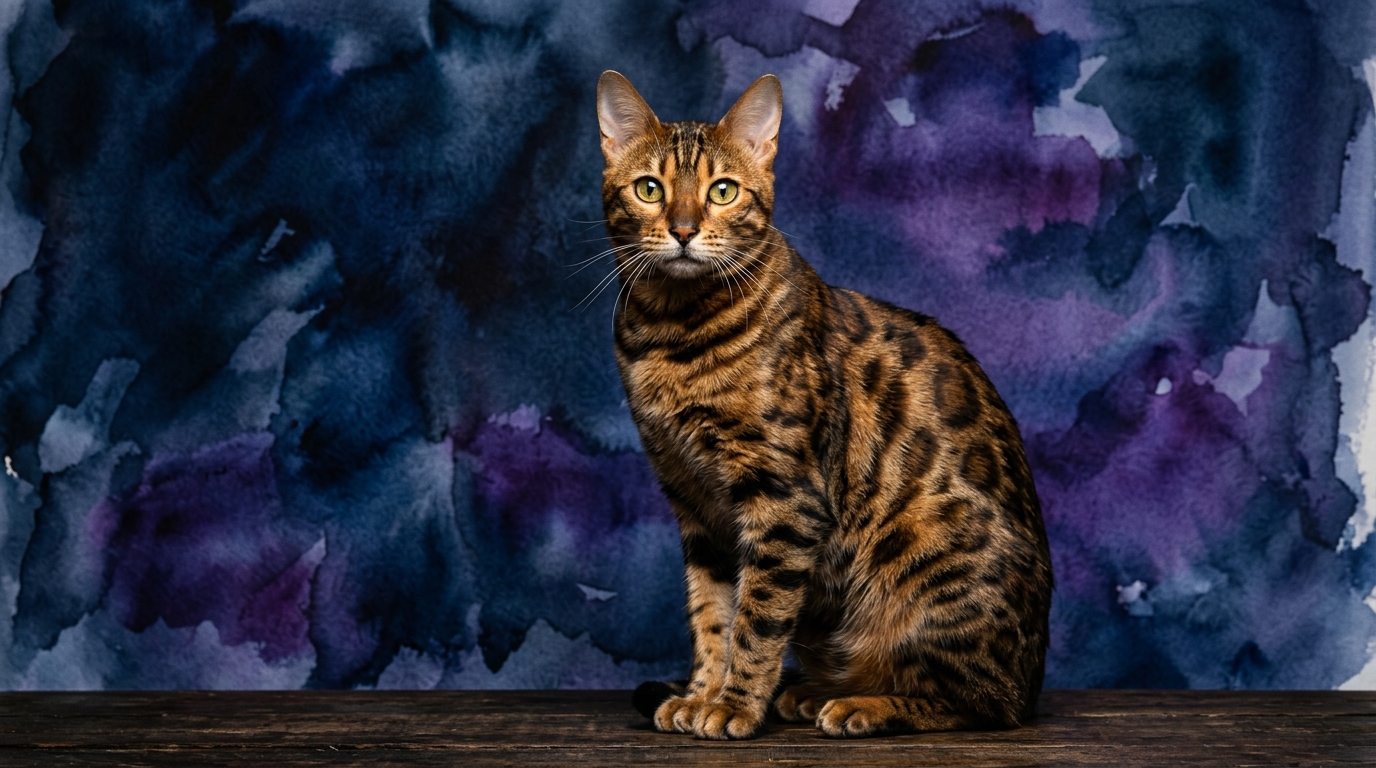
Bengal at a glance
| IQ Rank / Score | 23/25 |
|---|---|
| Trainability | ★★★★☆ (4/5) |
| Social Intelligence | ★★★★☆ (4/5) |
| Lifespan | 12-16 years |
| Shedding | Moderate to high |
| Exercise Needs | Needs active play (45-60 min/day) |
| Origin | USA (hybrid: domestic × Asian Leopard Cat) |
The Leopard Within: A Bengal's Unique Cognitive Blueprint
Originating from a careful cross between domestic cats and the majestic Asian Leopard Cat in the USA, Bengal cats carry a remarkable genetic legacy that profoundly shapes their intelligence. Unlike many breeds whose smarts lean towards social learning or human-centric problem solving, Bengals often approach challenges with a primal, predatory precision. Their cognitive hunting patterns, directly inherited from their wild ancestors, translate into a remarkable ability to dissect and conquer complex puzzles, making them compelling subjects for feline intelligence studies.
This deep-seated instinctive drive means that Bengal cats are masters of their environment, constantly observing, calculating, and strategizing. Their intelligence isn't just about learning tricks, but about understanding spatial relationships, cause-and-effect, and predicting outcomes, often with a laser focus on resource acquisition or navigation. This makes them adept at manipulating objects and exploring boundaries, driven by an innate curiosity that echoes their wild roots.
Bengal Intelligence Profile: Problem Solvers Par Excellence
At the Pet IQ Lab, we assess feline intelligence across several key dimensions, and the Bengal cat consistently scores exceptionally well in areas reflecting their ancestral heritage. Their Problem Solving ability stands at a formidable 5/5, indicating an outstanding capacity to work through novel challenges. This extends to their Training Speed, rated 4/5, as they can quickly grasp new commands or routines, especially when a clear, motivating reward is involved. Their sharp Social Intelligence, scoring 4/5, allows them to navigate household dynamics with keen awareness, understanding nuances in human behavior and routines.
However, where Bengals truly shine is in their Instinctive Drive, a perfect 5/5. This encompasses their powerful hunting instincts, exploratory urges, and an unyielding determination to overcome obstacles. Their exceptional Memory, also 5/5, complements this, enabling them to recall complex sequences, hiding places, and learned solutions with impressive accuracy. This combination creates a cat that is not just quick to learn, but also driven to apply that learning in practical, often ingenious ways, maintaining a mental sharpness that demands engagement and stimulation.
More Than Just Stripes: The Water-Loving Secret
One of the most surprising and endearing traits of Bengal cats, directly linked to their unique intelligence and ancestry, is their genuine enjoyment of water. While most domestic felines notoriously shy away from getting wet, Bengal cats are one of the few domestic cats that genuinely enjoy water and will fish with their paws in fish tanks. This fascinating behavior is directly inherited from their Asian Leopard Cat ancestors who fish in streams as a natural part of their foraging activities. This isn't just a quirk; it's a testament to their deep-seated instincts and their ancestral cognitive patterns for resource acquisition. Their ability to adapt their innate hunting skills to new environments, even a domestic fish tank, speaks volumes about their flexible, problem-solving minds. This playful interaction with water highlights their predatory precision and their keen understanding of their environment, demonstrating their continuous engagement with their surroundings and their willingness to explore and exploit new resources, much like their wild counterparts. Providing a water fountain or even supervised access to a shallow basin can be a wonderful form of enrichment for these aquatic adventurers.
Comparing Minds: Bengal vs. Savannah, Abyssinian, and Ocicat
When placing the Bengal's intelligence in context, comparing them to other dynamic breeds like the Savannah, Abyssinian, and Ocicat offers valuable insight into their unique cognitive blueprint. While a Savannah, also a hybrid, might showcase similar athletic prowess, the Bengal's problem-solving often leans more into intricate manipulation and spatial puzzles rather than sheer vertical exploration. An Abyssinian, known for its playful and people-oriented nature, exhibits high social intelligence and curiosity, but might not display the same intense, strategic predatory focus on object manipulation as a Bengal. The Ocicat, with its wild spots and active demeanor, shares some of the Bengal's zest for adventure, yet the Bengal's cognitive approach is more directly rooted in the analytical hunting patterns of its specific wild ancestor, evident in their detailed approach to hidden objects or complex feeders.
3 At-Home Tests to Measure Your Bengal's IQ
These tests are adapted from peer-reviewed ethology research. No equipment is needed beyond items you have at home. Run each test 5–10 times for reliable results.
The Myth: "Bengals are too wild and uncontrollable to live peacefully in a home."
✅ While Bengals possess a strong ancestral drive, they are truly domestic cats, bred for companionship. With proper socialization from a young age, ample environmental enrichment, and consistent positive reinforcement, Bengals are highly adaptable and can be affectionate, playful, and loyal family members. Their energetic nature simply requires an active owner willing to engage their sharp minds.
Bengal vs. Similar Breeds
🧠 What's Your Cat's IQ Score?
Our full Pet IQ Lab assessment includes 12+ tests across 5 cognitive dimensions, calibrated for Bengals specifically.
Take the Full IQ Test →Frequently Asked Questions
How smart is a Bengal?
Our Pet IQ Lab framework scores cognition across five dimensions (max 25). The Bengal totals 23/25 — exceptionally high for a domestic cat. The full article breaks down each dimension with at-home tests.
Are Bengals easy to train?
Bengals are generally easy to train when you use consistent, reward-based sessions. They score 4/5 on Training Speed in our breed profile.
Are Bengals good with children and other pets?
Yes — their Social Intelligence rates 4/5 in our Pet IQ Lab framework. With early socialization and supervised play, most Bengals integrate well into families with respectful children and other pets.
Do Bengals need a lot of mental stimulation?
Absolutely. With Problem Solving 5/5 and Instinctive Drive 5/5, Bengals need daily mental work — puzzle feeders, scent games, training sessions, or interactive wand toys — to avoid boredom.
How much exercise does a Bengal need?
Bengals need active engagement. Plan for 45-60 minutes of play and climbing per day, plus mental stimulation.
How good is a Bengal's memory?
Bengals score 5/5 on memory. They remember routines, hiding spots, and learned cues for months, sometimes years.
What is the typical lifespan of a Bengal?
Most Bengals live 12-16 years with good veterinary care, quality diet, and indoor living.
The Bengal cat is a living testament to the fascinating interplay between ancient instinct and domestic adaptability, offering a truly unique perspective on feline intelligence. Engaging with a Bengal's mind is a journey into problem-solving prowess and ancestral echoes, proving that 'smart' comes in many surprising forms.