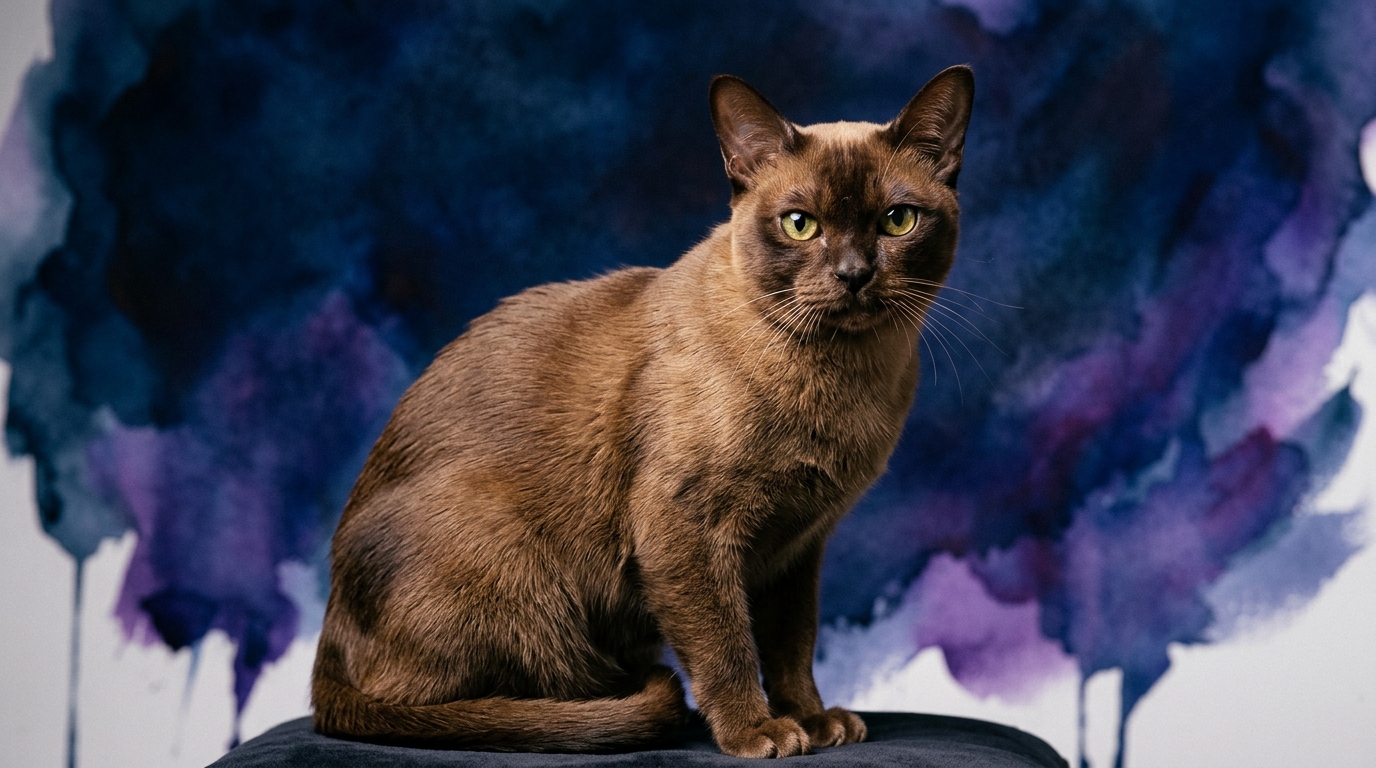
Burmese at a glance
| IQ Rank / Score | 21/25 |
|---|---|
| Trainability | ★★★★★ (5/5) |
| Social Intelligence | ★★★★★ (5/5) |
| Lifespan | 12-16 years |
| Shedding | Low to moderate |
| Exercise Needs | Moderate (20-40 min play/day) |
| Origin | Myanmar/Thailand |
Meet the Burmese: A Cat Apart
Originating from Southeast Asia, specifically Myanmar (formerly Burma) and Thailand, the Burmese cat is a medium-sized breed known for its compact, muscular build often described as a 'brick wrapped in silk.' Beyond their striking short, glossy coats that come in a variety of rich colors, it's their personality and unique cognitive abilities that truly set them apart in the feline world. Unlike many breeds stereotyped for their aloof independence, the Burmese thrives on interaction, forming profound bonds that challenge conventional perceptions of cat behavior.
The journey of the modern Burmese cat began in the 1930s when a single cat named Wong Mau was brought from Burma to the United States. She was a distinctive dark brown feline, initially thought to be a dark Siamese, but her unique characteristics led to careful breeding programs. These efforts revealed her distinct genetic makeup, establishing the foundation for the breed we know and adore today. This singular origin story highlights a breed developed not just for aesthetics, but for a unique temperament that soon captivated enthusiasts worldwide.
The Burmese Intelligence Profile: Unpacking Their Feline Acumen
Cats were notably absent from Dr. Stanley Coren's classic obedience scale, which focused primarily on dogs. However, our Pet IQ Lab uses a broader framework to assess feline intelligence, considering various dimensions beyond simple obedience. For the Burmese, their profile stands out dramatically, particularly in areas typically associated with canine companions.
We evaluate cat intelligence across five key dimensions: Problem Solving, Training Speed, Social Intelligence, Instinctive Drive, and Memory. The Burmese consistently achieves high marks, especially in areas that speak to their interactive nature. Their scores reflect a breed that is not only capable of complex thought but also deeply attuned to their human companions, making them exceptional partners in a shared home environment. Their approach to life demonstrates a profound capacity for learning and connection that often surprises first-time owners and seasoned cat aficionados alike, proving that intelligence isn't just about tricks, but about profound interaction.
Why Burmese Cats Are Feline Social Butterflies
If you've ever thought your cat behaves 'like a dog,' you might just be describing a Burmese. This breed is renowned as the most people-oriented of all cat breeds, often following their owners from room to room like a shadow, eager to be part of every activity. This isn't merely proximity; it's an active engagement. Burmese cats respond to emotional cues with unusual sensitivity, often seeming to understand and mirror their owners' moods, offering comfort or initiating play at just the right moment.
This extraordinary social aptitude is evidenced by specific behaviors rarely seen in other felines. Burmese cats are one of the few breeds that will play fetch consistently. They also initiate and maintain prolonged eye contact with their owners — a behavior associated with bonding hormones in both species. This consistent, reciprocal interaction points to a level of social attunement rarely seen in the feline world, fostering deeper, more complex bonds than previously thought possible. Their ability to engage in such sophisticated forms of communication speaks volumes about their cognitive flexibility and their deep desire for connection.
Beyond these playful interactions, their high Social Intelligence (5/5) means they are adept at understanding routines, anticipating actions, and even picking up on subtle non-verbal cues. This makes them incredibly responsive pets, capable of learning complex social rules within a household. Their Training Speed (5/5) further complements this, allowing them to quickly grasp commands and learn appropriate behaviors, often excelling in leash training or even performing simple tricks. Their Problem Solving (4/5) is also impressive, as they often figure out how to open cabinets or master puzzle toys, demonstrating a keen intellectual curiosity that goes hand-in-hand with their social drive.
Beyond Social Graces: Memory and Instinctive Drive
The impressive Memory (4/5) of the Burmese means they not only remember faces and routines but can also recall specific commands and past events, contributing to their remarkable trainability. This strong memory underpins their ability to form lasting associations, whether it's the sound of your car returning home or the specific cupboard where treats are stored. Their consistent behavior patterns are often a testament to their excellent recall.
While they possess a respectable Instinctive Drive (3/5), signifying their natural predatory instincts, the Burmese typically balances this with a strong desire for human interaction. Their hunting behaviors, though present, are often channeled into play with their owners rather than purely independent pursuits. This integration of their natural urges with their social needs makes them well-adjusted and engaging indoor companions, ready for a game of chase or a quiet cuddle depending on the moment.
Burmese Comparisons: Siamese and Abyssinian
Understanding the Burmese's unique intelligence is clearer when compared to other popular breeds. While Siamese cats are renowned for their distinct vocalizations and intense focus on their chosen human, the Burmese offers a uniquely tactile and consistently present companionship, often following their owner silently from room to room with an unwavering, dog-like devotion. Similarly, Abyssinian cats are celebrated for their active, playful, and curious nature, always exploring their environment, but the Burmese stands out for its direct, personal, and emotionally responsive engagement with people, prioritizing interaction over independent adventure. These comparisons highlight the Burmese's unparalleled capacity for intimate, reciprocal bonding, distinguishing them as truly special among felines.
3 At-Home Tests to Measure Your Burmese's IQ
These tests are adapted from peer-reviewed ethology research. No equipment is needed beyond items you have at home. Run each test 5–10 times for reliable results.
The Myth: "Cats that follow people around are just anxious and insecure, not intelligent."
✅ For Burmese cats, following their owners is a clear demonstration of high social intelligence and deep affection, not insecurity. It reflects a secure attachment, a desire for active engagement, and an ability to read and respond to human cues. This behavior is rooted in their unique capacity for bonding, indicating a cat that feels safe, loved, and wants to be an integral part of their human's life, demonstrating advanced social understanding.
Burmese vs. Similar Breeds
🧠 What's Your Cat's IQ Score?
Our full Pet IQ Lab assessment includes 12+ tests across 5 cognitive dimensions, calibrated for Burmeses specifically.
Take the Full IQ Test →Frequently Asked Questions
How smart is a Burmese?
Our Pet IQ Lab framework scores cognition across five dimensions (max 25). The Burmese totals 21/25 — very high for a domestic cat. The full article breaks down each dimension with at-home tests.
Are Burmeses easy to train?
Burmeses learn new cues very quickly — often in 5-15 repetitions. They score 5/5 on Training Speed in our breed profile.
Are Burmeses good with children and other pets?
Yes — their Social Intelligence rates 5/5 in our Pet IQ Lab framework. With early socialization and supervised play, most Burmeses integrate well into families with respectful children and other pets.
Do Burmeses need a lot of mental stimulation?
Absolutely. With Problem Solving 4/5 and Instinctive Drive 3/5, Burmeses need daily mental work — puzzle feeders, scent games, training sessions, or interactive wand toys — to avoid boredom.
How much exercise does a Burmese need?
Burmeses do well with 20-40 minutes of interactive play plus a few short training moments.
How good is a Burmese's memory?
Burmeses score 4/5 on memory. They remember routines, hiding spots, and learned cues for months, sometimes years.
What is the typical lifespan of a Burmese?
Most Burmeses live 12-16 years with good veterinary care, quality diet, and indoor living.
The Burmese cat stands as a testament to the diverse and often surprising forms of intelligence found within the feline world, proving that a cat's companionship can be as deeply social and responsive as any dog's. Their unique blend of problem-solving, trainability, and profound social acumen invites us to rethink our perceptions of what it means to be a truly 'smart' cat.