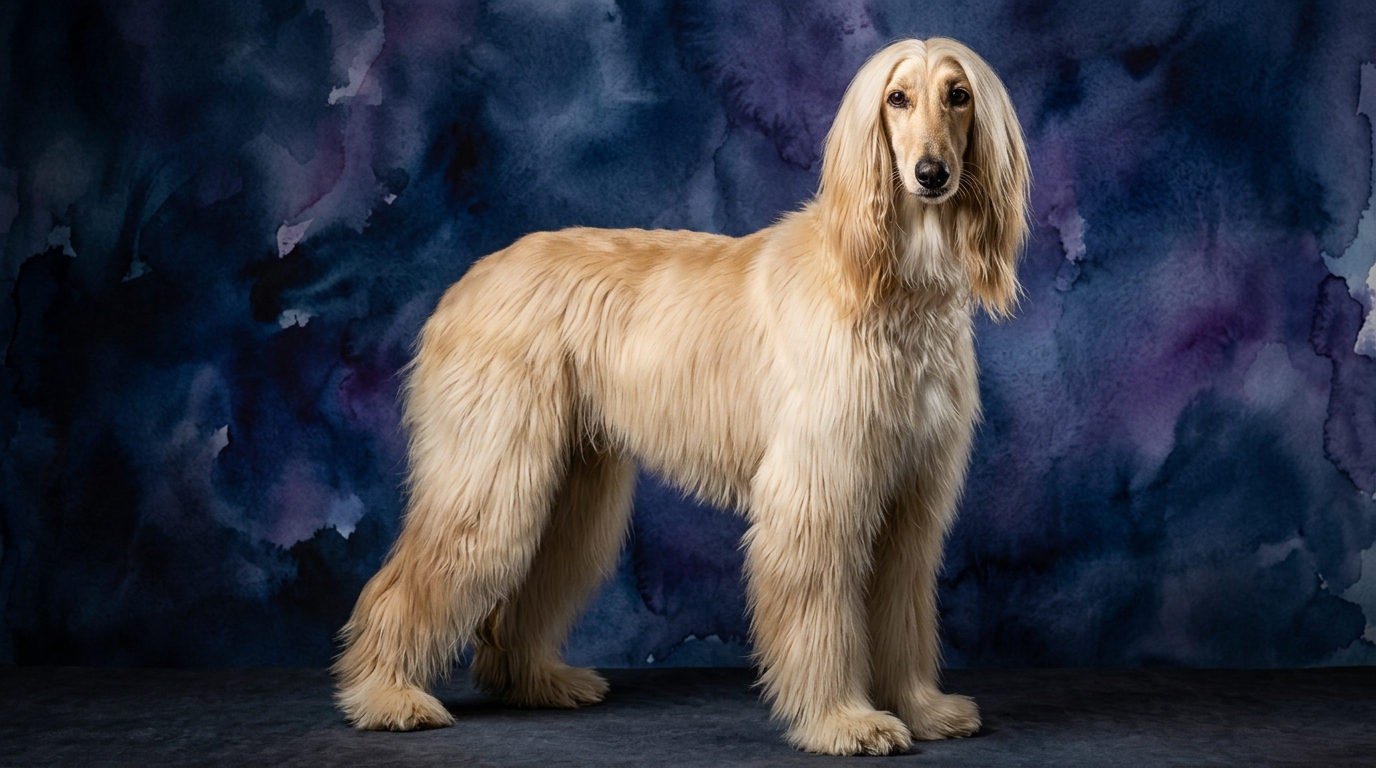
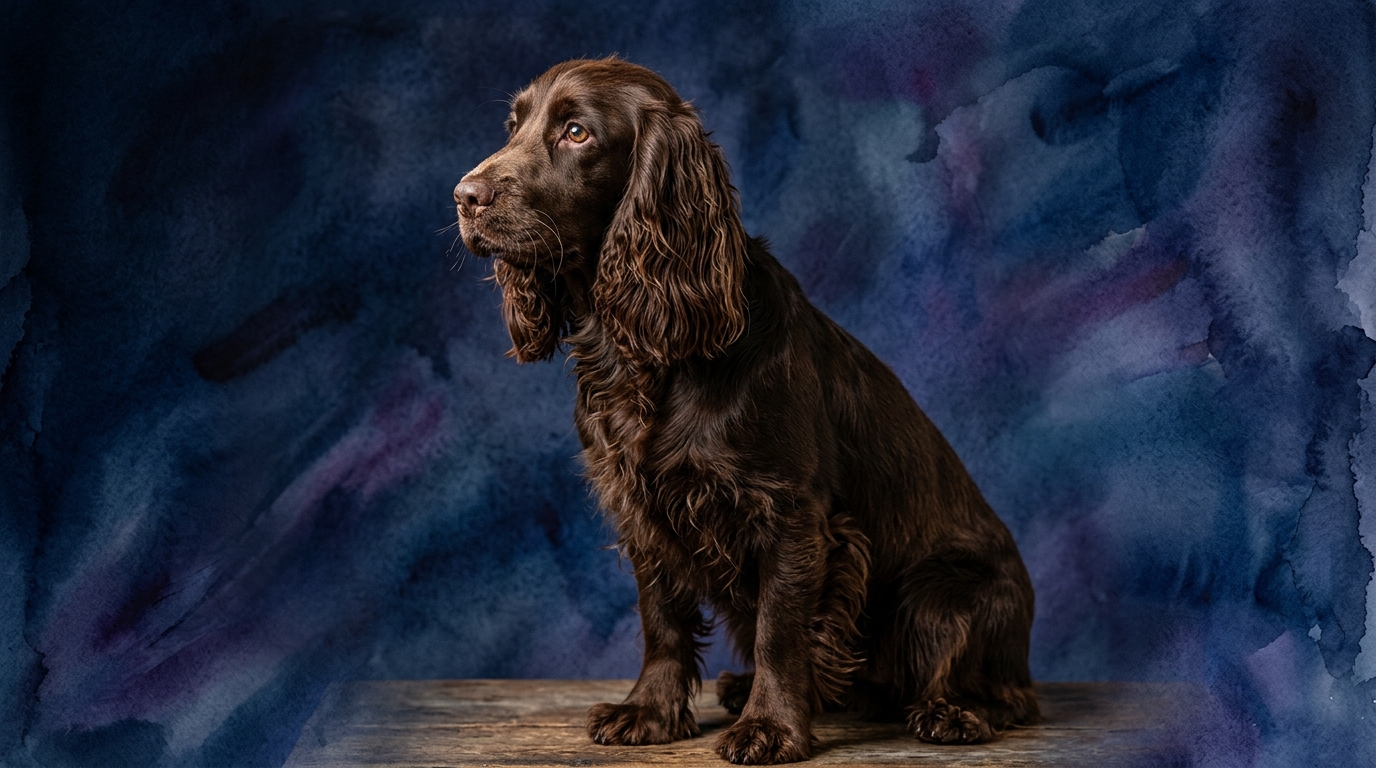
Side-by-Side Cognitive Profiles
Afghan Hound: This majestic sighthound, ranked #79 by Coren for working and obedience, exhibits a unique cognitive blend that reflects its ancient role as a hunter in challenging terrains. Its problem-solving ability scores a strong 4/5, indicating an aptitude for independent thought and figuring out novel situations, often on its own terms, without needing constant human guidance. However, its training speed is a modest 1/5, suggesting a more deliberate and often selective approach to learning human-directed commands, preferring to process information and comply only when it sees a clear benefit or motivation. Social intelligence registers at 2/5, reflecting a somewhat aloof or independent nature rather than a strong desire for constant human validation or group participation, making it a companion that values its own space. A powerful instinctive drive of 5/5 unequivocally underscores its deep-seated prey drive and genetic predisposition for chasing, constantly scanning the horizon for movement. Its memory is rated 3/5, allowing it to retain learned experiences and routes with moderate proficiency, particularly those related to its environment and hunting grounds.
Field Spaniel: While not Coren-ranked, the Field Spaniel, a gundog by heritage, presents a more balanced and cooperative cognitive blueprint, designed for working in partnership with humans. Its problem-solving skills are rated 3/5, demonstrating a competent ability to navigate everyday challenges and adapt to new situations, though perhaps with less independent flair than the Afghan, often looking to its handler for cues. Crucially, its training speed is a balanced 3/5, indicating a reasonable receptiveness to learning and retaining new commands, making it a rewarding student in various disciplines. Social intelligence also stands at 3/5, suggesting a moderate desire for interaction and an ability to read social cues, making it a more engaged and responsive companion within a family unit. An instinctive drive of 3/5 reflects a manageable level of retrieving and hunting instincts, less intense than a sighthound's prey drive, allowing it to focus on tasks. Its memory, like the Afghan, is also 3/5, supporting its capacity for consistent recall in training and daily life, remembering routines and commands effectively.
Where the Afghan Hound Excels Cognitively
The Afghan Hound truly shines in scenarios demanding independent thought and self-directed problem-solving. Its 4/5 problem-solving score means it can often devise its own solutions to obstacles, whether it's figuring out how to open a gate, navigating a complex off-leash environment, or even outsmarting a puzzle toy designed for more compliant breeds. This breed’s powerful 5/5 instinctive drive is another significant cognitive strength, making it unparalleled in activities that tap into its innate desire to chase and pursue, such as lure coursing, where its visual acuity and incredible speed combine with a primal mental focus on the "prey." This drive isn't just physical; it's a deep cognitive engagement with its environment, constantly scanning, assessing, and reacting to movement, making it an expert observer and independent decision-maker in the field.
Where the Field Spaniel Excels Cognitively
The Field Spaniel's cognitive strengths lie in its balanced adaptability and collaborative spirit, making it a highly versatile partner. Its 3/5 training speed and 3/5 social intelligence work in tandem, making it generally more receptive to human guidance and eager to participate in shared activities and learning experiences. This breed is more inclined to process and respond to commands efficiently, thriving in structured learning environments where it can work alongside its owner to achieve a common goal. Its moderate instinctive drive (3/5) means it can engage in task-oriented activities like scent work, retrieving games, or even complex agility courses without being overwhelmingly driven by a singular, intense focus, allowing for more versatile cognitive application in various dog sports or companion roles that require diverse mental engagement. The Field Spaniel's cognitive profile supports a more interactive, responsive, and cooperative partnership.
Ease of Training: Afghan Hound vs. Field Spaniel
When it comes to training, the differences between these two breeds are pronounced and stem directly from their cognitive profiles. The Afghan Hound’s training speed of 1/5 means it learns new commands at a significantly slower pace and often requires more repetition, patience, and creative motivation. This isn't due to a lack of capacity, but rather an independent cognitive style; the Afghan often weighs whether a command is "worth" its effort or if it has a more interesting self-directed pursuit in mind. Its lower social intelligence (2/5) means it's less driven by a strong desire to please its human, often prioritizing its own agenda over immediate human directives. This translates into a need for highly motivating rewards, consistent positive reinforcement, and a deep understanding that compliance with an Afghan Hound is earned through mutual respect and clear benefit, not simply given. Owners must be prepared for a journey of persuasion rather than simple instruction.
In stark contrast, the Field Spaniel, with its 3/5 training speed and 3/5 social intelligence, generally offers a more cooperative and rewarding training experience. This breed is typically more attentive to its handler, processes commands more readily, and is more inclined to engage in reciprocal learning, viewing training as a shared activity. Its moderate desire to please means it finds inherent satisfaction in working with its owner and receiving praise, making positive reinforcement highly effective and speeding up the learning process. While still requiring consistency and clear communication, the Field Spaniel is less likely to challenge commands or become easily bored with repetition, making it a more straightforward and enjoyable student for a wide variety of obedience, trick, or sport training regimens. Their cognitive makeup supports a partnership where learning is a collaborative and often joyful endeavor.
Suiting Active vs. Relaxed Owners
For owners seeking a dog for high-energy, independent pursuits that respect a breed's self-reliant nature, the Afghan Hound presents a compelling choice. Its extreme instinctive drive (5/5) means it thrives on opportunities to run freely in secure areas, engage in lure coursing, or participate in activities that satisfy its deep-seated chasing instincts and keen observational skills. This breed requires an owner who understands and can safely manage a powerful prey drive, providing outlets that align with its cognitive predisposition for independent observation and pursuit. While it enjoys a comfortable home life, its mental and physical well-being are intrinsically tied to fulfilling its independent, active nature. Relaxed owners or those new to dog ownership might find its self-directed energy and resistance to conventional training challenging, as it requires consistent, thoughtful engagement to prevent boredom and unwanted behaviors rooted in its strong instincts.
The Field Spaniel, with its balanced cognitive profile and moderate instinctive drive (3/5), is better suited for owners who enjoy a range of activities that foster partnership and engagement. This breed thrives on varied exercise, from brisk walks and hikes to interactive play, and excels in dog sports like agility, scent work, or obedience, where its cooperative nature is an asset. Its social intelligence (3/5) means it appreciates being an integral part of family activities, adapting well to both active outings and relaxed home time, enjoying the company of its people. Owners who enjoy consistent training, interactive games, and a companion eager to participate and learn will find the Field Spaniel a delightful and adaptable match. Its energy is robust but generally more manageable and less singularly focused than the Afghan Hound's, making it a versatile companion for moderately active to active households that value collaboration and a responsive partner.
The Verdict
Choose the Afghan Hound if you appreciate an independent, self-thinking companion with a powerful instinctive drive, and are prepared for a unique training journey focused on motivation and respect for its autonomy.
Opt for the Field Spaniel if you desire a cooperative, adaptable partner eager to learn and engage in shared activities, thriving on social interaction and a balanced approach to training and exercise.
🧠 Find Your Pet's IQ Score
Our Pet IQ Lab assessment covers 25+ tests across 5 cognitive dimensions — personalized to your breed.
Take the Full IQ Test →Frequently Asked Questions
Is the Afghan Hound truly untrainable?
No, the Afghan Hound is not untrainable, but its low training speed (1/5) and independent nature mean it learns at its own pace and on its own terms. Success requires immense patience, highly motivating rewards, and a deep understanding of its unique cognitive style, focusing on persuasion over strict obedience.
Are Field Spaniels good family dogs?
Yes, Field Spaniels generally make wonderful family dogs due to their balanced social intelligence (3/5) and cooperative nature. They enjoy being part of family activities and are typically adaptable and affectionate, though early socialization is always beneficial for any breed.
What are the main exercise differences between these two breeds?
The Afghan Hound requires extensive opportunities for high-speed running in secure areas to satisfy its powerful instinctive drive (5/5), often preferring independent bursts of activity. The Field Spaniel needs consistent, varied exercise like walks, hikes, and interactive play, thriving on activities that involve partnership and mental engagement, rather than just sheer speed.