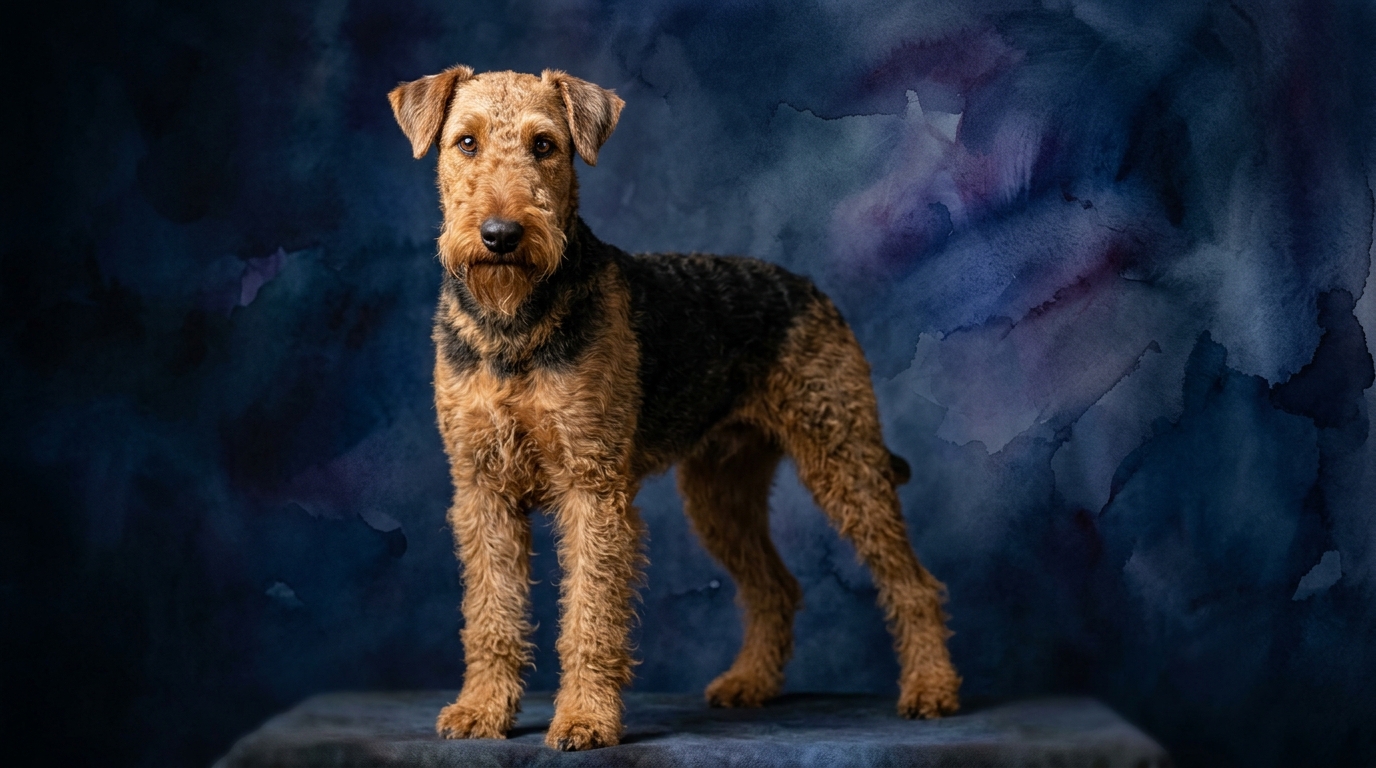

Side-by-Side Cognitive Profiles: A Deep Dive
At The Cosmic Pet Pet IQ Lab, we evaluate canine intelligence across five key dimensions. Let's break down how the Airedale Terrier and Rat Terrier measure up:
**Airedale Terrier:**
**Problem Solving (4/5):** The Airedale demonstrates a notable capacity for independent thought, often devising novel solutions to obstacles. They quickly learn to open latches or navigate intricate environments.
**Training Speed (4/5):** Their ability to grasp new commands and routines quickly makes them responsive learners. Strong associations accelerate progress in various disciplines.
**Social Intelligence (3/5):** Airedales possess a solid understanding of human social cues, interpreting body language and vocal tones effectively. They are adept at reading their family's moods.
**Instinctive Drive (3/5):** Their terrier heritage imbues them with a moderate yet persistent drive for hunting and exploring, manageable with appropriate outlets.
**Memory (4/5):** The Airedale exhibits excellent retention of learned behaviors, commands, and routines, contributing significantly to training consistency.
**Rat Terrier:**
**Problem Solving (3/5):** Rat Terriers display a practical, focused approach, employing persistence and agility to overcome challenges. They excel at finding ways to reach desired objects or navigate small spaces.
**Training Speed (3/5):** These compact terriers are capable learners, absorbing new commands at a steady pace, especially when training is engaging. They respond well to positive reinforcement.
**Social Intelligence (3/5):** Rat Terriers are attuned to their human companions, demonstrating a good grasp of social dynamics. They interpret human emotions, forming deep bonds.
**Instinctive Drive (3/5):** Their historical role means Rat Terriers possess a pronounced, focused prey drive, expressed through keen observation and quick pursuit. This drive is core to their identity.
**Memory (3/5):** Rat Terriers have a reliable memory for routines, learned commands, and significant experiences, contributing to their overall trainability.
Where the Airedale Terrier Excels Cognitively
The Airedale Terrier clearly takes the lead in several cognitive dimensions, most notably their capacity for intricate problem-solving and rapid training acquisition. Their 4/5 score in problem-solving indicates a dog that actively strategizes; they are more likely to independently figure out how to open a childproof gate or manipulate objects to achieve a goal. This cognitive flexibility allows them to adapt with greater ingenuity, making them excellent candidates for complex tasks or dog sports requiring sequential thinking. Furthermore, their 4/5 training speed means they absorb and retain complex command sequences and behavioral modifications with remarkable efficiency. An Airedale can master advanced obedience or intricate agility courses in fewer repetitions, demonstrating quicker cognitive processing and stronger generalization of learned behaviors. Their superior memory (4/5) reinforces this, ensuring lessons stick, enabling them to build a vast repertoire of skills.
Where the Rat Terrier's Cognitive Strengths Shine
While the Rat Terrier might not achieve the same high scores in abstract problem-solving or training speed, their cognitive profile presents distinct advantages, particularly related to their historical purpose and focused temperament. Their 3/5 instinctive drive, combined with smaller stature and agility, means their cognitive focus is often acutely directed towards specific tasks like scent detection and pursuit. This isn't just a physical trait; their minds are wired for intense, concentrated attention on small, fast-moving stimuli, making them incredibly efficient and relentless. Their practical problem-solving (3/5) is less about complex reasoning and more about efficient, persistent action; they excel at finding the most direct, often physical, solution to a perceived challenge, like squeezing through a tight space. This specific cognitive focus, while perhaps not as broadly applicable, makes them exceptionally effective in roles requiring single-minded determination and quick, decisive action.
Trainability: A Tale of Two Terriers
Based on their cognitive profiles, the Airedale Terrier generally presents as the easier breed to train for a wide range of tasks and obedience. Their 4/5 scores in both Problem Solving and Training Speed mean they not only grasp new concepts quickly but also possess the mental capacity to understand *why* certain behaviors are desired. An Airedale is more likely to generalize a command learned in one environment to another, or to understand a multi-step request after fewer repetitions. Their strong memory (4/5) ensures these lessons are deeply ingrained. In contrast, the Rat Terrier, with 3/5 in both Problem Solving and Training Speed, requires a more consistent and perhaps more repetitive approach. They learn effectively but might need more structured reinforcement to solidify new behaviors and may not generalize as readily. Their training often benefits from making the learning process feel like a game, appealing to their instinctive drive and focus. While both are capable, the Airedale's cognitive agility often translates to a faster, less labor-intensive training journey for complex tasks.
Matching Canine Cognition to Owner Lifestyles
When considering owner lifestyles, both breeds require engagement, but their cognitive and physical demands diverge. The Airedale Terrier, with its higher problem-solving and training speed scores, thrives with active owners who enjoy mental stimulation as much as physical exertion. An Airedale needs owners who can provide consistent, varied training, engage in dog sports, and offer intellectual puzzles to prevent boredom. A physically active owner who also enjoys teaching complex tricks or participating in scent work would find the Airedale a highly rewarding companion. Their social intelligence (3/5) means they appreciate interaction, but their independence requires an owner who respects their occasional desire for self-directed activity. Conversely, the Rat Terrier, while possessing an equal instinctive drive (3/5), often channels this energy into more focused bursts of activity. They are an excellent fit for active owners who appreciate a compact, agile companion for walks, hikes, or urban exploration, and who are prepared to manage their pronounced prey drive. For owners who are 'relaxed' in the sense of not wanting to constantly devise complex mental challenges, but are still physically active and appreciate a dog with a clear, focused purpose, the Rat Terrier can be an ideal match. A Rat Terrier might be less demanding in terms of *varied* mental stimulation compared to the Airedale, but still requires regular physical outlets.
The Verdict
Choose an Airedale Terrier if you are an owner who thrives on complex training, enjoys engaging in advanced dog sports, and seeks a highly adaptable companion capable of independent problem-solving.
Opt for a Rat Terrier if you are an active owner who appreciates a compact, agile companion with a focused drive, valuing practicality and persistence in a dog that excels in specific, instinct-driven activities.
🧠 Find Your Pet's IQ Score
Our Pet IQ Lab assessment covers 25+ tests across 5 cognitive dimensions — personalized to your breed.
Take the Full IQ Test →Frequently Asked Questions
Is the Airedale Terrier truly smarter than the Rat Terrier?
Based on our cognitive dimensions, the Airedale Terrier scores higher in problem-solving, training speed, and memory, suggesting a broader and more adaptable cognitive capacity for varied tasks. The Rat Terrier, while intelligent, exhibits a more focused and practical type of intelligence.
Which breed is better for a first-time dog owner?
Neither breed is typically recommended as an 'easy' first-time dog due to their strong terrier traits. However, the Airedale's quicker training speed might make initial obedience slightly less frustrating, provided the owner is committed to consistent mental and physical engagement.
Do both breeds have a strong prey drive?
Yes, both breeds have a pronounced instinctive drive (3/5), a hallmark of their terrier heritage. The Rat Terrier's drive is often more acutely focused on small prey, while the Airedale's drive is still strong but might manifest in broader exploratory behaviors.