
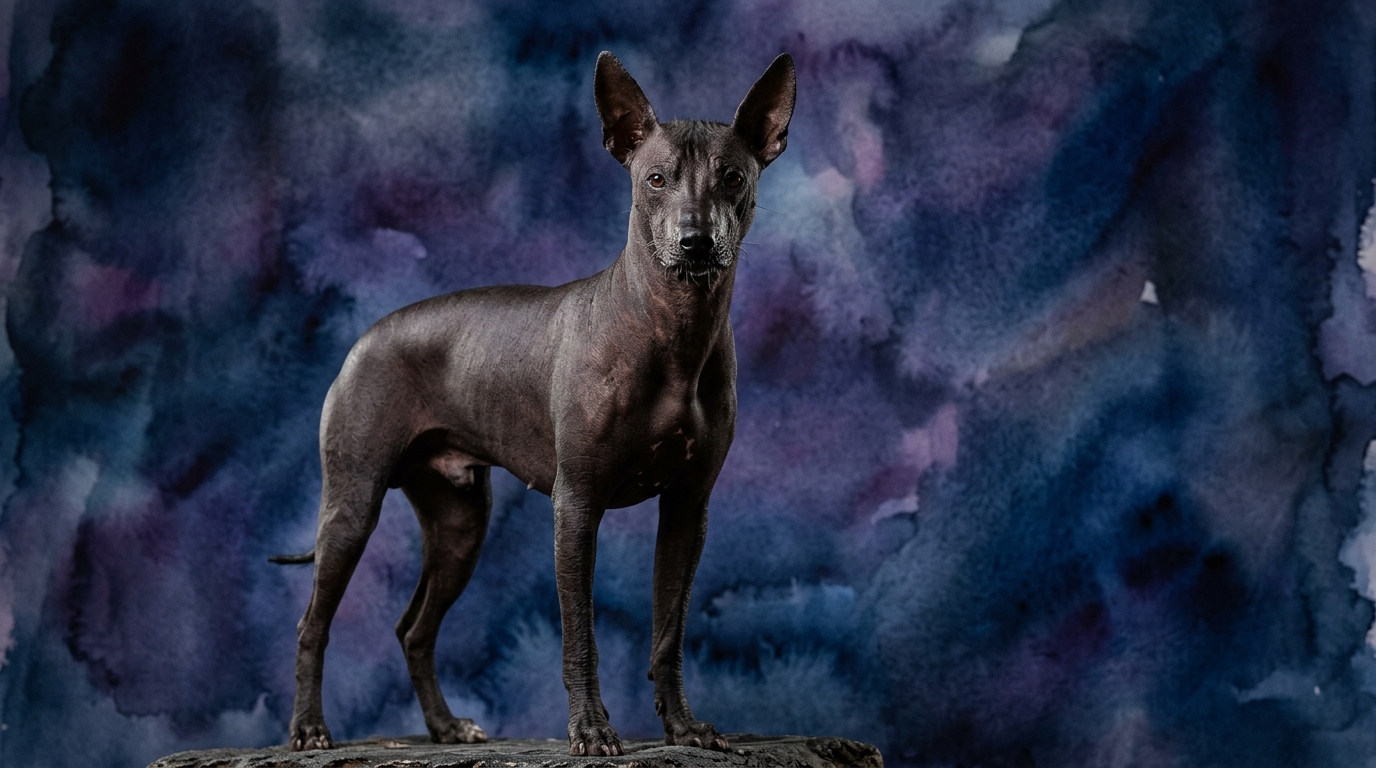
Side-by-Side IQ Profile: AmStaff vs. Xoloitzcuintli
At The Cosmic Pet Pet IQ Lab, we evaluate canine intelligence across five critical dimensions. The American Staffordshire Terrier, a resilient Terrier breed, holds a Coren rank of #48, reflecting its capabilities in working and obedience tasks. Its cognitive profile shows Problem Solving at 3/5, Training Speed at 3/5, Social Intelligence at 3/5, Instinctive Drive at 3/5, and a notable Memory score of 4/5.
In contrast, the Xoloitzcuintli, a distinctive Non-Sporting breed with an ancient lineage, is not Coren-ranked, suggesting a different historical role or a less conventional approach to obedience tasks. Its IQ scores present a remarkably balanced profile: Problem Solving 3/5, Training Speed 3/5, Social Intelligence 3/5, Instinctive Drive 3/5, and Memory at 3/5. This initial glance reveals a nuanced landscape where subtle differences can have significant real-world implications for owners and their companions.
Where the American Staffordshire Terrier Wins Cognitively
The American Staffordshire Terrier’s cognitive advantage becomes apparent in its superior Memory score of 4/5, compared to the Xoloitzcuintli’s 3/5. This higher capacity for recall means an AmStaff is generally more adept at retaining learned behaviors, commands, and routines over extended periods. For an owner, this translates into lessons that stick more firmly, requiring less frequent review once thoroughly established. For instance, an AmStaff is likely to remember complex sequences of commands or intricate house rules with greater consistency, making daily life and advanced training more streamlined.
This enhanced memory also extends to social learning and environmental understanding. An AmStaff with a 4/5 memory can more effectively recall past interactions, both positive and negative, shaping its future responses to people, other animals, and specific situations. This cognitive strength contributes to a more predictable and reliable companion once proper training and socialization are in place, as the dog remembers what is expected and how to navigate its world based on prior experiences.
Where the Xoloitzcuintli Wins Cognitively
While the Xoloitzcuintli’s individual scores match or are slightly lower than the AmStaff’s, its cognitive 'win' lies in the unique application and balance of its moderate intelligence, deeply rooted in its ancient heritage. With consistent 3/5 scores across Problem Solving, Training Speed, Social Intelligence, and Instinctive Drive, the Xolo embodies a self-sufficient and observant intelligence rather than one geared towards human-directed performance. This balance suggests an innate capability to assess situations and adapt independently.
The Xolo’s primitive nature means its problem-solving might manifest as a keen ability to navigate its environment with quiet efficiency or to protect its family through watchful awareness, relying on subtle cues rather than overt action. Its moderate instinctive drive, combined with its ancient role as a companion and guardian, points to a cognitive style that prioritizes loyalty and vigilance over high-energy tasks. This independent streak, a hallmark of many ancient breeds, can be seen as a cognitive advantage for owners who appreciate a dog capable of making its own assessments and acting with a reserved wisdom, fostering a deep, nuanced bond that doesn't rely on constant direction.
Training Dynamics: Which is Easier to Train and Why?
When considering ease of training, the American Staffordshire Terrier holds a slight edge, primarily due to its 4/5 Memory score. Although both breeds share an identical 3/5 Training Speed, meaning they grasp new concepts at a moderate pace, the AmStaff’s superior retention ensures that once a lesson is learned, it is remembered more consistently. This cognitive advantage reduces the need for constant repetition and reinforcement, allowing for quicker progression through training stages and a more reliable adherence to commands over time. Their tenacity, characteristic of the Terrier group, also contributes to their focus during training sessions.
The Xoloitzcuintli, with its 3/5 Memory, requires a more consistent and patient approach to training. While capable of learning at a moderate pace, the lessons may need more frequent revisiting to ensure long-term retention. Their independent nature, stemming from their ancient lineage, means they may not always be as eager to please or as handler-focused as some other breeds. Owners training a Xolo will benefit from engaging, positive reinforcement methods that appeal to the breed's intelligence and foster a strong bond, rather than relying on rote memorization. Understanding their unique motivations is key to successful and lasting training.
Matching Owners: Active vs. Relaxed Lifestyles
For active owners seeking a canine companion, the American Staffordshire Terrier often proves to be an excellent match. While their Instinctive Drive is rated 3/5, their terrier heritage imbues them with a robust energy level and a need for consistent mental and physical engagement. They thrive on structured activities, whether it's obedience training, agility, or long, stimulating walks. Their 3/5 Social Intelligence means they generally enjoy interacting and participating in family activities, making them eager partners for adventures. Owners who can provide regular exercise, consistent training, and ample opportunities for problem-solving will find the AmStaff to be a responsive and fulfilling companion.
The Xoloitzcuintli, with its balanced 3/5 scores across the board, including Instinctive Drive, can adapt to both active and more relaxed households, though they often lean towards owners who appreciate a dog with a calm, watchful presence. While they enjoy regular walks and play, their energy tends to be more conserved, making them less demanding of constant strenuous activity than some breeds. Their 3/5 Social Intelligence means they form deep bonds with their family but can be reserved with strangers, preferring quiet companionship. They are well-suited for owners who appreciate a dog that is alert and protective but also content to relax at home, offering a unique blend of vigilance and tranquility.
The Verdict: When to Choose Each Breed
The Verdict
Choose the American Staffordshire Terrier if you value a companion with superior memory, consistent retention of training, and a spirited engagement in structured activities, thriving on a clear routine and active participation.
Opt for the Xoloitzcuintli if you seek an independent, observant companion with a balanced, self-sufficient intelligence, valuing a deep, often reserved bond and a dog that excels in quiet vigilance and unique adaptability.
🧠 Find Your Pet's IQ Score
Our Pet IQ Lab assessment covers 25+ tests across 5 cognitive dimensions — personalized to your breed.
Take the Full IQ Test →Frequently Asked Questions
Does the Xoloitzcuintli's lack of Coren ranking mean it's less capable?
No, the Coren ranking primarily measures obedience and working intelligence in traditional trials, not overall cognitive ability. The Xolo's ancient lineage suggests a different, more independent application of its intelligence, often excelling in self-sufficiency and keen observation rather than formal obedience competitions.
How does the American Staffordshire Terrier's memory advantage affect daily life?
An AmStaff with a 4/5 memory will generally recall commands, house rules, and social interactions more consistently over time, making routines easier to establish and maintain. This means less reteaching and a more reliable response to learned behaviors in various situations.
Are both breeds suitable for first-time dog owners?
Both breeds possess moderate training speeds and social intelligence, benefiting from consistent, positive reinforcement. However, the AmStaff's better memory might make the learning curve slightly smoother for a novice, while the Xolo's independence requires a patient, understanding approach from an owner willing to embrace its unique cognitive style.