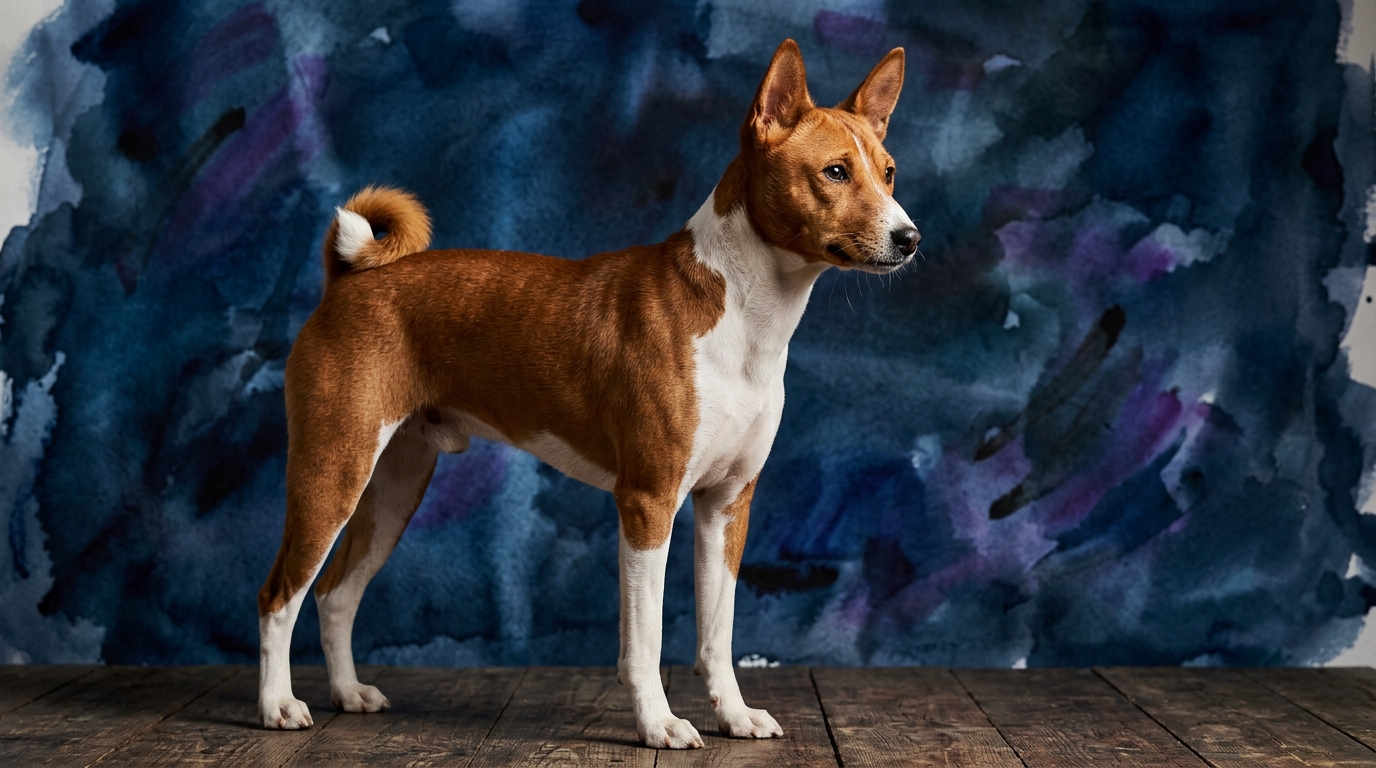

Side-by-Side IQ Profile: Basenji vs. Bull Terrier
The Basenji, a unique hound from Central Africa, carries a Coren rank of #78, indicating a distinct cognitive profile that often perplexes and fascinates owners. Their Problem Solving is rated an exceptional 5/5, showcasing a mind capable of intricate, self-motivated solutions to environmental challenges, often driven by curiosity or a desire for comfort. Training Speed, however, stands at a challenging 1/5, reflecting a breed that processes commands with strong independence and requires immense patience and creativity to engage. Social Intelligence is a moderate 3/5; while they form deep bonds with their chosen family, they can be reserved or even aloof with strangers, observing rather than overtly participating. An Instinctive Drive of 5/5 means their ancient hunting heritage is profoundly active, manifesting as intense prey drive and an unwavering focus on scents. Finally, their Memory is a strong 4/5, allowing them to recall complex sequences of events and past successes or failures with remarkable clarity, influencing future choices.
In contrast, the Bull Terrier, a robust terrier breed with a Coren rank of #66, presents a more balanced, yet equally distinctive, cognitive makeup. Their Problem Solving ability registers at 3/5, suggesting they can navigate moderate puzzles and learn through trial and error, though they might not always seek the most elegant solution. Training Speed is also a 3/5, indicating a dog that learns at a steady pace, responds well to consistent positive reinforcement, and generally enjoys the engagement of structured lessons. Social Intelligence matches the Basenji at 3/5, but often expresses itself as an outgoing, sometimes clownish friendliness, though they might miss subtle social cues in complex interactions. Their Instinctive Drive is a moderate 3/5, manifesting as a playful chase instinct and a love for vigorous activity, rather than the relentless pursuit seen in hounds. A Memory score of 3/5 means they retain basic commands and routines effectively, recognizing people and places, but may not recall the intricate details of past events with the same precision as the Basenji.
Where the Basenji Wins Cognitively
When we delve into specific cognitive strengths, the Basenji truly shines in areas demanding independent thought and resourcefulness. Their 5/5 Problem Solving score is not merely theoretical; it means a Basenji can analyze a situation and devise sophisticated, often unexpected, solutions to achieve their objectives. This might involve strategically opening a seemingly secure latch, meticulously planning an escape route from a yard, or cleverly manipulating objects to reach a desired treat. Their cognitive process in these scenarios is characterized by observation, hypothesis, and persistent experimentation, driven by an innate curiosity and self-interest rather than a desire for human approval. This makes them extraordinarily adept at navigating complex environments independently. Furthermore, their Instinctive Drive, also rated 5/5, signifies a profound connection to their ancestral hunting behaviors. This isn't just about chasing a squirrel; it involves a highly developed cognitive system for scent discrimination, tracking, and persistent pursuit. Their minds are wired for focused, almost obsessive, engagement with environmental cues related to prey or investigation, making them exceptional natural detectives. This deep-seated drive shapes their perception of the world, often overriding other stimuli and demanding specific outlets. Finally, their 4/5 Memory supports these capabilities, allowing them to recall intricate details of past successful (or unsuccessful) attempts at problem-solving or hunting. They learn from experience, remembering which actions yielded results, which contributes to their reputation for being both clever and, at times, stubbornly persistent in their self-directed endeavors.
Where the Bull Terrier Wins Cognitively
The Bull Terrier, while possessing a different set of cognitive priorities, demonstrates clear advantages in areas that foster harmonious human-canine partnership. Their Training Speed, rated 3/5, is a significant win when compared to the Basenji's 1/5. This moderate pace means Bull Terriers are generally more receptive to learning new commands and behaviors with consistent positive reinforcement. Their cognitive processing allows for a more straightforward connection between action and reward, leading to quicker acquisition of skills and a greater willingness to engage in structured training sessions. This trait makes them a more approachable canvas for owners looking to teach a wide array of commands and tricks without facing constant cognitive resistance. While both breeds score 3/5 in Social Intelligence, the Bull Terrier's expression of this often translates into a more openly affectionate and less reserved social demeanor. Their cognitive framework leans towards direct, often boisterous, interaction and a genuine desire to be part of family activities. They tend to be less suspicious of strangers and more readily integrate into varied social environments, making their social interactions more predictable and generally easier for owners to manage. This isn't about superior understanding of subtle cues, but rather a more direct and often joyous approach to social engagement. Additionally, the Bull Terrier's more balanced Instinctive Drive (3/5) allows for greater flexibility in their cognitive focus. Unlike the Basenji’s intense, singular drive, a Bull Terrier can more easily shift attention from an environmental distraction back to a human command, making them less prone to becoming entirely consumed by their instincts. This cognitive adaptability contributes to their easier trainability and general manageability in diverse situations.
Which is Easier to Train and Why?
When it comes to ease of training, the Bull Terrier distinctly holds the advantage. Their moderate Training Speed of 3/5, coupled with a generally amiable and people-oriented disposition, means they are more inclined to participate in training and respond positively to instruction. Bull Terriers typically enjoy the interaction involved in learning and are motivated by praise, treats, and play, making the training process a rewarding experience for both dog and owner. While they can exhibit a stubborn streak, it's usually manageable within a consistent, reward-based framework. Their cognitive architecture allows them to form associations between cues and desired behaviors relatively quickly, making foundational obedience and even more complex tasks achievable with patience. In stark contrast, the Basenji's training speed of 1/5 highlights a profound cognitive independence. This breed’s mind is often occupied with its own agenda, prioritizing self-directed exploration and problem-solving over human directives. They learn rapidly what benefits them personally, but they lack the inherent 'eagerness to please' often found in other breeds. Training a Basenji requires an owner to be exceptionally creative, patient, and consistent, often needing to 'trick' the dog into thinking the desired behavior was its own idea. Their strong instinctive drives (5/5) mean they are easily distracted by scents or movement, making focus challenging. Essentially, the Basenji processes commands through a lens of 'what's in it for me?', whereas the Bull Terrier is generally more open to collaborative learning.
Suited for Active vs. Relaxed Owners
For owners seeking a highly engaged and mentally stimulating companion, the Basenji, with its exceptional problem-solving (5/5) and intense instinctive drive (5/5), demands an active lifestyle that caters to its cognitive needs. These dogs thrive with owners who are committed to providing consistent, varied physical exercise and mental challenges, such as advanced obedience, scent work, or agility. Their independent nature and propensity for creative mischief necessitate an owner who is patient, consistent, and enjoys outsmarting a clever dog. A Basenji needs an owner who understands that 'relaxed' often translates into 'bored,' which can quickly lead to destructive behaviors or escape attempts driven by their active minds. Conversely, the Bull Terrier, while certainly energetic and playful, offers a more adaptable fit for a broader range of owners. With a moderate instinctive drive (3/5) and a more straightforward approach to social interaction, they suit owners who enjoy regular walks, interactive play, and a robust companion but aren't necessarily seeking a dog that constantly tests intellectual boundaries. They can integrate well into active family life but are also content with periods of relaxation, often enjoying a good snuggle on the couch after their exercise needs are met. This makes them a suitable choice for owners who are active but also appreciate downtime, seeking a dog that is affectionate and engaging without demanding constant, intricate mental gymnastics.
The Verdict
Choose a Basenji if you are an experienced, patient owner who thrives on intellectual challenges, appreciates an independent thinker, and can consistently provide varied mental and physical stimulation for a dog with powerful instincts.
Opt for a Bull Terrier if you seek a playful, affectionate companion with a moderate activity level, a more straightforward training approach, and a desire for direct social interaction, without the intense cognitive demands of a Basenji.
🧠 Find Your Pet's IQ Score
Our Pet IQ Lab assessment covers 25+ tests across 5 cognitive dimensions — personalized to your breed.
Take the Full IQ Test →Frequently Asked Questions
Are Basenjis difficult to live with due to their independence?
Basenjis can be challenging due to their extreme independence and high problem-solving skills, often leading them to find creative ways to explore or get into mischief. Their low training speed means they require consistent, engaging, and patient training from an owner who understands their unique cognitive makeup.
Do Bull Terriers need a lot of mental stimulation?
Bull Terriers benefit from regular mental stimulation through training, puzzle toys, and interactive play, but their needs are generally moderate compared to breeds with higher problem-solving or instinctive drives. They appreciate engagement but are less likely to devise complex schemes if bored.
How do their social intelligence scores of 3/5 differ in practice?
While both score 3/5, a Basenji's social intelligence often manifests as reserved observation, forming deep family bonds but being aloof with strangers, acting on their own social interpretations. A Bull Terrier's 3/5 often means they are friendly and clownish, eager for interaction but sometimes less attuned to subtle social cues, making them more outwardly approachable.