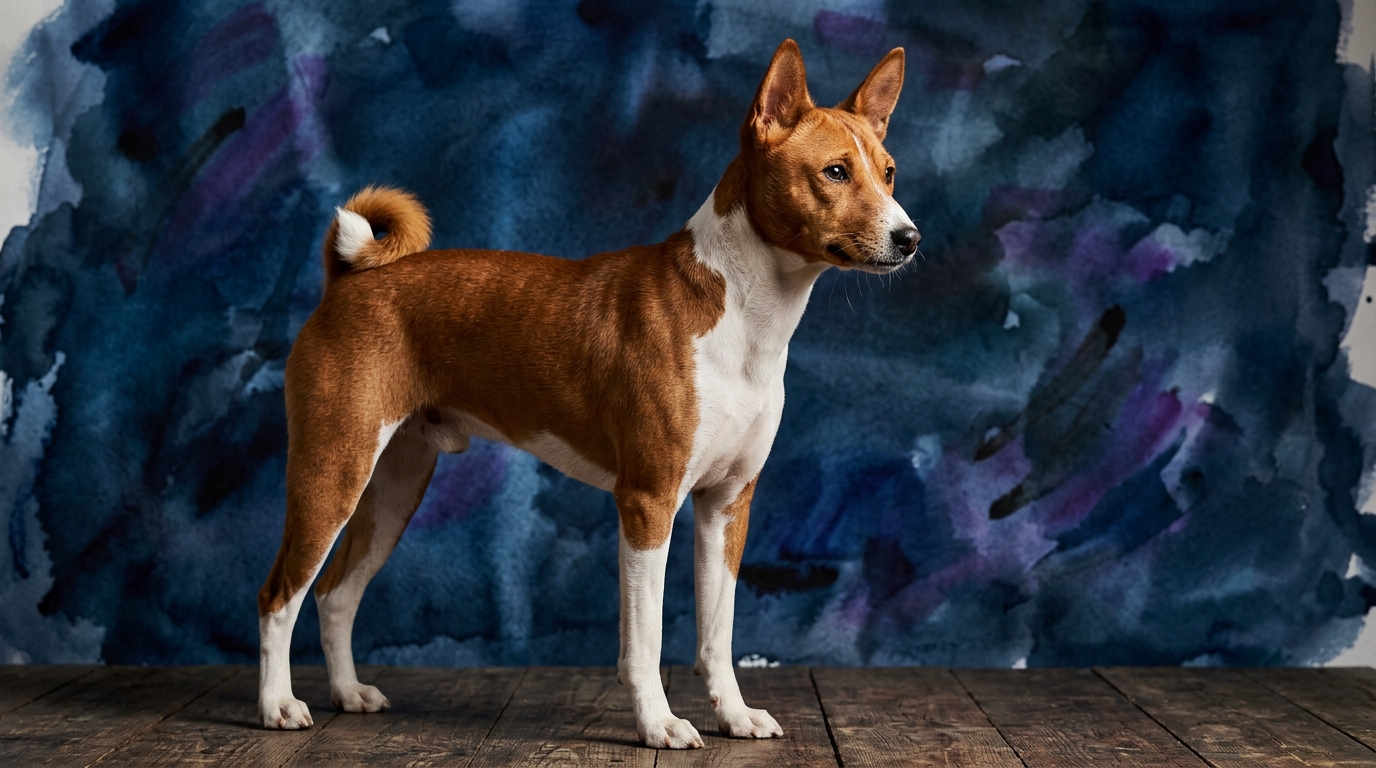

Side-by-Side IQ Profile: Basenji vs. Chinook
The Cosmic Pet Pet IQ Lab employs a five-dimensional framework to assess canine intelligence, offering a nuanced view beyond simplistic rankings. For the Basenji, a Hound breed, their profile is marked by extremes: an exceptional 5/5 in Problem Solving, a challenging 1/5 in Training Speed, a balanced 3/5 in Social Intelligence, a powerful 5/5 in Instinctive Drive, and a strong 4/5 in Memory. This combination paints a picture of a highly independent and resourceful thinker.
In contrast, the Chinook, a Working breed, presents a more uniformly balanced cognitive landscape. Their scores are consistently moderate: 3/5 in Problem Solving, 3/5 in Training Speed, 3/5 in Social Intelligence, 3/5 in Instinctive Drive, and 3/5 in Memory. This consistent performance across all dimensions suggests a dog that is adaptable, cooperative, and generally predictable in its cognitive responses, without the pronounced peaks and valleys observed in the Basenji's profile.
Where the Basenji's Cognition Excels
Basenjis stand out with a remarkable 5/5 in Problem Solving, indicating an exceptional capacity for independent thought and strategic action. This isn't just about figuring out simple puzzles; it translates into a dog that can cleverly navigate complex environments, outsmart barriers, or devise ingenious ways to access desired objects without direct human instruction. Their mental agility means they are constantly assessing their surroundings for opportunities and challenges, making them adept at self-directed tasks and often leading to resourceful, if sometimes mischievous, behaviors.
Coupled with their top-tier 5/5 Instinctive Drive, Basenjis are deeply in tune with their primal senses, excelling in activities that tap into scenting, tracking, or independent exploration. This drive fuels their curiosity and resilience, allowing them to pursue goals with intense focus, whether it's following a fascinating trail or meticulously planning an escape from an enclosure. This inherent motivation means they are often self-starters when it comes to engaging with their world, requiring outlets that respect their ancient instincts and provide appropriate mental stimulation.
Furthermore, their 4/5 Memory score means these experiences and learned strategies are retained effectively. A Basenji remembers which cabinet holds the treats, how to manipulate a gate latch, or the optimal route through a familiar park, leveraging past successes to inform future actions. This cognitive strength, combined with their problem-solving prowess, paints a picture of a dog that learns from its environment and adapts its behavior based on a strong recall of outcomes, often without needing external reinforcement.
Where the Chinook's Cognition Shines
While the Basenji's intelligence profile is defined by its extremes, the Chinook's strength lies in its balanced and cooperative cognitive approach. Their consistent 3/5 across Problem Solving, Training Speed, Social Intelligence, Instinctive Drive, and Memory signifies a well-rounded and adaptable mind. This moderation means they are less likely to exhibit the independent, sometimes challenging, behaviors associated with higher problem-solving scores when coupled with low training desire, instead offering a more predictable and collaborative presence.
The Chinook's 3/5 in Training Speed is a significant advantage over the Basenji's 1/5, indicating a dog that is receptive to instruction and willing to engage in learning. This moderate speed means they can grasp new commands and routines with reasonable effort, forming a more straightforward partnership in training endeavors. Their balanced Social Intelligence also contributes to their amiability, making them generally more attuned to human cues and eager to participate in shared activities, fostering a strong bond with their family.
Their 3/5 Instinctive Drive is present but manageable, channeled more towards purposeful work and companionship rather than intense, self-directed exploration. This allows the Chinook to focus on tasks given by their handler, making them excellent partners for activities like hiking, carting, or sledding, where cooperation is key. Their reliable 3/5 Memory ensures they retain these learned skills and routines consistently, contributing to their reputation as dependable working and family companions.
Training Dynamics: A Clear Distinction
When it comes to ease of training, the distinction between these two breeds is profound, largely due to their disparate Training Speed scores. The Chinook, with its 3/5 Training Speed, is a considerably more amenable and responsive learner. They possess a natural inclination to cooperate and form a working partnership, making them receptive to traditional training methods. Chinooks generally exhibit a desire to please their handler, which translates into a more straightforward and rewarding training experience, as they are motivated by praise and positive reinforcement to perform tasks and learn commands.
The Basenji, on the other hand, presents a significant challenge with its 1/5 Training Speed. This isn't a reflection of their capacity to understand, given their high problem-solving abilities, but rather their independent will and often low intrinsic motivation to perform on command. A Basenji understands what you want, but often decides if they *want* to do it, viewing commands as suggestions rather than directives. Their strong instinctive drive and problem-solving prowess mean they are more inclined to follow their own agenda, making consistent obedience training a test of patience, creativity, and a deep understanding of canine psychology, demanding owners who can make training feel like an engaging game rather than rote instruction.
Matching Owners: Active Lifestyle vs. Independent Spirit
Neither the Basenji nor the Chinook are suited for truly sedentary lifestyles, but they cater to very different types of active owners. The Chinook is an ideal companion for owners seeking a devoted, purpose-driven partner for outdoor adventures. Their balanced scores across all IQ dimensions, particularly their moderate instinctive drive and cooperative training speed, mean they thrive on structured activity like hiking, canicross, sledding, or agility, often eager to participate alongside their human. Owners who enjoy shared experiences and desire a dog that is consistently engaged and responsive to their guidance will find a fulfilling partnership with a Chinook.
The Basenji, with its intense problem-solving and instinctive drive, appeals to owners who appreciate and can manage an independent, clever companion. These dogs require consistent, creative mental stimulation to prevent boredom-induced behaviors, thriving on puzzle toys, scent games, and secure environments that allow for supervised exploration. Owners must be prepared for a dog that might 'outwit' them, requiring a firm but fair approach, and a sense of humor. They are best suited for experienced individuals who value a dog's self-reliance and unique personality over immediate obedience, and can provide outlets for their ancient hunting and exploring instincts in a safe, engaging manner.
The Verdict: Choosing Your Canine Companion
The choice between a Basenji and a Chinook ultimately depends on an owner's lifestyle, experience, and expectations regarding canine partnership. Both breeds offer unique joys and challenges stemming directly from their distinct cognitive profiles.
For those who value a cooperative, devoted, and active partner, the Chinook stands out. Their balanced intelligence and willingness to engage in shared activities and training make them an excellent choice for families or individuals seeking a consistent and amiable companion for outdoor adventures and family life. They are a predictable and rewarding partner for those who appreciate a dog eager to work alongside them.
Conversely, the Basenji is ideal for experienced owners who appreciate an independent, clever companion. If you are prepared for a dog with a strong will, exceptional problem-solving abilities, and a unique approach to obedience, valuing their self-reliance and ancient instincts, the Basenji offers a fascinating and deeply engaging relationship that constantly challenges and rewards.
The Verdict
Choose a Basenji if you are an experienced owner who appreciates an independent, clever companion, valuing their unique problem-solving abilities and strong self-reliance over immediate obedience.
Opt for a Chinook if you seek a cooperative, devoted, and active partner, valuing their balanced intelligence and willingness to engage in shared activities and training.
🧠 Find Your Pet's IQ Score
Our Pet IQ Lab assessment covers 25+ tests across 5 cognitive dimensions — personalized to your breed.
Take the Full IQ Test →Frequently Asked Questions
Do Basenjis bark?
Basenjis are often called 'barkless dogs' because they typically don't bark like other breeds. Instead, they produce a unique yodel-like sound, often referred to as a 'baroo,' especially when excited or expressing themselves, which is quite distinct from a traditional bark.
Are Chinooks good family dogs?
Chinooks are generally considered excellent family dogs, known for their patient and gentle nature with children, supported by their balanced social intelligence. Their desire to be part of the family pack makes them devoted and protective companions, thriving on close family interaction.
What kind of mental stimulation do Basenjis need?
Basenjis thrive on mental challenges that engage their high problem-solving and instinctive drives, such as complex puzzle toys, scent work, secure agility courses, and opportunities for supervised exploration. These activities satisfy their curiosity and independent thinking, preventing boredom and channeling their energy constructively.