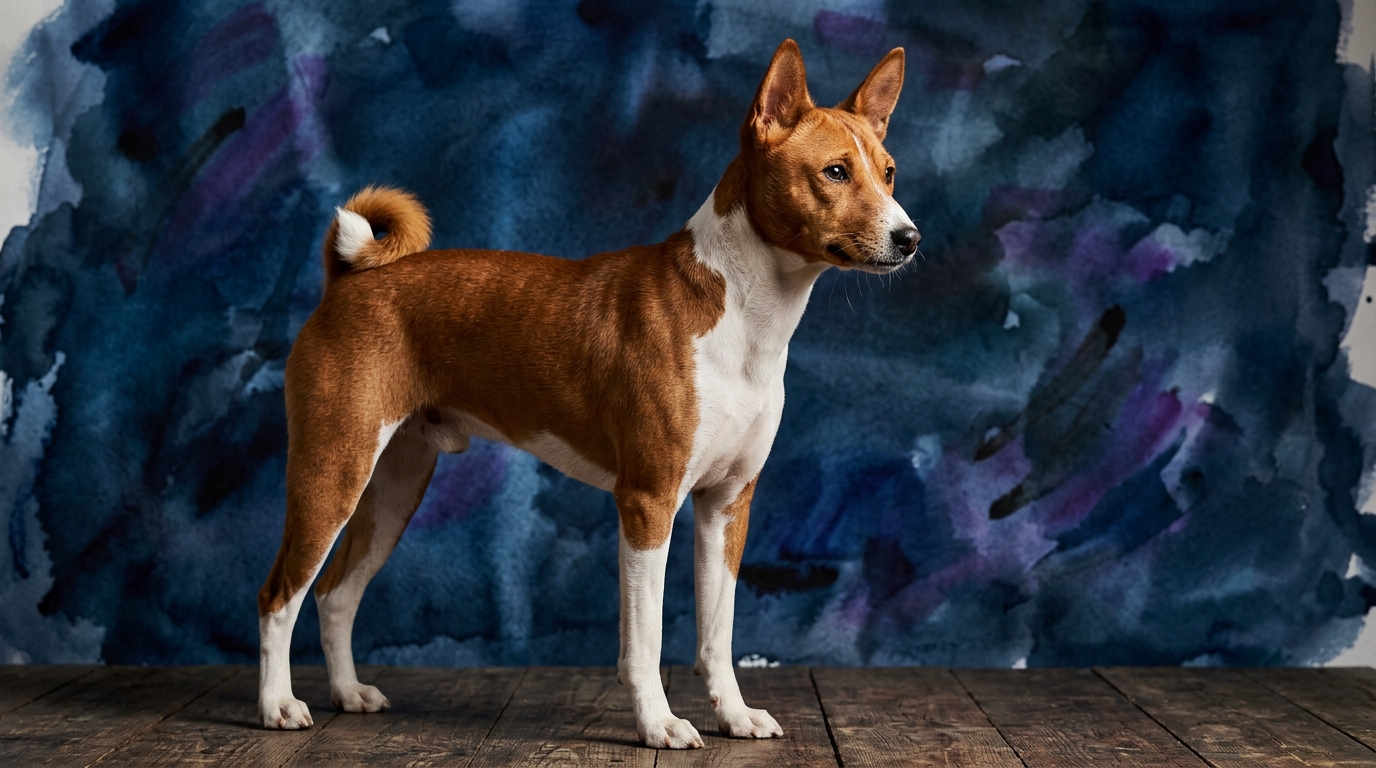

Side-by-Side IQ Profile: Basenji vs. Old English Sheepdog
At The Cosmic Pet Pet IQ Lab, we assess canine intelligence across five key dimensions, and for the Basenji and Old English Sheepdog, these scores illuminate their fundamental differences. For the Basenji (Coren rank #78), its Problem Solving is 5/5, Training Speed 1/5, Social Intelligence 3/5, Instinctive Drive 5/5, and Memory 4/5. The Old English Sheepdog (Coren rank #44) presents a profile of Problem Solving 3/5, Training Speed 3/5, Social Intelligence 3/5, Instinctive Drive 3/5, and Memory 4/5.
The Basenji’s Problem Solving at 5/5 signifies a profound ability to independently analyze situations and devise novel solutions, often to its own benefit. They are master escape artists, adept at figuring out latches, opening containers, or navigating complex environments to reach a desired object or location, demonstrating intrinsic ingenuity rather than instruction-following. The Old English Sheepdog (3/5) displays capable problem-solving, but often prefers established methods or seeks human guidance when faced with a challenge. While they can learn complex tasks, their approach is generally less about radical innovation and more about applying learned principles effectively.
In Training Speed, the Basenji’s 1/5 score reflects its profound independence and selective motivation. They possess a strong will and often see little inherent value in performing tasks simply because a human requests it, requiring immense patience, creative engagement, and a deep understanding of their unique drives. The Old English Sheepdog (3/5), however, possesses a moderate training speed. Their herding background instilled a cooperative spirit, making them generally receptive to learning and eager to please their human companions, learning at a steady pace with consistent positive reinforcement.
Both breeds score 3/5 in Social Intelligence, but their expressions differ. The Basenji forms deep, often singular bonds with its primary family, displaying nuanced understanding of their specific household dynamics and emotional states, yet can be aloof or indifferent to strangers, choosing to engage selectively. The Old English Sheepdog typically exhibits a more generalized social affability, often good-natured with family, friends, and respectful strangers, possessing a keen awareness of group harmony and an ability to adapt behavior to various social settings, enjoying being part of the family 'flock.'
The Basenji’s Instinctive Drive at 5/5 is exceptionally strong, rooted in its ancient hunting heritage, manifesting as a powerful prey drive, a keen sense of scent, and an inherent need to explore and hunt independently, driven by senses and ancestral programming. The Old English Sheepdog (3/5) has a moderate instinctive drive, primarily expressed through its herding instincts, which includes a watchful nature, a desire to keep its 'flock' (family) together, and a protective inclination, typically less intense and more readily channeled than the Basenji's. Both the Basenji and the Old English Sheepdog share an impressive Memory score of 4/5, indicating excellent retention of spatial information, routines, commands, and past experiences, though their application of this memory differs based on their primary cognitive drives.
Where the Basenji Wins Cognitively
The Basenji truly shines in its capacity for independent problem-solving (5/5). Unlike breeds that might wait for human direction, the Basenji possesses an intrinsic drive to analyze a situation and devise its own solutions, often with surprising ingenuity. This manifests in their unparalleled ability to open various latches, navigate complex obstacles, or figure out how to access 'forbidden' areas, all without explicit training. Their cognitive strength lies in autonomous reasoning and a resourceful adaptability to novel challenges, making them masters of self-directed exploration and subtle manipulation of their environment.
Where the Old English Sheepdog Wins Cognitively
The Old English Sheepdog's cognitive strengths lie in its cooperative learning and application of social intelligence within a structured environment. While its problem-solving is rated 3/5 compared to the Basenji's 5/5, the OES excels in its willingness to engage with human instruction and execute multi-step commands reliably. Their ability to quickly grasp and retain complex sequences, coupled with their desire to work alongside their human companions, means they often outperform the Basenji in tasks requiring sustained focus on human-directed goals, such as advanced obedience or agility. Their social intelligence, while rated similarly, translates into a greater predisposition for harmonious group work and understanding human social cues in a cooperative context.
Which is Easier to Train and Why
When it comes to ease of training, the Old English Sheepdog (Training Speed 3/5) significantly surpasses the Basenji (Training Speed 1/5). The OES's herding lineage instilled a strong desire to cooperate and work in partnership with humans, making them naturally more receptive to commands and eager to please. They learn new behaviors at a steady pace, responding well to positive reinforcement and consistency, thriving on the structure and engagement that training provides.
The Basenji, conversely, presents a formidable training challenge due to its profound independence and self-directed motivation. Their ancestral role as independent hunters means they often question the necessity of performing tasks for human approval, preferring to follow their own instincts. Training a Basenji requires extraordinary patience, creative methods to make learning intrinsically rewarding, and a deep understanding of how to motivate a dog that values its autonomy above all else. They learn what you want, but often choose whether to comply, making consistency and clear boundaries paramount.
Suitability for Active vs. Relaxed Owners
Both breeds, in different ways, benefit from active engagement, but their ideal owner profiles diverge significantly. The Basenji, with its intense instinctive drive (5/5) and high problem-solving capacity (5/5), thrives with active, experienced owners who appreciate and can channel their independent spirit and boundless curiosity. They require extensive mental stimulation that challenges their ingenuity, often in the form of scent work, puzzle toys, or complex exploration, in addition to physical exercise. A relaxed owner might find the Basenji's independent and often mischievous nature overwhelming.
The Old English Sheepdog, while requiring regular exercise to maintain its physical and mental well-being, is also highly adaptable to more relaxed family life once its needs are met. Its cooperative nature and social intelligence (3/5) make it a wonderful companion for owners who enjoy walks, family outings, and shared downtime. While they need activity, their desire for companionship means they often thrive in a more settled home environment where they can be an integral part of daily family life, making them suitable for active but also potentially more relaxed owners who prioritize companionship and cooperative activities.
The Verdict
Choose the Basenji if you are an experienced owner seeking a truly independent, intellectually challenging companion who thrives on self-directed problem-solving and respects a dog's profound autonomy. Be prepared for a unique and often demanding training journey, rewarding those who appreciate a dog that thinks for itself.
Opt for the Old English Sheepdog if you desire a cooperative, trainable, and affectionate family member who excels in structured learning, enjoys social engagement, and thrives on being an integrated part of family activities.
🧠 Find Your Pet's IQ Score
Our Pet IQ Lab assessment covers 25+ tests across 5 cognitive dimensions — personalized to your breed.
Take the Full IQ Test →Frequently Asked Questions
Are Basenjis truly untrainable?
While Basenjis (Training Speed 1/5) are notoriously challenging due to their independent nature and low intrinsic motivation for human-directed tasks, they are not untrainable; they require immense patience, creative engagement, and consistent positive reinforcement tailored to their unique drives. Their memory (4/5) means they do learn, but often choose when to apply that learning.
How does the Old English Sheepdog's herding background influence its cognitive profile?
The OES's herding heritage fostered a strong desire to cooperate with humans and work as part of a team, making it more receptive to training (Training Speed 3/5) and direction. This background also contributes to its robust social intelligence (3/5), as it naturally understands group dynamics and seeks to maintain harmony within its 'flock.'
Do Basenjis and Old English Sheepdogs have similar memory capabilities?
Yes, both breeds demonstrate a strong memory (4/5), allowing them to retain learned behaviors, recognize people and places, and remember routines with impressive clarity. However, their application of this memory differs; the Basenji might use it for independent problem-solving, while the OES leverages it for cooperative tasks and retaining commands.