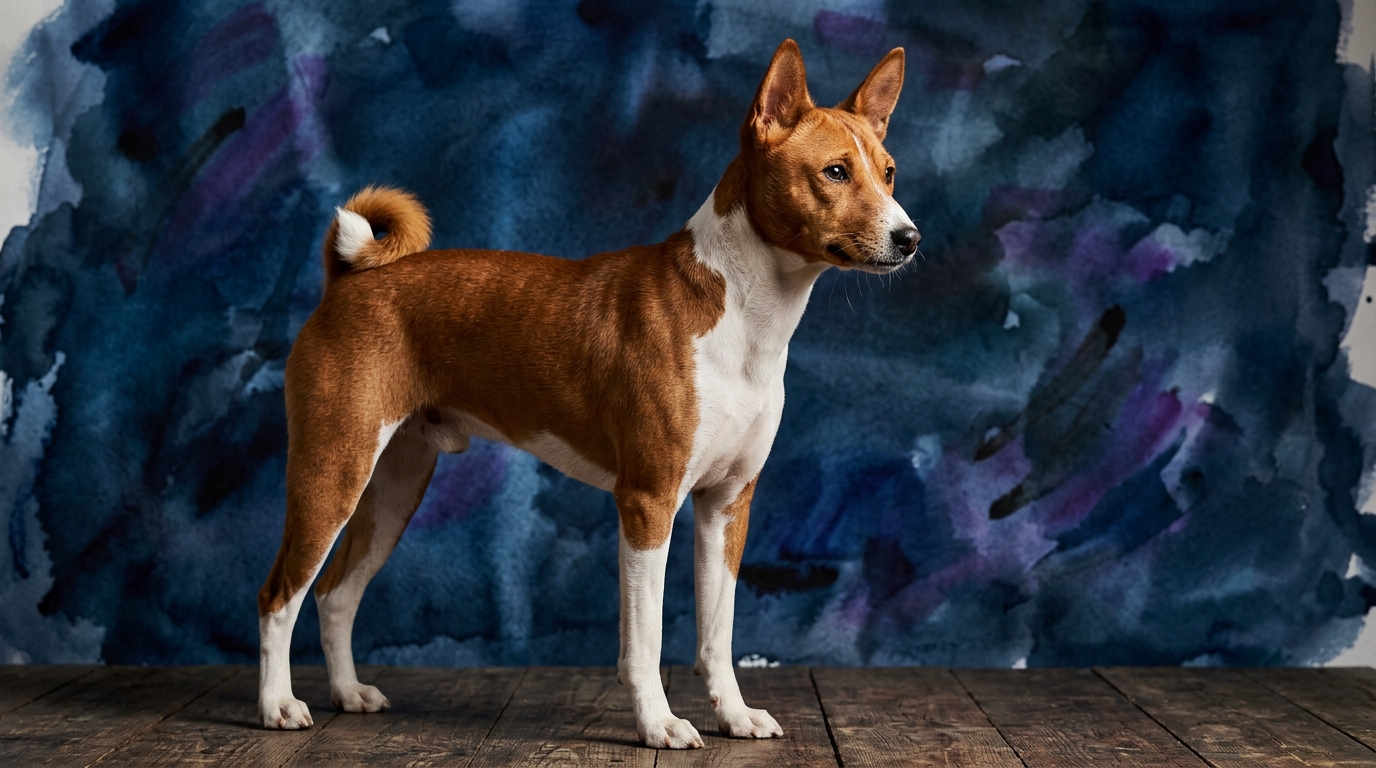

Side-by-Side Cognitive Profiles
The Basenji, ranked #78 by Coren, demonstrates a unique cognitive makeup. Their Problem Solving score of 5/5 highlights an extraordinary ability to independently strategize and overcome obstacles, often to their owner's chagrin. This resourcefulness, however, pairs with a Training Speed of 1/5, indicating a profound resistance to conventional obedience, as they rarely feel compelled to perform for human approval. Social Intelligence stands at 3/5, reflecting a selective bonding style; they are devoted to their inner circle but reserved with outsiders. An Instinctive Drive of 5/5 underscores their powerful hunting heritage, making them keenly aware of their environment and prone to acting on primal urges. Finally, their Memory at 4/5 means they retain complex information and experiences, contributing to both their clever escapades and their cautious approach to novelty.
In contrast, the Rhodesian Ridgeback, holding a Coren rank of #52, presents a more balanced cognitive profile. Their Problem Solving is rated 3/5, indicating a capable but often human-directed approach to challenges, preferring to work with their owner rather than purely independently. A Training Speed of 3/5 suggests they are teachable with consistent methods, though their strong will requires a firm, fair hand. Their Social Intelligence, also 3/5, manifests as loyalty and protectiveness towards their family, accompanied by a dignified aloofness towards strangers. The Instinctive Drive of 3/5 points to a significant prey drive, historically for large game, but one that is generally more manageable and less impulsive than the Basenji's. Their Memory score of 3/5 indicates a solid capacity for recalling routines and learned behaviors, essential for their role as a cooperative partner.
Where the Basenji Excels Cognitively
The Basenji's cognitive strengths primarily lie in their unparalleled independent thought and self-reliance. Their 5/5 Problem Solving score means they are constantly assessing situations and devising their own solutions, a trait that makes them exceptionally adept at navigating complex environments or outmaneuvering perceived restrictions. This isn't just about opening a latch; it's about understanding the mechanics of a barrier and formulating a multi-step plan to circumvent it, often with a mischievous glint in their eye. They don't wait for human direction; they innovate.
Furthermore, the Basenji's potent 5/5 Instinctive Drive fuels their intense curiosity and predatory focus. This isn't merely a physical drive; it's a cognitive preoccupation with scent, movement, and the thrill of the chase. This makes them exceptional at tracking and highly attuned to subtle environmental changes. Coupled with their 4/5 Memory, they can recall specific locations of interest or past successful hunting strategies, enabling them to refine their independent pursuits over time. These combined traits foster a truly self-sufficient mind, one that processes information and acts upon it with remarkable autonomy.
Where the Rhodesian Ridgeback Shines Cognitively
The Rhodesian Ridgeback demonstrates its cognitive advantages in areas that foster a more harmonious partnership with humans. Their 3/5 Training Speed, while not lightning fast, is significantly higher than the Basenji's, indicating a greater willingness and capacity to learn and retain commands when provided with consistent, fair training. This allows for a broader range of cooperative activities and a more predictable household dynamic, as they are more inclined to respond to established rules and cues.
While their Social Intelligence is rated equally at 3/5, the Ridgeback's expression of this trait often leans towards a more nuanced understanding of human social cues and expectations. They are sensitive to their owner's moods and can form incredibly deep, protective bonds, translating into a desire to please their primary caretaker, albeit on their own terms. Their 3/5 Problem Solving, while lower than the Basenji's, is often applied in a context of shared goals, such as finding a lost item with their owner, rather than purely independent mischief. This cooperative intelligence makes them more receptive to complex training and working roles, where understanding and responding to human directives are paramount.
Training Dynamics: Basenji vs. Rhodesian Ridgeback
When it comes to trainability, the contrast between these two breeds is stark and often defines the ownership experience. The Basenji's 1/5 Training Speed is not an indicator of a lack of intelligence, but rather a profound lack of motivation to comply with human commands. They are independent thinkers who don't possess a strong innate desire to please; instead, they weigh whether a command aligns with their own interests. Training a Basenji requires immense patience, creativity, and a deep understanding of their unique motivations, often involving high-value, novel rewards and making every session feel like a game they choose to play, rather than an obligation.
Conversely, the Rhodesian Ridgeback, with a 3/5 Training Speed, is generally more amenable to traditional training methodologies. They are strong-willed and can be stubborn, requiring a confident and consistent leader, but they do possess a desire to understand and respond to their human's expectations. Their protective instincts and loyalty often translate into a willingness to learn tasks that benefit their family unit. While they are not a 'soft' breed that will blindly obey, a Ridgeback can be trained to a high level in obedience, dog sports, or even as a working companion, provided the training is fair, consistent, and begins early to channel their strong personality effectively.
Matching Lifestyles: Active vs. Relaxed Owners
Neither the Basenji nor the Rhodesian Ridgeback is suitable for a truly 'relaxed' owner in the sense of minimal engagement. Both breeds demand significant investment in their physical and mental well-being, though the nature of that investment differs. The Basenji, with its high instinctive drive and problem-solving prowess, requires an owner who can appreciate and manage an independent, often self-directed, adventurer. They need secure environments, creative mental stimulation to prevent boredom-induced destruction, and owners who are prepared for a dog that will always seek its own entertainment and challenge boundaries. They are ideal for owners who enjoy figuring out a puzzle alongside their dog, or who find joy in a companion with a distinctly feline independence, requiring bursts of intense activity and opportunities for scent work.
The Rhodesian Ridgeback, by contrast, suits an active owner seeking a more structured and cooperative partnership. Their need for physical exercise is substantial, often enjoying long runs, hikes, or vigorous play sessions with their human. Mentally, they thrive on purpose and consistent routine, making them excellent candidates for dog sports like agility, tracking, or lure coursing, where they can work alongside their owner. An owner who can provide firm yet loving leadership, consistent training, and channel their protective instincts and physical capabilities into productive outlets will find the Ridgeback a dignified, loyal, and fulfilling companion. They are not a dog to be left to their own devices for extended periods; they crave inclusion and a role within the family unit.
The Verdict
Choose the Basenji if you are an experienced owner who values an independent, highly resourceful, and often challenging companion, prepared for unconventional training and a dog that consistently thinks for itself.
Opt for the Rhodesian Ridgeback if you seek a loyal, protective, and strong-willed partner, capable of cooperative work with consistent leadership, ample exercise, and structured training.
🧠 Find Your Pet's IQ Score
Our Pet IQ Lab assessment covers 25+ tests across 5 cognitive dimensions — personalized to your breed.
Take the Full IQ Test →Frequently Asked Questions
Are Basenjis really untrainable?
Basenjis are not untrainable, but they require a unique approach due to their independent nature and low desire to please. Training success comes from making activities highly rewarding and engaging on their terms, rather than relying on traditional obedience methods.
Do Rhodesian Ridgebacks need a lot of exercise?
Yes, Rhodesian Ridgebacks require significant daily exercise to maintain their physical and mental health. This includes long walks, runs, or vigorous play, ideally with a purpose-driven activity like tracking or lure coursing to satisfy their breed instincts.
Which breed is better with children?
Both breeds can be good with children when properly socialized and raised, but supervision is always key. Rhodesian Ridgebacks are generally more tolerant and protective of their family unit, while Basenjis might prefer calmer interactions and can be less patient with boisterous play.