
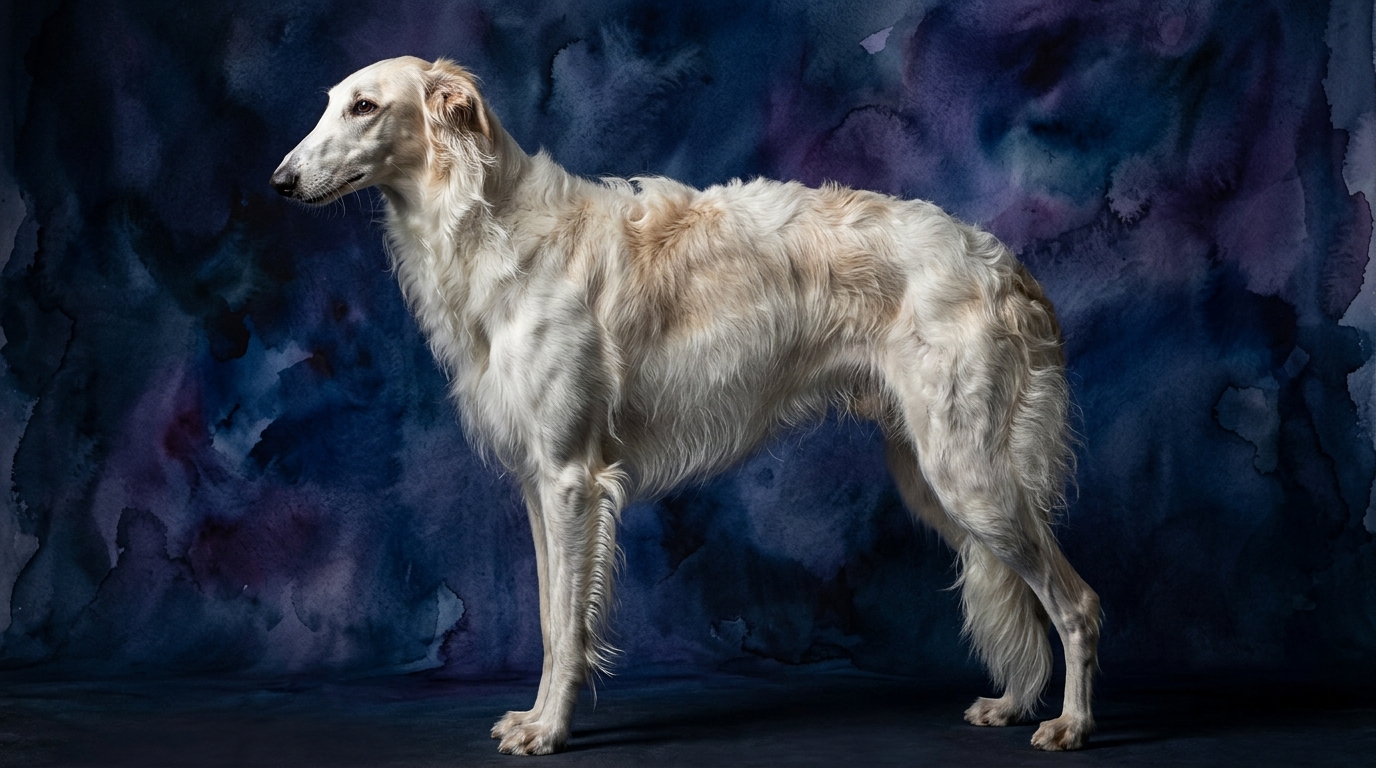
Side-by-Side IQ Profile: Basset Hound vs Borzoi
At The Cosmic Pet Pet IQ Lab, we assess canine intelligence across five key dimensions. Interestingly, both the Basset Hound (Coren rank #71) and the Borzoi (Coren rank #75) score 3/5 in every category, hinting at a nuanced rather than overt difference in their cognitive capabilities. Let's unpack what a '3/5' signifies for each breed specifically.
For the **Basset Hound**:
**Problem Solving (3/5):** A Basset Hound's problem-solving often manifests as a methodical, scent-driven pursuit of a goal. Faced with an obstacle, they might not immediately seek the quickest route over or around it, but rather will meticulously follow a scent trail, often bypassing conventional solutions in favor of olfactory data. Their 'thinking' is deeply rooted in persistent sensory input, making them formidable at tracking but less inclined towards abstract puzzles.
**Training Speed (3/5):** Basset Hounds learn at a moderate pace, but their primary challenge in training stems from their intense focus on scent. Once a compelling scent is detected, external commands often become secondary, requiring consistent, high-value reinforcement to maintain attention. They are not unwilling to learn, but their internal motivation to follow a trail can easily override human direction.
**Social Intelligence (3/5):** Basset Hounds typically exhibit moderate social intelligence, being generally amiable with family and familiar individuals. They are capable of forming strong bonds and understanding household routines, but their deep immersion in their scent world can sometimes make them appear aloof or less responsive to social cues when their nose is engaged. They appreciate companionship but might not constantly seek intense social interaction beyond their established pack.
**Instinctive Drive (3/5):** Their instinctive drive is profoundly centered on scent work. A 3/5 here signifies a strong, unwavering urge to follow a trail, bay, and flush game. This drive is not easily suppressed and is a fundamental aspect of their cognitive makeup, directing much of their natural behavior and attention towards olfactory exploration.
**Memory (3/5):** Basset Hounds demonstrate a moderate memory, particularly adept at recalling scent patterns and established routes. They can remember specific locations where interesting smells were found and retain training cues with consistent practice. Their long-term memory for positive and negative associations is solid, contributing to their ability to navigate familiar environments and routines.
For the **Borzoi**:
**Problem Solving (3/5):** For a Borzoi, problem-solving is often a question of visual assessment and rapid, independent action. When pursuing prey, they swiftly calculate trajectories, anticipate movement, and choose the most efficient path to intercept. This cognitive strength is less about methodical persistence and more about instantaneous evaluation and decisive, high-speed execution, often without direct human instruction in the field.
**Training Speed (3/5):** Borzoi learn at a moderate pace, but their training can be influenced by their independent sighthound nature. They are sensitive and respond best to gentle, consistent methods, often questioning the 'point' of a command if it doesn't align with their natural drives or seems illogical. While capable of learning a wide range of commands, their inherent independence means they might choose to comply only if they perceive value in it.
**Social Intelligence (3/5):** Borzoi typically display moderate social intelligence, often reserved and dignified with strangers but deeply devoted and affectionate with their immediate family. They are observant of human behavior and routines, forming strong, quiet bonds. Their social interactions are often subtle, preferring calm companionship over boisterous engagement, and they can be quite perceptive of their owner's moods.
**Instinctive Drive (3/5):** The Borzoi's instinctive drive is powerfully geared towards visual pursuit and coursing. A 3/5 indicates a strong, innate urge to chase anything that moves quickly, an instinct developed for hunting fast-moving game. This drive is a core component of their cognitive processing, leading them to be highly attuned to movement in their environment and capable of incredible speed and agility.
**Memory (3/5):** Borzoi possess a moderate memory, particularly for visual cues, routes, and routines. They can remember specific areas for running, the layout of their home, and established daily schedules. Their capacity to retain training is good with positive reinforcement, and they often recall past experiences and associations with people and places.
Where the Basset Hound Wins Cognitively
While both breeds score identically across our IQ dimensions, the Basset Hound truly shines in its specialized olfactory processing. Their problem-solving, rated 3/5, is a masterclass in scent-based deduction; they can unravel complex scent trails, prioritizing minute chemical information over visual or auditory distractions. This isn't just sniffing; it's a sophisticated form of data analysis, allowing them to follow a cold trail for hours, demonstrating an unparalleled cognitive stamina and persistence within their sensory domain. Their memory, also 3/5, is uniquely tuned to recall specific scent patterns and the geography associated with them, forming intricate mental maps based on smell rather than sight, a distinct advantage when navigating challenging terrains or tracking elusive quarry.
Where the Borzoi Wins Cognitively
The Borzoi, conversely, exhibits cognitive strengths rooted in its sighthound heritage. Its problem-solving, also 3/5, excels in dynamic, high-speed situations, requiring instantaneous visual assessment and rapid decision-making to intercept fast-moving targets. This involves complex spatial reasoning – calculating speed, distance, and trajectory in a blink – a form of cognitive agility distinct from the Basset Hound's methodical approach. Their instinctive drive, rated 3/5, is a testament to this visual prowess, enabling them to process vast amounts of visual information quickly and react with incredible precision and speed. Their memory, a 3/5, is particularly adept at recalling visual landscapes, open spaces conducive to running, and the optimal paths for pursuit, showcasing a different kind of environmental intelligence.
Which is Easier to Train and Why?
When considering ease of training, both the Basset Hound and Borzoi present unique challenges, despite their identical 3/5 Training Speed scores. The Basset Hound's primary cognitive hurdle in training is its powerful instinctive drive for scent. A fascinating smell can instantly override any command, requiring owners to develop strategies that make training more rewarding than the allure of a trail. Their 'stubbornness' is often a misinterpretation of their profound focus on their nose; consistent, positive reinforcement and patience are key, along with understanding that recall around compelling scents will always be a work in progress.
On the other hand, the Borzoi’s training challenges stem from its independent sighthound nature and sensitivity. They respond poorly to harsh methods, shutting down or becoming resistant. Their problem-solving (3/5) often means they will weigh the 'value' of a command, and if it doesn't make sense to their independent mind or conflicts with their instinctive drive to chase, they might simply choose not to comply. While capable of learning complex commands, their training requires a nuanced approach, building trust and demonstrating the utility of cooperation rather than expecting blind obedience. Neither breed is inherently 'easier'; rather, they demand different training philosophies – one to compete with a nose, the other to engage an independent spirit.
Which Suits Active Owners vs. Relaxed Owners?
The suitability of each breed for active versus relaxed owners hinges on how 'activity' is defined. A Basset Hound, with its 3/5 instinctive drive for scent, thrives on mental engagement through sniffing games, tracking, and leisurely but long walks where their nose can explore. They are not built for sustained, high-speed exercise, but their need for mental stimulation and consistent, albeit slow-paced, physical activity means a 'relaxed' owner might still need to dedicate significant time to scent-based outings. They are content with a quiet home life, but their mind needs to work.
The Borzoi, conversely, appears more 'relaxed' indoors, often choosing to lounge elegantly. However, their 3/5 instinctive drive for visual pursuit means they absolutely require regular, intense bursts of exercise in a securely fenced area where they can stretch their legs and gallop at full speed. They are sprinters, not marathon runners, and a truly 'relaxed' owner might struggle to provide the necessary outlets for their physical prowess. Therefore, active owners for a Borzoi are those who can facilitate these specific, high-energy sprints, while a Basset Hound suits owners who are active in a more meandering, scent-following capacity, valuing mental exploration over physical exertion.
The Verdict
Choose a Basset Hound if you appreciate a methodical, scent-driven companion who finds profound satisfaction in olfactory exploration and offers unwavering, if sometimes comically stubborn, affection.
Opt for a Borzoi if you admire grace, appreciate a reserved yet deeply devoted companion, and can provide ample, secure space for them to express their incredible speed and visual pursuit instincts.
🧠 Find Your Pet's IQ Score
Our Pet IQ Lab assessment covers 25+ tests across 5 cognitive dimensions — personalized to your breed.
Take the Full IQ Test →Frequently Asked Questions
Do Basset Hounds or Borzoi get along with other pets?
Basset Hounds are generally amiable and can coexist well with other pets, though their strong scent drive means they might view smaller animals as something to investigate. Borzoi, due to their sighthound prey drive, require careful introductions and supervision with smaller, fast-moving pets, but can form strong bonds with other dogs in the household.
Are Basset Hounds or Borzoi good with children?
Basset Hounds are typically patient and gentle with children, making them suitable family companions, though supervision is always advised. Borzoi are often tolerant and gentle with respectful children, often preferring quieter interactions, but their size means accidental bumps are possible, so calm interactions are best.
What are the grooming needs for these breeds?
Basset Hounds have a short, dense coat that requires minimal grooming, usually weekly brushing to remove loose hair and keep their skin healthy. Borzoi possess a long, silky coat that demands more frequent attention, typically several times a week, to prevent mats and tangles, especially around their feathering.