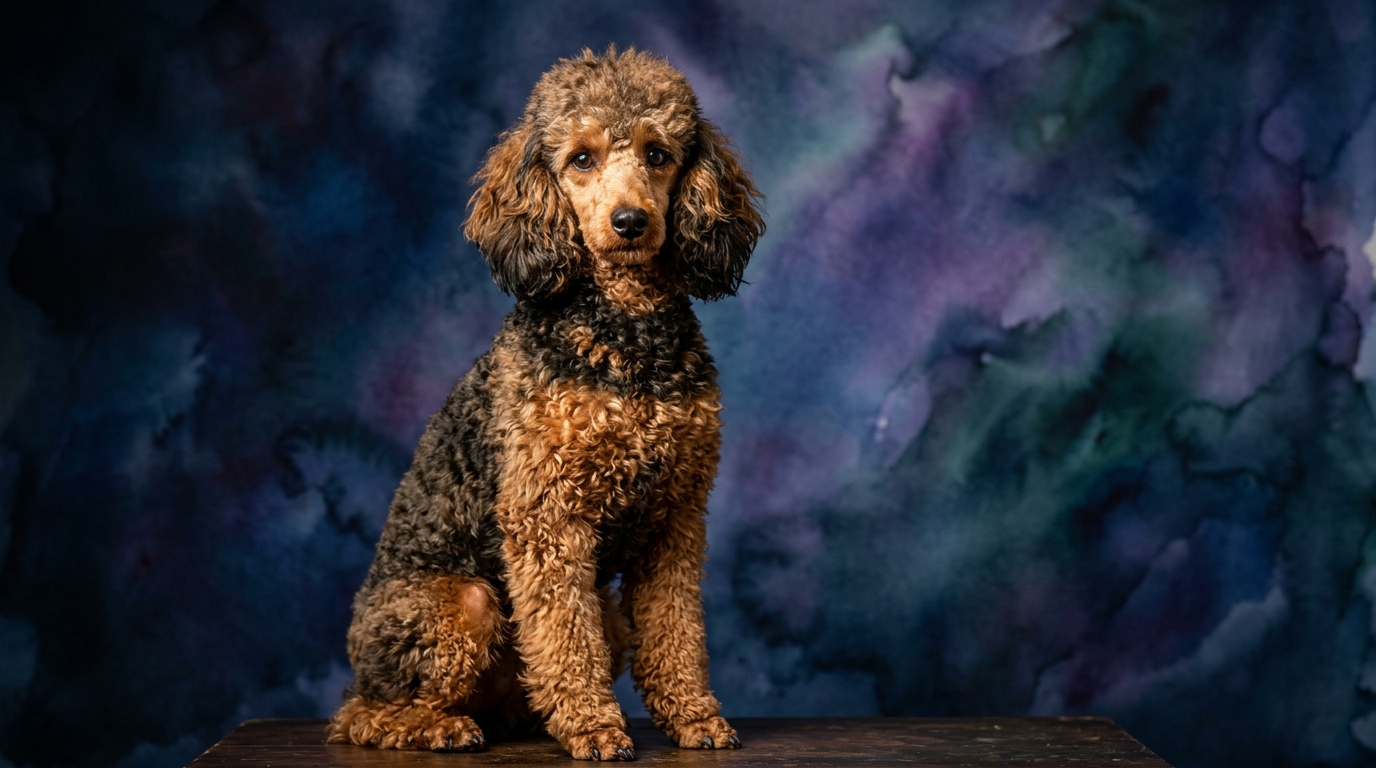

Side-by-Side Cognitive Profiles: Poodle (Standard) vs. Basset Hound
The Cosmic Pet Pet IQ Lab assesses canine intelligence across five key dimensions, revealing distinct cognitive landscapes for these two breeds. The Standard Poodle, holding a Coren rank of #2, demonstrates exceptional aptitude across the board. Its Problem Solving is rated 5/5, indicating a superior ability to understand and navigate complex situations. Training Speed is also 5/5, signifying remarkably quick assimilation of new commands. Social Intelligence stands at 5/5, reflecting a profound understanding of human cues and interactions. Its Instinctive Drive is a robust 4/5, rooted in its historical retrieving and water work, while Memory is a perfect 5/5, ensuring durable retention of learned behaviors and experiences.
In contrast, the Basset Hound, with a Coren rank of #71, presents a more specialized cognitive profile. Its Problem Solving is rated 3/5, suggesting a methodical, often scent-driven approach to challenges. Training Speed is 3/5, indicating a steady but not rapid learning pace. Social Intelligence is 3/5, showing a general awareness and affection for companions, but less inclination for complex human directives. Its Instinctive Drive is also 3/5, singularly focused on its powerful olfactory senses. Memory is rated 3/5, functional for routines but less precise for complex or infrequent commands than higher-scoring breeds.
Where the Standard Poodle Wins Cognitively
The Standard Poodle's cognitive strengths are evident across nearly all measured dimensions, making it a standout in adaptive intelligence. Its exceptional Problem Solving score of 5/5 means it not only understands a new puzzle but can quickly strategize and execute a solution, whether it’s figuring out how to open a child-proof gate or mastering a multi-step agility course. This isn't just about repetition; it's about genuine comprehension and application. Furthermore, its 5/5 Social Intelligence allows it to read subtle human body language and vocal tones, often anticipating commands or moods before they are explicitly expressed, fostering a deeply responsive partnership.
This acute social awareness, combined with its flawless Memory (5/5), ensures that once a lesson is learned or a social cue understood, it remains firmly embedded, leading to a consistently predictable and cooperative companion. The Poodle's comprehensive cognitive framework allows it to excel in diverse environments and learn a vast repertoire of behaviors, from complex service tasks to intricate performance routines, demonstrating a remarkable mental flexibility.
Where the Basset Hound Wins Cognitively
While the Basset Hound's overall cognitive profile, with scores predominantly at 3/5, suggests a different kind of intellect, it undeniably excels within its specialized sphere. Its 3/5 Instinctive Drive, though not a 5/5, represents an unparalleled dedication to scent work, a singular focus that overrides many other stimuli. This isn't a generalist's intelligence; it's a hyper-specialized form of problem-solving where the 'problem' is locating a scent source, and the 'solution' is an unwavering, methodical pursuit.
Its cognitive structure is optimized for persistence and discrimination within a vast olfactory landscape, a domain where its keen nose provides a richer, more detailed map of the world than visual cues ever could. This deep-seated drive, coupled with a memory tuned to scent trails, allows it to perform tasks that other breeds, despite higher general IQ scores, simply cannot replicate, making it a master of scent detection and tracking within its own unique cognitive framework.
Training Ease: Poodle vs. Basset
When considering ease of training, the Standard Poodle presents a significantly smoother journey for most owners. Its 5/5 Training Speed means it grasps new commands with remarkable alacrity, often needing only a few repetitions to understand and internalize a concept. This rapid learning is bolstered by its 5/5 Social Intelligence, enabling it to quickly discern what its human companion desires, fostering a cooperative dynamic. Poodles are generally eager to engage in structured learning, finding satisfaction in mastering new skills and pleasing their people, making them highly responsive to positive reinforcement and consistent instruction.
In contrast, the Basset Hound, with its 3/5 Training Speed, requires a more patient and persistent approach. Its primary instinctive drive is to follow scents, which can often supersede an owner's commands, making recall or focus challenging in stimulating environments. While capable of learning, the Basset often processes information at a slower pace and may require more creative, high-value motivators to maintain engagement, as its independent, scent-driven nature can sometimes be interpreted as stubbornness rather than a deep focus on olfactory information.
Suitability for Active vs. Relaxed Owners
The choice between these breeds often aligns with an owner's lifestyle and their capacity for mental and physical engagement. A Standard Poodle, with its high problem-solving capacity and social intelligence, thrives with active owners who can provide consistent mental stimulation through training, puzzle toys, and varied activities like agility, obedience, or even dog sports. Its substantial energy level, coupled with a desire to learn and participate, makes it an ideal companion for those who enjoy an intellectually stimulating partnership and regular physical exercise, requiring daily engagement to prevent boredom and channel its cognitive energy productively.
Conversely, the Basset Hound is better suited for more relaxed owners. While it still requires daily walks to satisfy its need to explore scent-rich environments, its overall energy output is considerably lower than a Poodle's. Bassets are content with a slower pace of life, enjoying long naps and leisurely explorations of the backyard. Their cognitive needs are primarily met through olfactory pursuits, meaning owners don't need to dedicate extensive time to complex obedience routines, but rather to allowing safe, supervised scent-tracking opportunities where their natural instincts can flourish without the pressure of constant mental gymnastics.
The Verdict
If you seek a highly adaptable, rapidly learning partner eager for intellectual challenges and consistent engagement, the Standard Poodle is an exceptional choice. Its comprehensive cognitive strengths make it suitable for various roles, from family companion to performance athlete.
However, if your preference is for a more relaxed, independent companion whose greatest joy lies in the subtle world of scent, and you appreciate a steadfast, affectionate presence without the constant demand for complex mental tasks, the Basset Hound will be a wonderfully fulfilling addition to your home.
🧠 Find Your Pet's IQ Score
Our Pet IQ Lab assessment covers 25+ tests across 5 cognitive dimensions — personalized to your breed.
Take the Full IQ Test →Frequently Asked Questions
Does a Basset Hound's lower IQ score mean it cannot be trained?
Absolutely not. A Basset Hound's 3/5 Training Speed indicates it learns at a steady pace, but consistency and patience are key. They respond well to positive reinforcement and can master essential commands, especially when motivation is high, such as with food rewards or opportunities for scent work. Their independent nature means training must be engaging and consistent.
Are Standard Poodles prone to boredom if not adequately stimulated?
Yes, their 5/5 Problem Solving and Social Intelligence mean Standard Poodles have a significant need for mental engagement. Without sufficient stimulation through training, puzzles, or interactive play, they can become bored and may develop undesirable behaviors as they seek outlets for their cognitive energy. Active participation in family life and regular learning opportunities are crucial for their well-being.
How does a Basset Hound's Instinctive Drive impact daily life?
A Basset Hound's 3/5 Instinctive Drive is predominantly scent-driven, meaning their nose often takes precedence. This can lead to them becoming engrossed in a scent trail, potentially ignoring commands or wandering off if not securely leashed or contained in a fenced area. Owners must be vigilant and understand that their dog's world is often dominated by olfactory information, requiring specific management strategies like long lines for safe exploration.