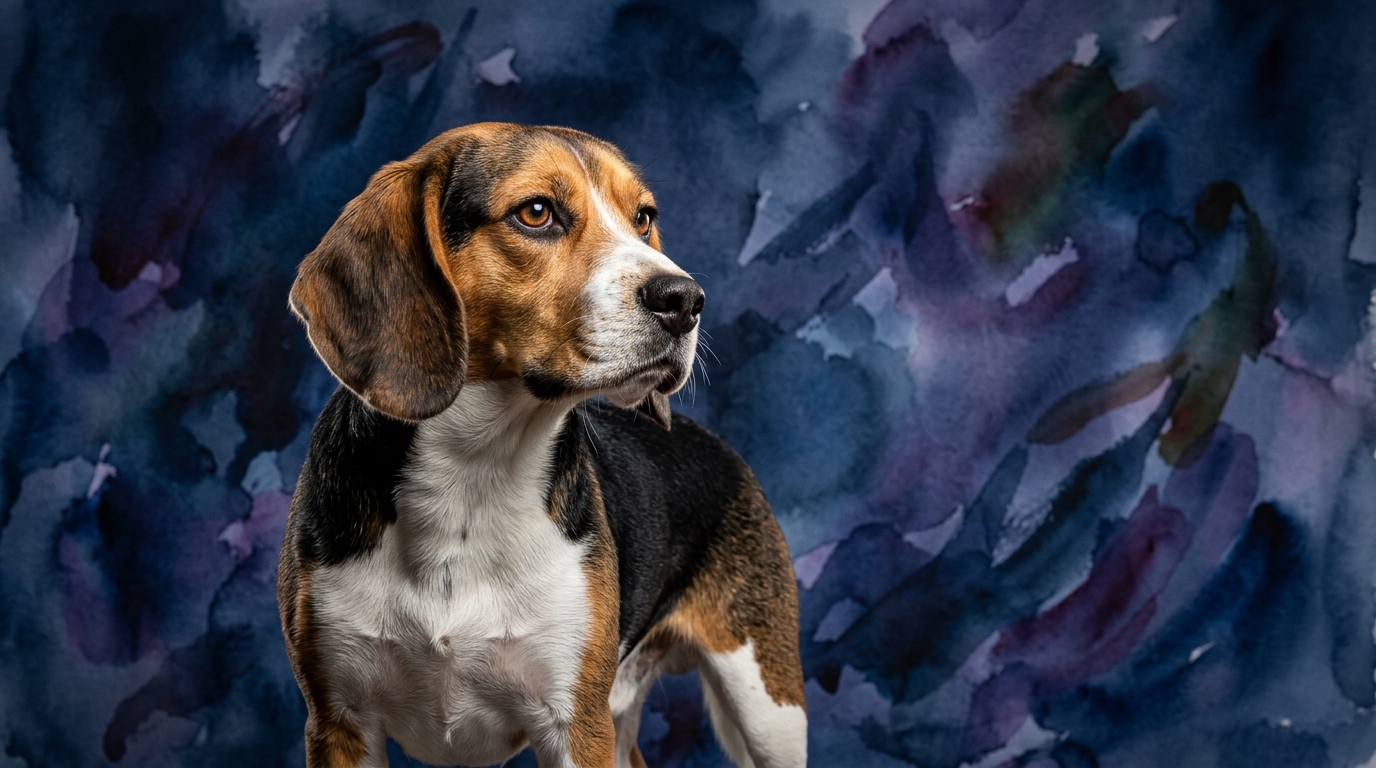

Side-by-Side IQ Profile: Beagle vs. Flat-Coated Retriever
The Cosmic Pet Pet IQ Lab employs five key dimensions to evaluate canine intelligence, offering a nuanced perspective beyond simple obedience ranks. The Beagle, holding a Coren rank of #72, showcases a distinctive cognitive makeup. Their Problem Solving is rated 4/5, particularly evident in their relentless pursuit of scent trails and navigating complex olfactory puzzles. Training Speed, however, stands at 2/5, reflecting their independent nature and propensity to follow their nose over human directives. Social Intelligence is 3/5; while generally amiable, their focus can quickly shift to an enticing scent. Instinctive Drive is a commanding 5/5, almost entirely centered on their ancestral purpose as scent hounds. Finally, their Memory is 4/5, proving robust for recalling scent pathways and experiences that yield a reward.
In stark contrast, the Flat-Coated Retriever, with a much higher Coren rank of #17, presents a different cognitive blueprint. Their Problem Solving also scores 4/5, often manifesting in clever strategies for retrieving objects or understanding spatial relationships in their environment. Training Speed is a commendable 4/5, indicating a quick grasp of new commands and a strong desire to cooperate. Social Intelligence is 3/5; they are typically friendly and outgoing but can be exuberantly boisterous, requiring consistent guidance in social settings. Their Instinctive Drive is 3/5, primarily focused on retrieving and a moderate prey drive, making it more manageable than a Beagle's. Memory for the Flat-Coated Retriever is an exceptional 5/5, allowing them to recall intricate routines, multiple commands, and specific locations with remarkable accuracy.
Where the Beagle Wins Cognitively
The Beagle's cognitive strengths are deeply rooted in their primal purpose. They exhibit an extraordinary capacity for sustained focus on olfactory information, a trait unmatched by many breeds. Their 5/5 Instinctive Drive translates into a relentless ability to follow complex scent trails, demonstrating a type of problem-solving (4/5) that is highly specialized and persistent. A Beagle doesn't just find a scent; they methodically dissect it, following faint traces over varied terrains and for extended periods, showcasing incredible mental stamina in their chosen domain. This tenacity, coupled with their robust memory (4/5) for scent patterns, allows them to navigate and re-navigate intricate olfactory landscapes, making them unparalleled in tasks requiring detailed scent discrimination and tracking. Their independent nature, while a challenge in obedience, paradoxically empowers them to solve scent puzzles without constant human direction, trusting their own powerful sensory input.
Where the Flat-Coated Retriever Wins Cognitively
The Flat-Coated Retriever excels in areas that demand collaborative intelligence and adaptability. Their 4/5 Training Speed, combined with a 5/5 Memory, means they absorb and retain a vast repertoire of commands and routines with impressive efficiency. This makes them particularly adept at learning complex sequences of behaviors required in dog sports like obedience, agility, or competitive retrieving. Unlike the Beagle's independent scent-driven problem-solving, the Flat-Coated Retriever's 4/5 Problem Solving often involves understanding human cues, adjusting strategies based on feedback, and demonstrating a flexible approach to novel tasks. They are quick to generalize learned behaviors to new situations, and their moderate 3/5 Instinctive Drive is channeled productively into tasks like retrieving, making them highly responsive partners in a wide array of activities. Their joyful and eager-to-please temperament further enhances their cognitive wins, as they are intrinsically motivated to engage and learn alongside their human companions.
Which Breed is Easier to Train and Why
When it comes to ease of training, the Flat-Coated Retriever generally presents a more straightforward path for owners. Their Coren rank of #17 signifies a predisposition for quickly understanding and executing human commands, reinforced by their 4/5 Training Speed. They possess a strong desire to please and collaborate, making them highly receptive to positive reinforcement methods. Behavioral differences such as their inherent biddability and excellent memory (5/5) mean they not only learn new cues rapidly but also retain them reliably over time, forming a solid foundation for advanced training.
Conversely, the Beagle, with a Coren rank of #72 and a Training Speed of 2/5, offers a more considerable training challenge. Their paramount 5/5 Instinctive Drive is their nose, and a compelling scent can easily override any learned command or human appeal. This makes achieving consistent off-leash reliability particularly difficult, as their independent problem-solving (4/5) is often geared towards following a trail, not necessarily complying with a “stay” or “come.” Training a Beagle requires immense patience, creativity, and a deep understanding of their hound nature, often incorporating scent work into their training to harness rather than fight their strongest instinct. While capable of learning, their attention is frequently pulled by the olfactory world, demanding persistent and engaging methods to maintain focus.
Suitability for Active vs. Relaxed Owners
For active owners, both breeds can be a fulfilling match, though their activity needs diverge in nature. The Flat-Coated Retriever thrives on diverse physical and mental stimulation. Their moderate Instinctive Drive (3/5) for retrieving, combined with their eagerness to learn, makes them ideal companions for hiking, swimming, competitive dog sports, or long interactive play sessions. They need consistent engagement to channel their boundless enthusiasm and prevent boredom, making them perfect for families who enjoy incorporating their dog into a wide range of outdoor adventures and structured activities.
The Beagle also requires an active lifestyle, but one centered around their powerful nose. While they appreciate walks, their mental stimulation comes primarily from scent work. Owners must be prepared for long, leashed “sniffaris” or engaging in scent games and tracking sports to satisfy their 5/5 Instinctive Drive. A Beagle will not be content with just a quick romp; their minds demand to be engaged through their primary sense. For more relaxed owners, neither breed is truly a “couch potato.” However, a Beagle might fit a moderately active home if their scenting needs are consistently met through dedicated activities, preventing them from creating their own “fun” by following interesting smells into mischief. A Flat-Coated Retriever, without sufficient activity and mental engagement, can become boisterous and prone to destructive behaviors due to their high energy and cleverness.
The Verdict
Choose a Beagle if you are captivated by a dog with an independent spirit, a profound connection to scent, and are prepared to engage with their specific hound instincts through dedicated scent work and consistent, patient training. They are ideal for owners who appreciate tenacity and curiosity, and who can provide a safe, secure environment for their wandering nose.
Opt for a Flat-Coated Retriever if you seek a highly trainable, enthusiastic companion eager for diverse activities, from obedience to dog sports, and are ready to provide ample physical exercise and mental engagement. They excel with owners who enjoy collaborative learning and structured play, channeling their joyful energy into productive pursuits.
🧠 Find Your Pet's IQ Score
Our Pet IQ Lab assessment covers 25+ tests across 5 cognitive dimensions — personalized to your breed.
Take the Full IQ Test →Frequently Asked Questions
Are Beagles difficult to train?
Beagles present unique training considerations due to their powerful independent scent drive, which can override commands. While not "difficult" in the sense of being unable to learn, they require consistent, patient, and engaging training methods that incorporate their natural instincts, making quick obedience a challenge.
How do Flat-Coated Retrievers perform in complex problem-solving?
Flat-Coated Retrievers demonstrate good problem-solving capabilities, particularly when tasks involve retrieving, spatial reasoning, or learning multi-step sequences. Their excellent memory and eagerness to engage make them adept at figuring out new challenges, especially when motivated by interaction or a reward.
Which breed is better for a first-time dog owner?
For a first-time dog owner seeking a companion that generally learns commands more readily and is highly motivated by interaction, the Flat-Coated Retriever might be a more straightforward choice due to their higher training speed and eagerness to please. Beagles, with their strong independent scent drive, often require more specialized understanding and patience from their owners.