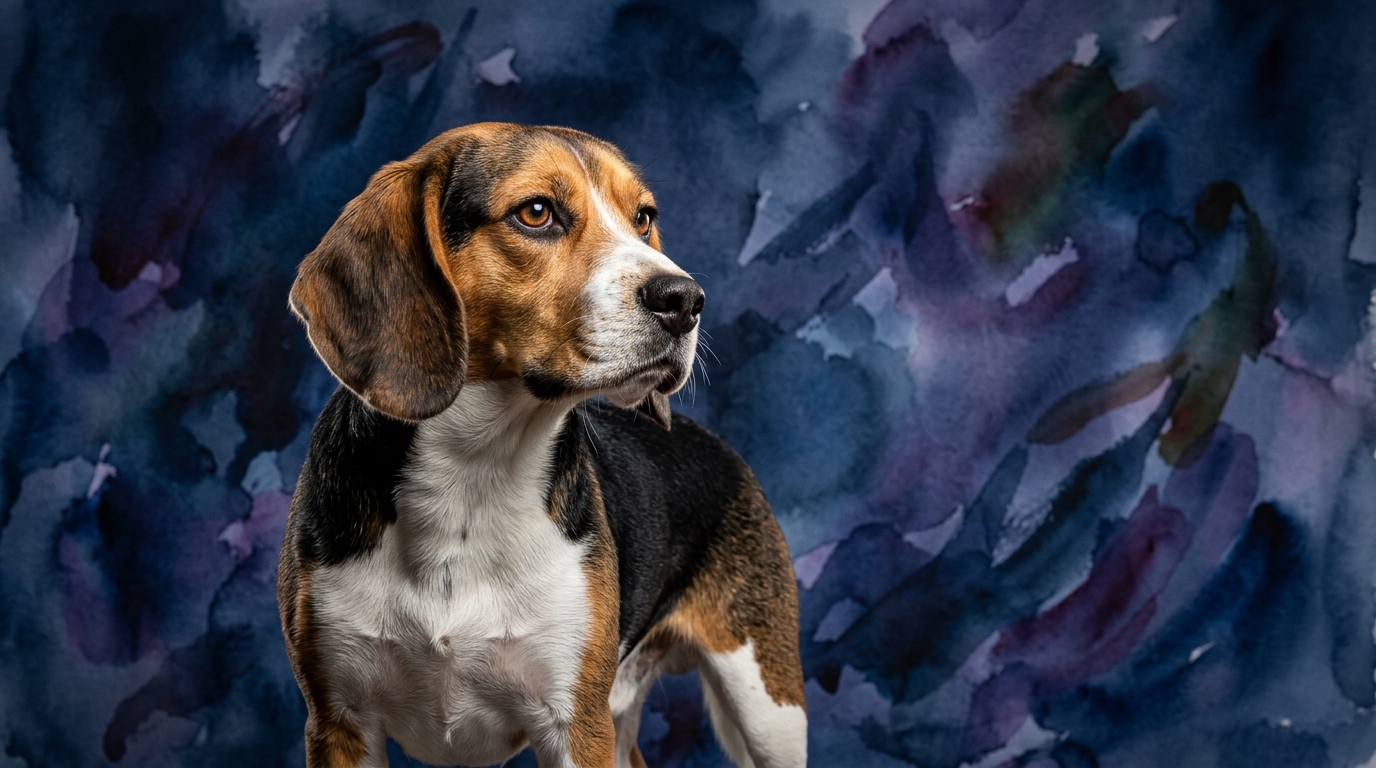

Side-by-Side IQ Profile: Beagle vs. Manchester Terrier
The Cosmic Pet Pet IQ Lab provides a structured way to understand canine cognition, breaking down intelligence into five key dimensions. For the Beagle, a hound breed, these scores reflect its specialized sensory world. Its Problem Solving is rated 4/5, indicative of its profound ability to navigate complex scent trails and decipher olfactory puzzles. Training Speed is 2/5, reflecting challenges in maintaining focus against environmental distractions. Social Intelligence stands at 3/5, showcasing its amiable pack nature. A commanding 5/5 for Instinctive Drive highlights its unwavering commitment to scent work, while Memory, at 4/5, underscores its capacity to recall intricate scent patterns and successful routes.
In contrast, the Manchester Terrier, a terrier breed, presents a different cognitive blueprint. Its Problem Solving is 3/5, demonstrating resourcefulness in its historical role as a vermin hunter, with quick assessments of situations. Training Speed is 3/5, suggesting a more moderate pace of learning but generally responsive nature. Social Intelligence also scores 3/5, pointing to its devotion to family and alert demeanor. Instinctive Drive is 3/5, reflecting its prey drive and territorial awareness without the overwhelming singular focus of a scent hound. Finally, Memory is 3/5, indicating a solid recall for routines and learned behaviors.
Where the Beagle Wins Cognitively
The Beagle's cognitive strengths distinctly lie in its profound olfactory processing and the unwavering dedication fueled by its instinctual drive. With a Problem Solving score of 4/5, compared to the Manchester Terrier’s 3/5, Beagles demonstrate a superior capacity for intricate scent-based puzzles. This isn't about solving a logic grid, but rather the sophisticated mental mapping and navigation required to follow a faint, twisting scent trail for miles, a task demanding immense cognitive focus and spatial reasoning tied to their nose. Their Instinctive Drive, rated 5/5 against the Manchester Terrier's 3/5, underpins this, providing an unparalleled tenacity and motivation to pursue an olfactory goal relentlessly. Furthermore, their Memory, at 4/5 versus 3/5, excels in recalling complex scent patterns and the specific routes taken during their scent quests, allowing them to revisit productive areas or successfully re-trace steps.
Where the Manchester Terrier Wins Cognitively
While the Beagle excels in its specialized scent work, the Manchester Terrier showcases its cognitive advantages in areas emphasizing handler-oriented cooperation and adaptable alertness. Their Training Speed, rated 3/5 compared to the Beagle's 2/5, indicates a relatively quicker uptake of new commands and a more direct responsiveness to human instruction. This difference stems from a less overwhelming internal drive, allowing them to focus more readily on the handler's cues. Although both breeds share a 3/5 Social Intelligence score, the Manchester Terrier's manifestation often involves a sharper, more watchful awareness of its immediate family and surroundings. This enables them to be highly observant of human behavior and subtle environmental changes, contributing to their role as alert companions and guardians, without the same level of distraction from external sensory input that a Beagle might experience.
Which is Easier to Train and Why
Evaluating training ease requires understanding each breed's primary motivators and distractions. The Manchester Terrier, with a Training Speed of 3/5, is generally considered more straightforward to train than the Beagle, which scores 2/5. Manchester Terriers often display a keen desire to please their primary human, coupled with an inherent alertness that makes them attentive students. While they possess the typical terrier independence, their focus can be more readily directed towards learning commands and performing tasks, especially with positive reinforcement.
In contrast, the Beagle's phenomenal instinctive drive (5/5) for scent exploration often overrides human instruction. Their nose is their world, making them highly susceptible to environmental distractions. A Beagle might understand a 'stay' command perfectly but choose to follow an intriguing scent, requiring extraordinary patience, consistency, and incredibly high-value rewards to maintain focus against their powerful olfactory urges. This fundamental behavioral difference means a Manchester Terrier is likely to progress more rapidly and with less effort in general obedience training.
Which Suits Active Owners vs. Relaxed Owners
Both Beagles and Manchester Terriers are active breeds, but their activity profiles suit different types of energetic owners. The Beagle, defined by its 5/5 Instinctive Drive, thrives with owners who can channel its relentless desire to sniff and explore. They are ideal for active individuals or families who enjoy long, investigative walks, participate in scent work, or have secure outdoor spaces where the Beagle can safely follow its nose. Their need for olfactory stimulation is profound, making them less suitable for genuinely relaxed owners who prefer minimal outdoor engagement.
The Manchester Terrier, while also active, with an Instinctive Drive of 3/5, offers a different kind of energy. They excel in activities requiring agility, quick bursts of speed, and interactive play sessions. Owners who enjoy dog sports, brisk walks, or engaging in varied mental challenges will find a Manchester Terrier a spirited companion. While neither is a 'relaxed' couch potato, the Manchester Terrier's activity requirements can be more varied and handler-directed, potentially suiting owners who seek active engagement but perhaps not the same sustained, scent-driven endurance as a Beagle.
The Verdict
Opt for a Beagle if you are prepared to embrace and channel an unparalleled scent drive, enjoying long, exploratory walks and patient, reward-based training.
Select a Manchester Terrier if you seek an alert, devoted companion that thrives on interactive engagement, enjoys varied activities, and responds well to consistent, engaging training.
🧠 Find Your Pet's IQ Score
Our Pet IQ Lab assessment covers 25+ tests across 5 cognitive dimensions — personalized to your breed.
Take the Full IQ Test →Frequently Asked Questions
Do Beagles need a lot of mental stimulation beyond sniffing?
While scent work is paramount, Beagles also benefit from puzzle toys and training that challenges their problem-solving skills in other contexts. This helps to balance their intense olfactory focus and provide well-rounded mental engagement.
Are Manchester Terriers good apartment dogs despite being active?
Yes, Manchester Terriers can adapt well to apartment living if their exercise and mental stimulation needs are consistently met. Daily brisk walks, play sessions, and training help to expend their energy and keep them content in smaller spaces.
How do their social intelligence scores of 3/5 differ in practice?
A Beagle's social intelligence often manifests as amiable pack behavior, generally friendly with most. A Manchester Terrier's 3/5 score typically means strong devotion to its family and a more reserved, watchful demeanor around strangers, valuing its inner circle.