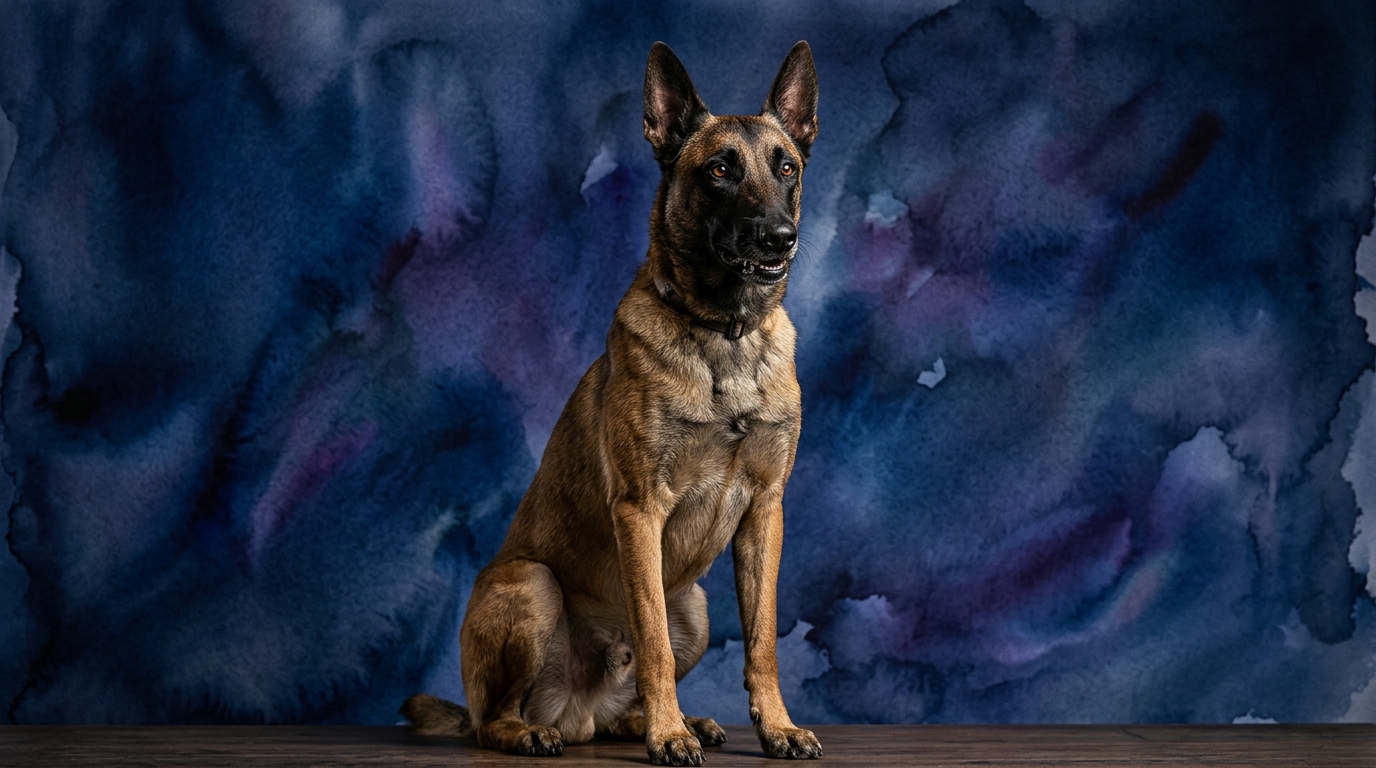

Side-by-Side IQ Profile: Precision vs. Purpose
The Cosmic Pet Pet IQ Lab employs a five-dimensional framework to assess canine intelligence, offering a nuanced view beyond simple obedience. For the Belgian Malinois, a breed often associated with demanding working roles and ranked #22 by Coren for working intelligence, we observe a profile built for complexity and rapid adaptation. Their Problem Solving is rated 5/5, indicating an exceptional capacity to analyze intricate situations and devise effective solutions, a trait critical in protection or search and rescue scenarios. Training Speed also scores 5/5, reflecting their remarkable ability to acquire new commands and tasks with minimal repetitions, making them highly efficient learners. Social Intelligence, at 4/5, highlights their strong attunement to human cues and their ability to form deep, responsive partnerships, though perhaps with a more utilitarian focus than some companion breeds. An Instinctive Drive of 5/5 underscores their profound, intrinsic motivation for work, whether it's herding, guarding, or detection tasks, a drive that propels them to perform consistently. Finally, Memory at 5/5 ensures that once a lesson is learned or an experience gained, it is retained with remarkable precision and longevity, allowing for consistent performance over time.
In contrast, the Pointer, a sporting breed not included in Coren's specific working intelligence rankings, presents a cognitive profile optimized for endurance and specialized sensory tasks. Their Problem Solving is rated 3/5, indicating a capacity for navigating straightforward challenges, particularly those related to their primary function of hunting, but they may not exhibit the same level of abstract or multi-layered problem-solving as a Malinois. Training Speed also stands at 3/5, suggesting a moderate learning pace where consistent repetition and clear, positive reinforcement are key for skill acquisition. Social Intelligence, at 3/5, reflects a generally amiable and cooperative nature, responsive to human interaction, but perhaps less attuned to the subtle, continuous communication demanded in high-stakes working partnerships. Their Instinctive Drive is 3/5, specifically channeled towards hunting, scenting, and retrieving, a powerful force within their specialized domain but not as broadly applied to diverse working tasks as the Malinois. Memory, rated 3/5, means they effectively retain learned behaviors and patterns, especially those pertinent to their field work, ensuring reliability during hunts, though perhaps without the immediate, intricate recall seen in the Malinois.
Where the Belgian Malinois Excels Cognitively
The Belgian Malinois’s cognitive strengths are particularly evident in scenarios demanding rapid processing and versatile application of skills. Their 5/5 Problem Solving shines when faced with novel, dynamic environments, such as navigating complex obstacle courses in agility or making split-second decisions during protection work. This isn't just about speed; it's about the depth of their analytical capacity, quickly assessing threats or opportunities and formulating an appropriate response. The Malinois’s 5/5 Training Speed means they don't just learn quickly; they absorb multi-step commands and intricate routines with remarkable efficiency, often mastering new sequences in a fraction of the time compared to many other breeds. This rapid acquisition of knowledge allows for a continually expanding repertoire of skills, essential for their diverse working roles.
Furthermore, their 5/5 Memory is a cornerstone of their reliability. Once a task, a command, or even a specific scent profile is learned, it is deeply embedded, allowing for consistent and precise execution, even after long periods of inactivity. This robust memory, combined with their 4/5 Social Intelligence, enables a sophisticated level of communication with their handler. They are adept at interpreting subtle body language and vocal cues, creating a tightly synchronized working partnership where the Malinois often anticipates the handler's next move. Finally, their 5/5 Instinctive Drive isn't just about enthusiasm; it's a deep-seated cognitive engine that fuels their focus and persistence, allowing them to sustain high-intensity work for extended periods, undeterred by distractions or fatigue. This combination of cognitive assets makes the Malinois an unparalleled candidate for roles requiring precision, adaptability, and unwavering dedication.
Where the Pointer Excels Cognitively
While the Pointer’s cognitive profile differs from the Malinois, it is exquisitely tailored for its specialized purpose, demonstrating unique strengths within its domain. The Pointer’s 3/5 Problem Solving, while not as broad as the Malinois, is acutely focused on challenges encountered in the field. This means they are adept at identifying optimal scent trails, navigating varied terrain to locate game, and making practical decisions within a hunting context. Their problem-solving isn't about abstract puzzles, but about efficient, real-world application of their senses and physical abilities to achieve a specific goal.
The Pointer’s 3/5 Instinctive Drive, though not a 5/5 like the Malinois, is a powerful and persistent force dedicated to scent work and pointing. This drive translates into an unwavering focus on their task, allowing them to methodically cover vast areas, remaining undistracted by peripheral stimuli that do not pertain to game. Their cognitive stamina in repetitive, long-duration scenting tasks is a testament to this focused drive. While their Training Speed is 3/5, they are highly capable of learning the specific commands and routines necessary for effective hunting, such as 'whoa' or 'retrieve,' and their 3/5 Memory ensures these vital skills are reliably retained. Their Social Intelligence, also 3/5, supports a cooperative working relationship with a hunter, where understanding clear, consistent signals is paramount for a successful outing. The Pointer's intelligence is a testament to specialized evolution, where specific cognitive attributes are honed to perfection for a particular, demanding role.
Which is Easier to Train and Why
Determining which breed is 'easier' to train is nuanced, as it depends heavily on the trainer's experience, the desired outcomes, and the specific cognitive strengths of each dog. The Belgian Malinois, with its 5/5 Training Speed and 5/5 Memory, is undeniably faster at acquiring new commands and retaining them. An experienced trainer can teach a Malinois complex sequences and intricate behaviors with remarkable efficiency, often needing only a few repetitions. Their high social intelligence (4/5) also means they are highly attentive to their handler's cues, making communication during training very fluid. However, this ease of acquisition comes with a caveat: their profound instinctive drive (5/5) and high problem-solving capacity (5/5) mean they require consistent, demanding mental engagement. A Malinois that isn't sufficiently challenged will invent its own 'work,' which can manifest as destructive behaviors or excessive vigilance, making them challenging for novice owners to manage without proper guidance.
The Pointer, with 3/5 ratings across Problem Solving, Training Speed, Social Intelligence, and Memory, learns at a more moderate pace. They require more repetitions and consistent reinforcement to solidify new behaviors. This isn't a deficit in intelligence; rather, it indicates a different cognitive learning style. For a novice owner, a Pointer might initially seem 'easier' to train in basic obedience because their drives are less intense and more singularly focused on field work, leading to fewer complex behavioral 'problems' outside of their hunting instincts. However, achieving precise, advanced obedience with a Pointer will take more time and patience than with a Malinois. Pointers respond well to positive reinforcement and clear, consistent communication. Their training is often more about channeling their natural hunting instincts effectively, such as teaching them to 'point' on command or to retrieve gently, rather than mastering a vast array of complex, abstract tasks. Therefore, for a highly experienced trainer seeking to push boundaries, the Malinois offers faster progress, but for a patient owner focused on fundamental obedience and specific field skills, the Pointer can be a more manageable, albeit slower, journey.
Which Suits Active Owners vs. Relaxed Owners
The choice between a Belgian Malinois and a Pointer based on owner lifestyle is quite clear, with each breed demanding a distinct level and type of activity. A Belgian Malinois is unequivocally suited for active owners, and not just 'active' in the sense of daily walks. Their 5/5 Instinctive Drive and 5/5 Problem Solving demand constant mental and physical engagement that goes far beyond typical pet ownership. These dogs thrive when given a 'job' – whether it's competitive dog sports like agility or protection work, advanced obedience, or even complex scent detection tasks. Owners must be prepared to dedicate significant time daily to structured exercise, training sessions, and mental enrichment activities. A Malinois left under-stimulated will often channel its formidable cognitive and physical energy into unwanted behaviors, making them unsuitable for owners seeking a relaxed, low-maintenance companion. They require an owner who enjoys an intensely active lifestyle and is willing to invest deeply in their dog's continuous development.
The Pointer, while also an active breed, aligns with a different kind of active owner. Their activity needs are rooted in their sporting heritage, requiring vigorous outdoor exercise and opportunities for their 3/5 Instinctive Drive (for scenting) to be satisfied. This means long runs, hikes, or field excursions where they can utilize their keen sense of smell and cover ground. They are not typically suited for 'relaxed' owners in the sense of minimal exercise, as their physical stamina is substantial. However, compared to the Malinois, their mental stimulation requirements are generally less intense and less diversified. A Pointer is often content with a good run and some focused scent work, followed by a period of rest. They don't typically demand the same level of complex problem-solving or continuous 'work' to feel fulfilled. Therefore, a Pointer suits an owner who enjoys being outdoors, engaging in long, free-ranging physical activities, and perhaps has an interest in bird hunting or scent games, but who may not be prepared for the relentless mental demands of a top-tier working breed like the Malinois.
The Verdict
Choose a Belgian Malinois if you are an experienced, highly active owner seeking an intensely engaged working partner for advanced training, dog sports, or professional roles. You must be prepared to provide constant mental challenge and structured physical exertion.
Opt for a Pointer if you are an active individual who enjoys extensive outdoor activities, particularly those involving scent work or hunting, and can provide consistent, patient training for a cooperative, field-oriented companion.
🧠 Find Your Pet's IQ Score
Our Pet IQ Lab assessment covers 25+ tests across 5 cognitive dimensions — personalized to your breed.
Take the Full IQ Test →Frequently Asked Questions
Are Belgian Malinois good family dogs?
Belgian Malinois can be good family dogs for experienced owners who understand their demanding nature and provide extensive socialization and training. Their protective instincts and high energy require careful management to ensure they are well-adjusted and safe around children and other pets, making them less suitable for casual family environments.
Do Pointers need a lot of exercise?
Yes, Pointers require a significant amount of exercise daily, typically at least one to two hours of vigorous activity such as running, hiking, or field work. Their sporting heritage means they thrive on opportunities to stretch their legs and utilize their keen sense of smell, making them unsuitable for sedentary lifestyles.
Which breed is more prone to separation anxiety?
While both breeds can develop separation anxiety, the Belgian Malinois's intense bond with its handler and high need for mental engagement can make them more prone to destructive behaviors or distress when left alone for extended periods without adequate preparation. Pointers, though social, tend to be a bit more independent when their exercise needs are met.