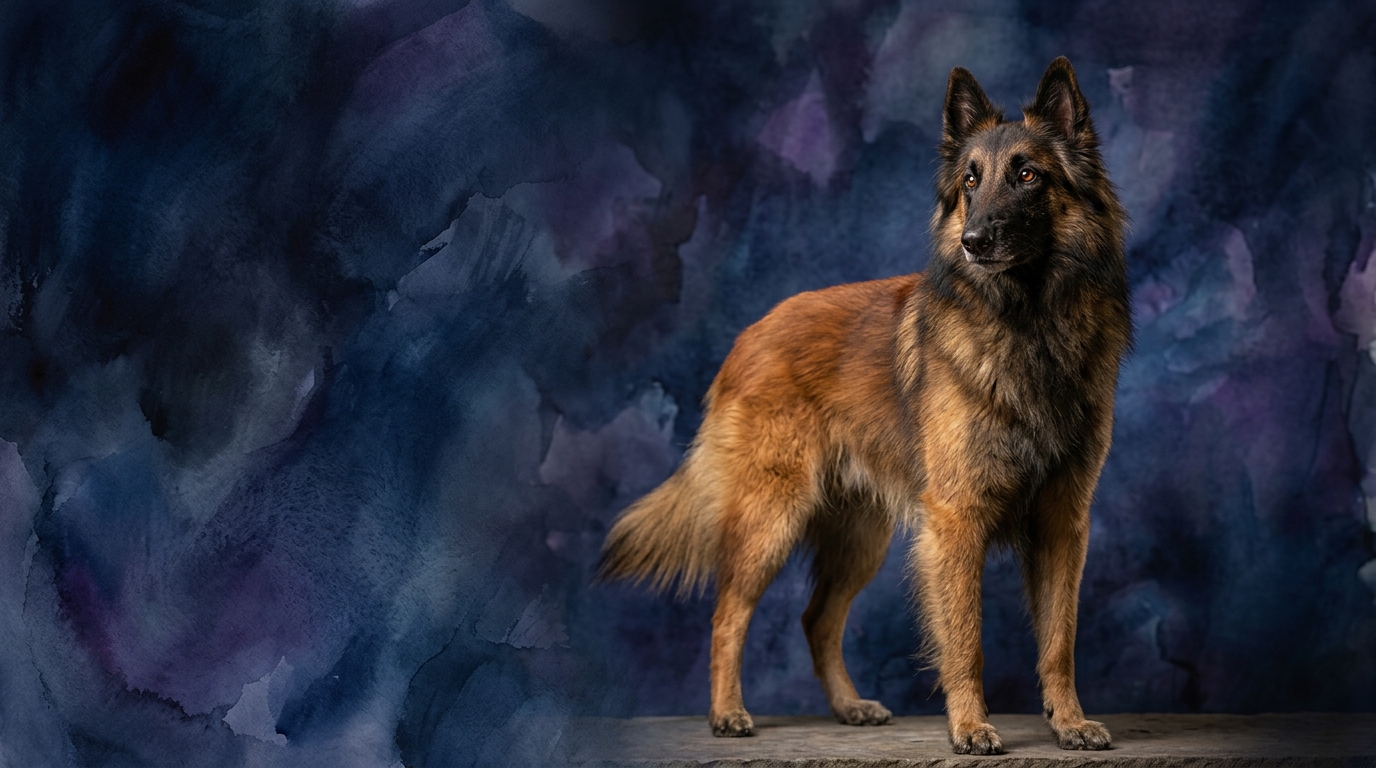
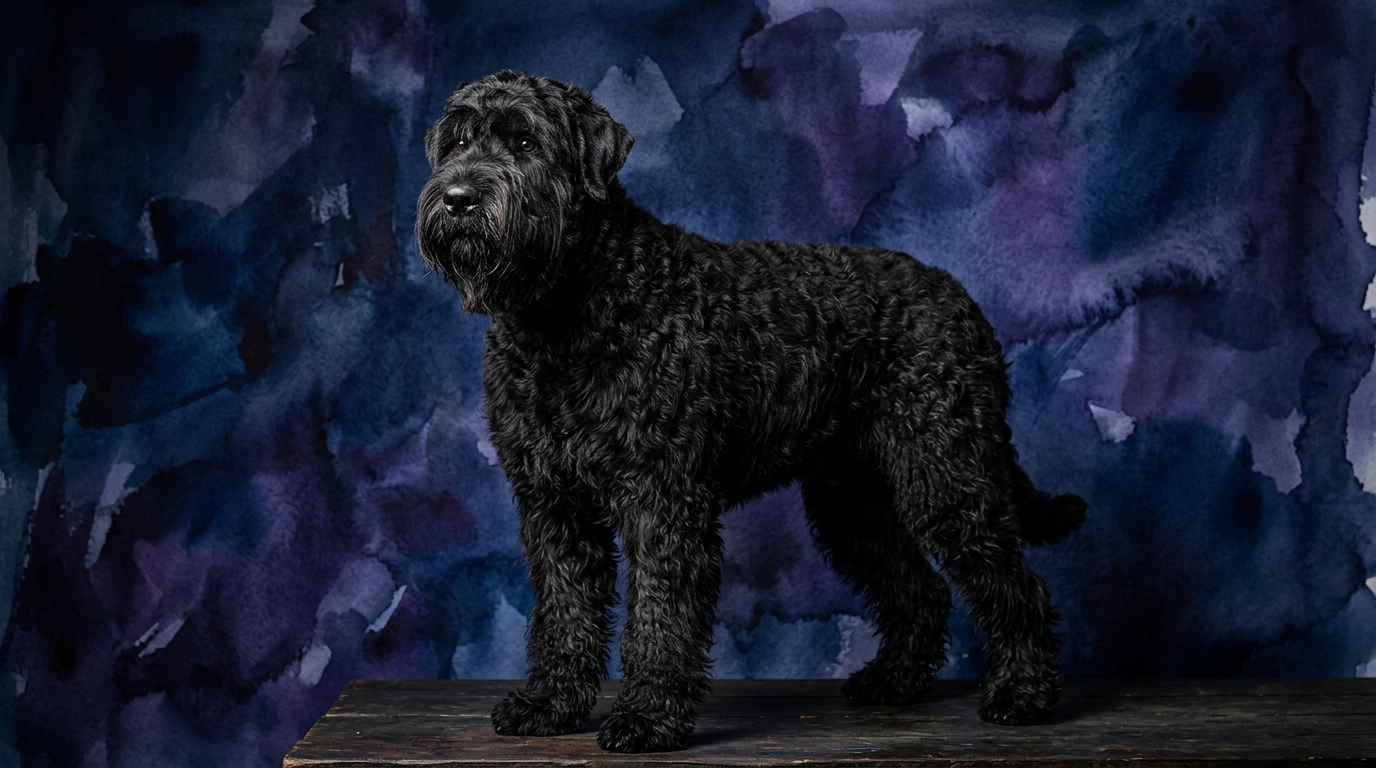
Side-by-Side Cognitive Profile
The Cosmic Pet Pet IQ Lab employs a five-dimensional framework to map canine intelligence, assessing Problem Solving, Training Speed, Social Intelligence, Instinctive Drive, and Memory. This granular approach moves beyond simple rankings to illustrate the nuanced cognitive strengths and applications of each breed, providing a clearer picture of their mental aptitudes.
The Belgian Tervuren, a Herding breed, presents a remarkable cognitive blueprint: Problem Solving at 5/5, Training Speed at 5/5, Social Intelligence at 3/5, Instinctive Drive at 3/5, and Memory at 5/5. This profile suggests a highly adaptable and quick-witted dog, capable of rapid learning and retaining complex information, with a moderate but focused social awareness and instinctual underpinning.
In contrast, the Black Russian Terrier, a Working breed not featured on the Coren ranking, demonstrates a different set of mental strengths: Problem Solving at 3/5, Training Speed at 3/5, Social Intelligence at 3/5, Instinctive Drive at 3/5, and Memory at 3/5. This breed exhibits a consistent, competent cognitive ability across the board, indicating a dog that learns steadily and reliably, with a balanced social and instinctive engagement, without the Tervuren's extraordinary speed or innovative problem-solving flair.
Where the Belgian Tervuren Excels Cognitively
The Belgian Tervuren's cognitive prowess shines brightest in its Problem Solving (5/5) and Memory (5/5) capabilities. These dogs exhibit a remarkable capacity for strategic thinking, often devising novel solutions to environmental challenges or complex tasks. Their herding heritage equips them with an ability to anticipate, plan, and adapt, making them adept at navigating intricate obstacle courses or understanding multi-step commands. Their memory allows them to recall these solutions and apply them efficiently across various contexts, retaining training and experiences with exceptional clarity over long periods.
Furthermore, the Tervuren's Training Speed (5/5) sets it apart. These dogs grasp new concepts and commands with astonishing rapidity, often requiring fewer repetitions than many other breeds to achieve mastery. This swift acquisition of knowledge is coupled with an eager desire to engage, making them highly responsive to cues and quick to generalize learned behaviors. This cognitive speed enables them to excel in advanced obedience, agility, and competitive dog sports, where split-second decisions and precise execution are paramount.
Where the Black Russian Terrier Holds Its Own Cognitively
While the Black Russian Terrier's scores are consistently 3/5, this indicates a practical and purposeful intelligence rather than a deficit. Its Problem Solving (3/5) focuses on applying learned solutions effectively, particularly in scenarios requiring vigilance and protection. These dogs are methodical, capable of understanding and executing complex protective tasks, relying on their steady memory (3/5) to recall boundaries, protocols, and identified threats. Their intelligence is geared towards steadfast reliability and consistent performance in their working roles, rather than spontaneous innovation.
The BRT's Social Intelligence (3/5) and Instinctive Drive (3/5), while numerically similar to the Tervuren, manifest distinctly. Their social intelligence is characterized by a discerning and watchful nature, carefully evaluating strangers and forming deep, protective bonds with their family. This isn't about rapid, subtle human cue reading in a sport context, but rather a profound understanding of their social environment for security purposes. Their instinctive drive is channeled into guardian behaviors, requiring a controlled and thoughtful application of their protective instincts, rather than the gathering impulse of a herding dog. This focused drive ensures they are formidable yet stable protectors, relying on their learned understanding of appropriate responses.
Training Dynamics: Tervuren's Zest vs. BRT's Resolve
Training a Belgian Tervuren is often described as a dynamic and engaging experience, largely due to their 5/5 Training Speed and high Problem Solving. They are eager participants, often anticipating a handler's next move and quickly connecting actions with desired outcomes. This means they pick up new commands and intricate sequences with minimal repetition, thriving on the mental challenge of advanced training in sports like agility, obedience, and even complex scent work. Their sensitivity to handler mood and subtle cues contributes to this rapid learning, making them highly responsive partners.
The Black Russian Terrier, with its 3/5 Training Speed, requires a different training approach characterized by patience, consistency, and clear, fair methods. While they are certainly capable learners, they typically need more repetition to solidify new commands and generalize behaviors across different environments. Their problem-solving leans more towards applying established rules rather than inventing novel solutions, meaning training should focus on structured, consistent reinforcement. A BRT may not grasp a concept in two tries, but with steady, positive guidance, they will reliably integrate it.
Behaviorally, the Tervuren's quick uptake and sensitivity mean they respond well to positive reinforcement and can be quite attuned to handler subtle body language. A BRT, while equally desiring positive interaction, often exhibits a more stoic and independent streak; they need a handler who is a confident leader, providing firm, consistent direction without harshness. Their commitment to learned tasks is unwavering once established, but the journey to that establishment demands a methodical and dedicated approach.
Matching Cognitive Profiles to Owner Lifestyles
For active owners seeking a true cognitive partner, the Belgian Tervuren is an exceptional match. Their high Problem Solving and Memory demand consistent mental engagement, making them ideal for individuals committed to dog sports such as agility, competitive obedience, herding trials, or advanced protection work. Owners who enjoy teaching complex tricks, engaging in daily puzzle-solving, and providing varied mental stimulation will find the Tervuren a responsive and enthusiastic collaborator, thriving on the challenges presented.
The Black Russian Terrier, while requiring a firm foundation in training and regular physical activity, might suit committed owners who appreciate a more self-contained, less overtly demanding cognitive presence once core training is established. Their intelligence is focused on vigilance, discernment, and protection, rather than a constant need to invent new games or solve novel puzzles. They are better suited for owners who value a steady, watchful companion, are prepared for consistent, foundational training, and understand the need to channel their working drives responsibly into purposeful activities, such as advanced obedience or protection sports, without requiring the same level of spontaneous mental output as a Tervuren.
The Verdict
Choose the Belgian Tervuren if you are an active, engaged owner seeking a highly responsive, mentally agile partner for dog sports, advanced training, and complex problem-solving. Their rapid learning and exceptional memory make them ideal for demanding cognitive pursuits.
Opt for the Black Russian Terrier if you are a committed owner seeking a steadfast, protective companion who thrives on structure, consistency, and purposeful work, valuing loyalty and discerning vigilance. Their reliable, focused intelligence makes them excellent guardians with proper training.
🧠 Find Your Pet's IQ Score
Our Pet IQ Lab assessment covers 25+ tests across 5 cognitive dimensions — personalized to your breed.
Take the Full IQ Test →Frequently Asked Questions
Is a Black Russian Terrier harder to train than a Belgian Tervuren?
The Black Russian Terrier is not necessarily 'harder' to train, but requires a different approach. With a Training Speed of 3/5 compared to the Tervuren's 5/5, BRTs need more repetition and consistency to master commands. Their training is a steady, methodical process rather than a rapid acquisition.
Which breed is better for a first-time dog owner?
Neither breed is typically recommended for first-time dog owners due to their strong working drives and need for experienced handling. Both require significant commitment to training and socialization, but the Tervuren's intensity and the BRT's protective nature demand particular expertise.
Do both breeds require significant mental stimulation?
Yes, both breeds absolutely require significant mental stimulation to prevent boredom and undesirable behaviors. The Tervuren thrives on complex puzzles and advanced training, while the BRT benefits from structured tasks and consistent reinforcement of their protective roles, engaging their minds through purpose.