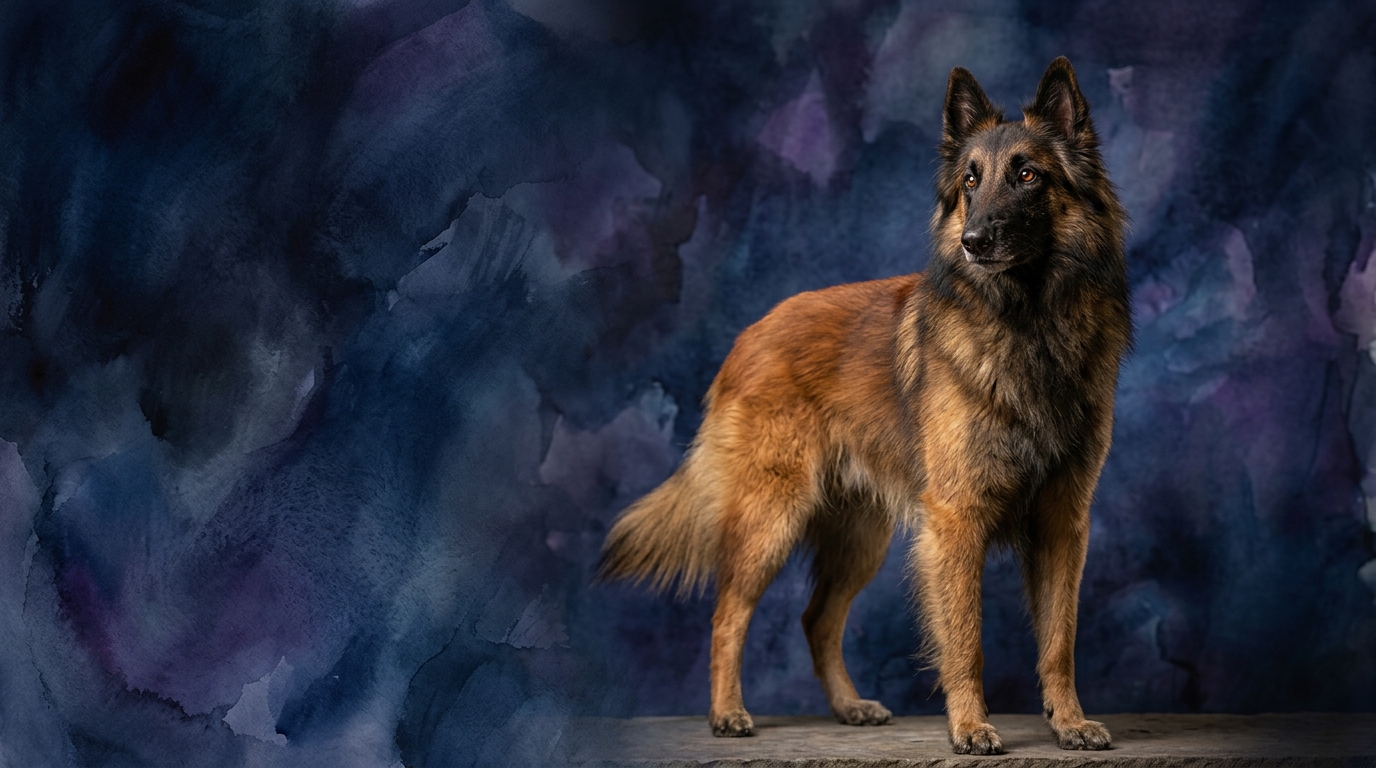

Side-by-Side IQ Profile: Belgian Tervuren vs. Pointer
The Cosmic Pet Pet IQ Lab employs a five-dimensional framework to assess canine intelligence, offering a nuanced view beyond simplistic labels. For the Belgian Tervuren, a dog from the Herding group, its cognitive makeup reflects a history of managing livestock with precision. Its Problem Solving score of 5/5 indicates an exceptional capacity to analyze novel situations and devise effective strategies, whether navigating complex obstacle courses or understanding multi-step commands. This breed's Training Speed, also at 5/5, signifies a rapid grasp of new routines, often requiring fewer repetitions to solidify learning. Its Social Intelligence, rated 3/5, suggests a moderate ability to interpret human cues and adapt to social dynamics, being competent but perhaps not exceptionally nuanced in reading subtle emotional shifts. The Instinctive Drive, at 3/5, is present but channeled more into working tasks like herding rather than raw prey pursuit. Finally, a Memory score of 5/5 underscores its capability to retain a vast repertoire of learned behaviors and experiences over long periods, making it highly reliable once a task is mastered.
In contrast, the Pointer, a distinguished member of the Sporting group, exhibits a cognitive profile optimized for its specific field work. Its Problem Solving score of 3/5 suggests a competent but less spontaneously innovative approach to novel challenges; it excels within established frameworks rather than consistently inventing new solutions. Training Speed, also at 3/5, implies a steady learning pace that benefits from consistent repetition and clear communication, though it may not pick up complex sequences as quickly as some breeds. Its Social Intelligence, matching the Tervuren at 3/5, indicates a practical understanding of handler cues, sufficient for collaborative hunting, but perhaps not a deeply intuitive connection to human emotional states. The Instinctive Drive, also 3/5, is highly specialized and powerful within its domain, primarily focused on scenting, locating, and pointing game with unwavering focus and endurance. Its Memory score of 3/5 means it retains commands and learned hunting patterns effectively for its purpose, but perhaps not with the same breadth or detail as breeds with higher scores across the board.
Where the Belgian Tervuren Wins Cognitively
The Belgian Tervuren's cognitive strengths are particularly evident in its superior Problem Solving and Memory capabilities. A Tervuren doesn't just learn commands; it often grasps the underlying intent, allowing it to adapt learned behaviors to slightly altered circumstances or to troubleshoot a task independently when an expected step is missing. For instance, if taught to retrieve a specific toy and that toy is out of reach, a Tervuren with its 5/5 problem-solving might creatively use a paw or nose to dislodge it, rather than simply giving up or waiting for human intervention. Its 5/5 Memory means that complex sequences, once learned, are deeply ingrained. This allows them to perform intricate obedience routines, agility courses, or protection work with remarkable consistency, even after a break from training. The Tervuren's ability to quickly process new information and retain it long-term makes it an excellent candidate for advanced dog sports, service work, or any role requiring dynamic, adaptive thinking and a reliable recall of vast information.
Where the Pointer Wins Cognitively
While the Pointer's overall cognitive scores might appear lower than the Tervuren's in generalist categories, its strength lies in the highly specialized application of its Instinctive Drive. A Pointer "wins" in the realm of single-minded, sustained focus on a specific task: locating game. Its 3/5 Instinctive Drive, though numerically matched by the Tervuren, manifests as an unparalleled dedication to scent work and pointing. This isn't just a physical act; it's a cognitive process involving intense sensory analysis, pattern recognition (of scent trails), and the discipline to "freeze" upon discovery, signaling to a handler. This specialized cognition allows Pointers to cover vast terrains, systematically searching for subtle cues invisible to humans, and to maintain this high-level concentration for extended periods without distraction. Their cognitive profile is perfectly optimized for endurance and precision in the field, making them masters of their ancestral hunting role. It’s a different kind of "winning" – less about general adaptability and more about supreme mastery of a niche.
Which is Easier to Train and Why
Based on their respective IQ profiles, the Belgian Tervuren is demonstrably easier to train for a wide variety of tasks. Its 5/5 Training Speed means it absorbs new information with remarkable alacrity, often picking up new commands or behaviors in just a few repetitions. This rapid learning curve, combined with its 5/5 Problem Solving, allows Tervurens to generalize concepts and apply them to novel situations quickly, meaning less rote memorization and more genuine understanding. Their exceptional Memory (5/5) ensures that once a behavior is learned, it tends to stick, reducing the need for constant refresher training. In contrast, the Pointer, with its 3/5 Training Speed, requires more consistent and patient repetition to solidify new commands. While Pointers are certainly trainable and eager to please their handlers, particularly in tasks related to their instinctive drive, they typically won't grasp complex, multi-step sequences or abstract concepts as quickly. Training a Pointer often involves breaking down tasks into smaller, more manageable steps and reinforcing them diligently, leveraging their focused drive for specific outcomes rather than broad cognitive flexibility.
Which Suits Active Owners vs. Relaxed Owners
Neither the Belgian Tervuren nor the Pointer is suitable for relaxed owners seeking a low-maintenance companion; both breeds demand substantial engagement, though the nature of that activity differs. The Belgian Tervuren, with its high cognitive scores and herding background, requires an owner who can provide not just physical exercise but also significant mental stimulation. This means daily structured activities like advanced obedience, agility, protection sports, or complex puzzle toys to keep their active minds engaged. An owner who doesn't challenge a Tervuren mentally will likely find themselves with a dog who invents its own (often undesirable) "problems" to solve.
The Pointer, while also requiring robust physical activity, especially off-leash running and opportunities to use its scenting abilities, is less about constant mental puzzles and more about satisfying its primal drive. Owners who enjoy long hikes, field trials, or hunting will find a Pointer thrives. For a Pointer, a long run in an open field, even without complex commands, can be profoundly satisfying in a way that wouldn't fully engage a Tervuren's intricate mind. Therefore, owners committed to consistent physical activity and intellectual challenges will find joy with a Tervuren, while those who prioritize extensive outdoor physical exertion, particularly with a specific purpose like hunting, will align better with a Pointer.
The Verdict
Choose a Belgian Tervuren if you are an experienced owner eager to engage in advanced dog sports, complex training, or work that demands adaptive problem-solving and a highly reliable memory.
Opt for a Pointer if your lifestyle revolves around extensive outdoor physical activity, particularly hunting or field work, where single-minded focus and endurance are paramount.
🧠 Find Your Pet's IQ Score
Our Pet IQ Lab assessment covers 25+ tests across 5 cognitive dimensions — personalized to your breed.
Take the Full IQ Test →Frequently Asked Questions
Does a lower IQ score mean a dog is less intelligent overall?
Not necessarily. Our IQ scores reflect specific cognitive dimensions. A breed with a lower score in one area might excel uniquely in another, perfectly suiting its historical purpose or specific tasks, highlighting specialization over generalist capabilities.
Can a Pointer be trained for agility or obedience like a Tervuren?
Yes, Pointers can certainly be trained for agility and obedience. However, due to their lower Training Speed and Problem Solving scores compared to a Tervuren, the process may require more patience, repetition, and a consistent approach to achieve similar levels of precision.
How important is social intelligence for a family dog?
Social intelligence, rated 3/5 for both breeds here, is crucial for harmonious living in a family environment. It dictates how well a dog reads human emotions, adapts to household routines, and interacts with various family members and strangers, influencing their overall temperament and trainability for social contexts.