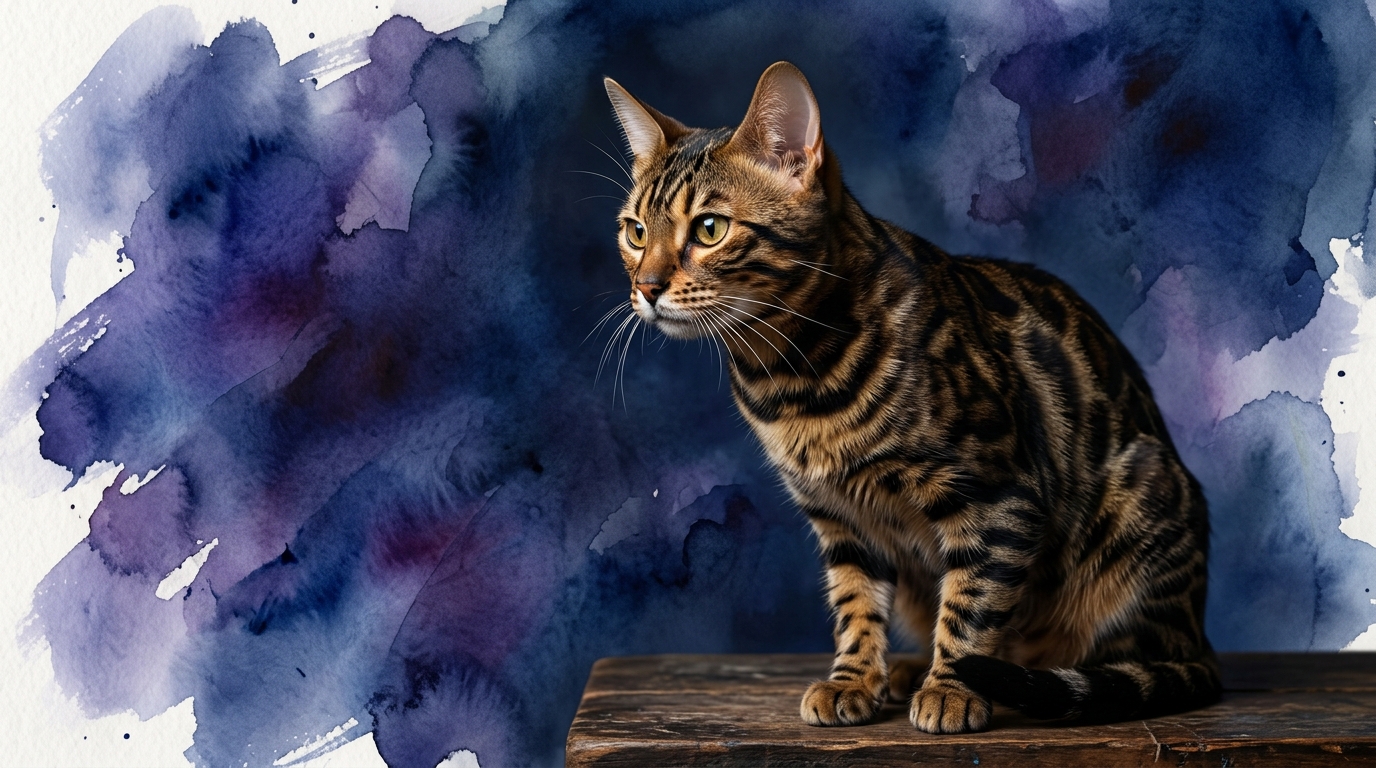
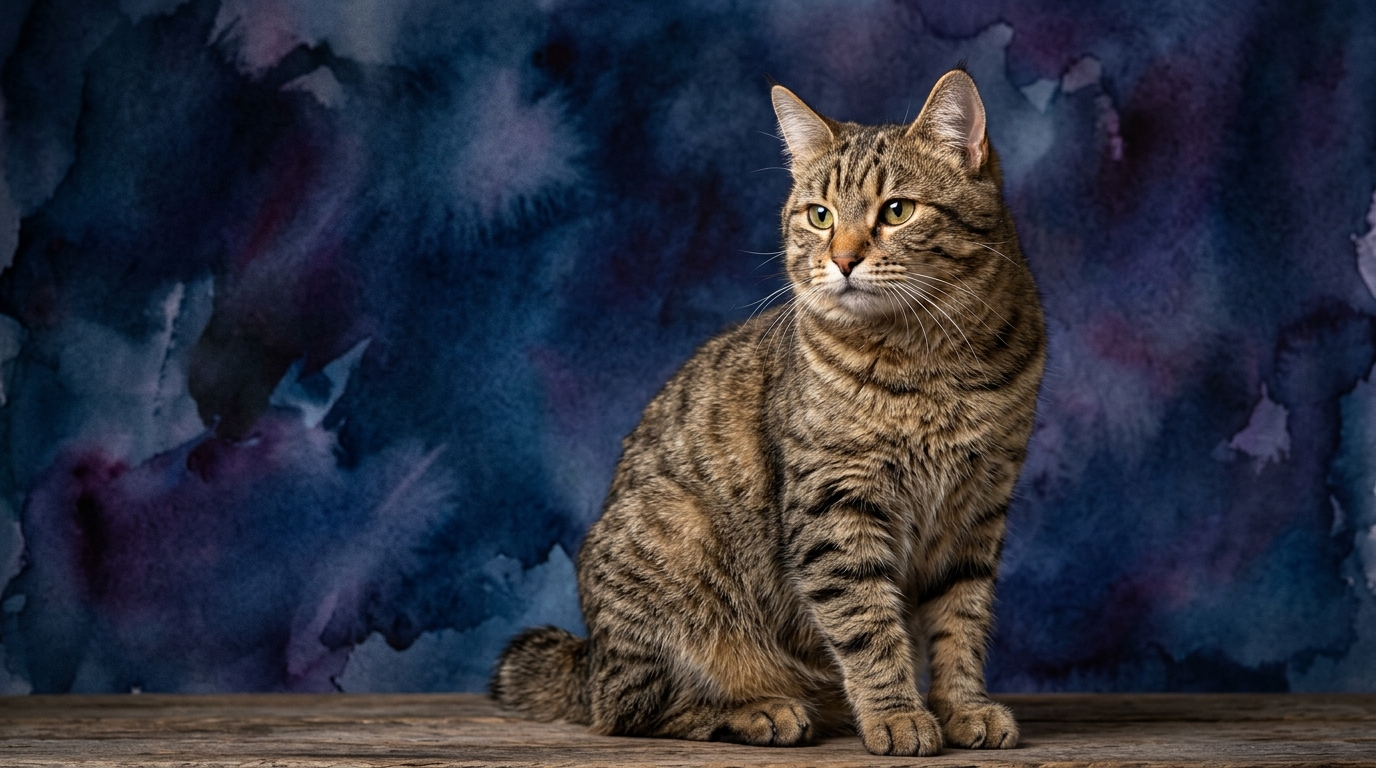
Side-by-Side IQ Profile: Bengal vs. Pixiebob
The Cosmic Pet Pet IQ Lab employs a five-dimensional framework to assess feline cognition, offering a granular view of each breed's mental strengths. For the Bengal, a breed known for its striking wild appearance, its cognitive scores paint a picture of a highly engaged and dynamic mind.
The Bengal’s IQ profile stands out with a Problem Solving score of 5/5, indicating master strategists who excel at complex puzzles, opening sophisticated latches, and devising methods to reach desired objects. Their Training Speed is rated 4/5, signifying rapid learners who pick up commands, leash training, and tricks with impressive efficiency. In Social Intelligence, they achieve a 4/5, forming deep, interactive bonds, often reading human emotions, and engaging in reciprocal play. Their Instinctive Drive is a formidable 5/5, reflecting powerful predatory instincts, intense focus on hunting-like play, exploration, and climbing. Finally, their Memory is exceptional at 5/5, demonstrating recall for routines, learned tasks, specific people, and object locations, even after long periods.
In contrast, the Pixiebob, often celebrated for its domestic, bobtailed charm, presents a more balanced and moderately paced cognitive profile.
The Pixiebob’s IQ scores are consistently 3/5 across all dimensions. Their Problem Solving score of 3/5 indicates they are capable of solving straightforward challenges, learning consistent routines, and navigating familiar environments effectively. For Training Speed, a 3/5 suggests they learn commands and behaviors at a steady, consistent pace with patient, positive reinforcement. Their Social Intelligence at 3/5 means they are affectionate and devoted to their family, showing warmth and enjoying companionship, though sometimes more reserved with new faces. An Instinctive Drive of 3/5 points to a moderate prey drive, enjoying interactive play sessions but without the intense, relentless focus seen in some breeds. Lastly, their Memory, also 3/5, ensures good recall for daily habits, family members, and basic learned cues, maintaining a stable understanding of their world.
Where the Bengal Wins Cognitively
A Bengal's cognitive profile, highlighted by its 5/5 scores in Problem Solving, Instinctive Drive, and Memory, presents a distinct advantage for owners seeking a cat that actively engages with and manipulates its environment. Their superior Problem Solving means they don't just react to their surroundings; they strategize, often figuring out multi-step puzzles, opening child-proof cabinets, or even learning to operate simple household mechanisms to achieve a goal. This cognitive depth allows them to continually seek and master new challenges, turning everyday objects into intricate games. Furthermore, their 5/5 Instinctive Drive fuels this exploratory nature, compelling them to investigate, stalk, and 'hunt' with remarkable focus and persistence, transforming mundane play into a highly engaging activity. This drive, combined with a 5/5 Memory, enables them to recall complex sequences of actions, remember where specific toys are hidden, and retain advanced training, making them adept at navigating intricate home layouts or remembering specific interactions with various family members over time. Their cognitive strength lies in their capacity for sustained mental effort and adaptation.
Where the Pixiebob Wins Cognitively
While the Pixiebob's cognitive scores are consistently at 3/5, this profile offers unique advantages, particularly for owners preferring a less intensely demanding feline companion. Its moderate Instinctive Drive (3/5) means a more measured approach to play and exploration; they enjoy chasing and interacting but are less likely to exhibit the relentless, high-energy predatory behaviors that can sometimes lead to household disruptions or excessive demands for stimulation. This moderated drive translates to a calmer presence, reducing the likelihood of them 'hunting' other pets or valuable household items with the same intensity as a Bengal. The Pixiebob's 3/5 in Problem Solving and Memory suggests a practical intelligence focused on routine and comfort rather than constant innovation or environmental manipulation. They are content with predictable challenges and familiar patterns, making them less prone to outsmarting owners for mischief like opening forbidden doors or accessing high shelves. Their cognitive strength lies in their balanced and manageable engagement with their world, providing a steady and affectionate companionship without the constant need for complex mental gymnastics.
Which is Easier to Train and Why
Evaluating trainability involves both the speed of learning and the manageability of the training process itself. The Bengal, with its 4/5 Training Speed, 5/5 Problem Solving, and 5/5 Memory, demonstrates an impressive capacity for rapid acquisition and retention of commands and tricks. They can be taught complex behaviors, excel at leash training, and even learn to play fetch with enthusiasm, understanding the purpose behind the tasks quickly. Their high problem-solving ability helps them grasp the 'why' of a command, making them quick studies. However, their formidable 5/5 Instinctive Drive can present a challenge; these cats are easily distracted by moving objects or prey-like stimuli, requiring highly engaging, focused, and often frequent training sessions to maintain attention.
For the Pixiebob, a 3/5 in Training Speed, Problem Solving, and Memory means learning occurs at a more measured pace. They respond well to consistent, positive reinforcement and thrive on routine. While they may not pick up new tricks as quickly as a Bengal, their moderate 3/5 Instinctive Drive means they are generally less distracted during training sessions. This can make the overall training experience feel less demanding for the owner, as the Pixiebob is less likely to constantly challenge boundaries or get sidetracked by environmental stimuli. Therefore, while a Bengal learns faster, a Pixiebob might offer a more straightforward, less intense training journey for an owner seeking steady progress without extreme mental exertion from their feline.
Which Suits Active Owners vs. Relaxed Owners
The choice between a Bengal and a Pixiebob significantly depends on an owner's lifestyle and their capacity for feline engagement. Owners with an active, hands-on approach will find the Bengal an ideal match. Their 5/5 Instinctive Drive, coupled with 5/5 Problem Solving and Memory, translates into a cat that thrives on constant mental and physical stimulation. They require daily interactive play sessions, challenging puzzle feeders, opportunities for climbing and exploration, and often enjoy leash walks or agility training. A Bengal left without sufficient enrichment can become bored, potentially leading to destructive behaviors as they invent their own 'puzzles' or 'hunts.'
For more relaxed owners, the Pixiebob's balanced cognitive profile, with all scores at 3/5, offers a much more adaptable companionship. They enjoy play and interaction but do not demand it with the same relentless intensity. A Pixiebob is often content with regular play sessions, ample lap time, and observing their environment from a comfortable perch. Their moderate drives mean they are less prone to creating their own high-energy entertainment if left alone for periods, making them a more predictable and generally calmer presence in the home. They appreciate affection and routine without the intense pressure for constant, complex engagement.
The Verdict
Choose a Bengal if you desire a highly interactive, challenge-seeking companion who can be taught complex behaviors and thrives on intense mental and physical engagement.
Opt for a Pixiebob if you seek a companionable, moderately playful cat that enjoys interaction but doesn't require constant, high-level stimulation, offering a more predictable and generally calmer presence.
🧠 Find Your Pet's IQ Score
Our Pet IQ Lab assessment covers 25+ tests across 5 cognitive dimensions — personalized to your breed.
Take the Full IQ Test →Frequently Asked Questions
Do Bengals need more mental stimulation than Pixiebobs?
Yes, Bengals have a 5/5 Problem Solving and Instinctive Drive, indicating a profound need for mental challenges and active engagement. Pixiebobs, with 3/5 in these areas, require less intense and complex stimulation.
Are Pixiebobs less prone to mischief due to their IQ scores?
Pixiebobs, with a 3/5 in Problem Solving, are generally less inclined to devise complex schemes to open cabinets or get into forbidden areas compared to Bengals (5/5 Problem Solving), potentially leading to less household mischief.
Can both breeds be leash trained?
Both breeds can be leash trained, but a Bengal's 4/5 Training Speed and 5/5 Memory mean they typically pick it up faster and with greater enthusiasm. A Pixiebob's 3/5 scores suggest a slower, more patient approach is needed for consistent results.