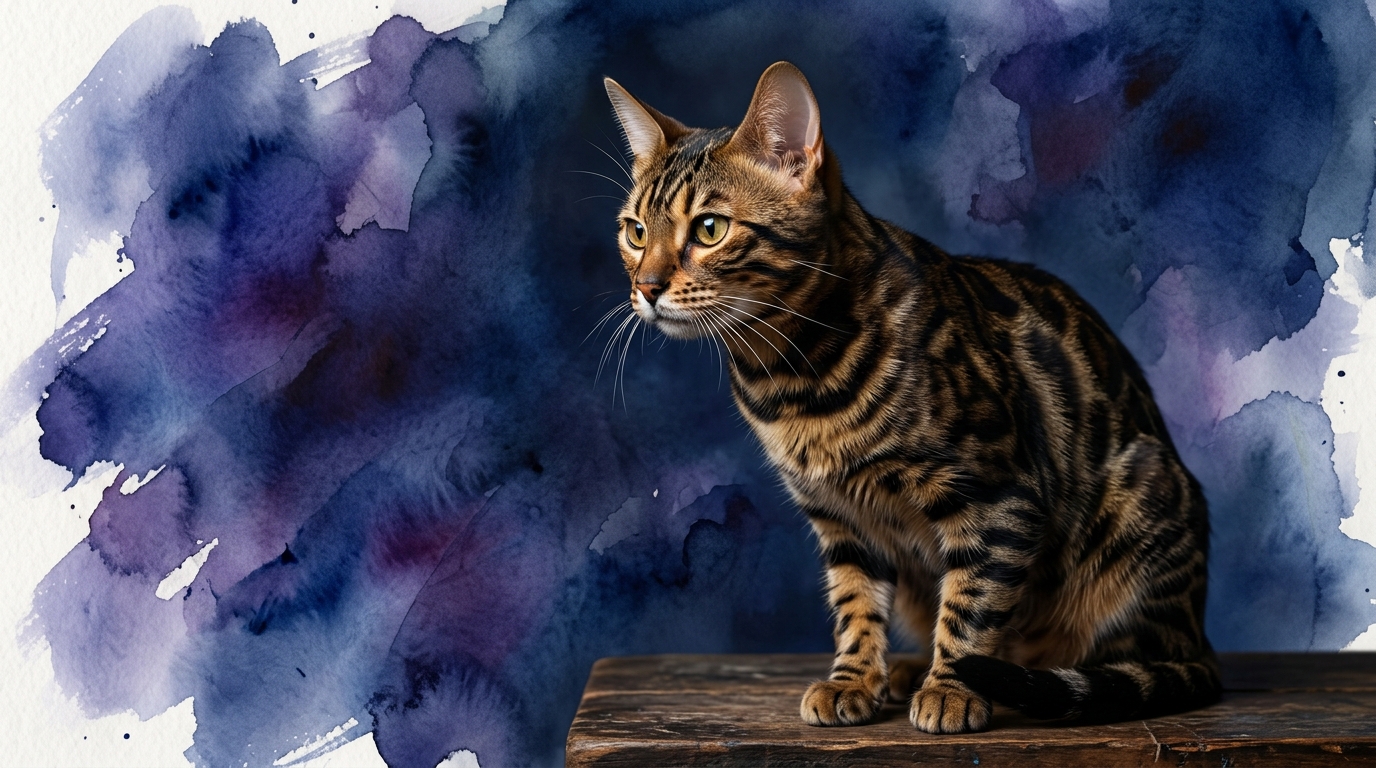
Bengal at a glance
| IQ Rank / Score | 23/25 |
|---|---|
| Trainability | ★★★★☆ (4/5) |
| Social Intelligence | ★★★★☆ (4/5) |
| Lifespan | 12-16 years |
| Shedding | Moderate to high |
| Exercise Needs | Needs active play (45-60 min/day) |
| Origin | USA |
The Bengal Brain: A Blueprint for Adventure
Hailing from the USA, the Bengal is a large, athletic cat whose lineage is evident in every move, and perhaps most profoundly, in its mind. Our Pet IQ Lab assessment reveals a fascinating profile: Problem Solving (5/5), Training Speed (4/5), Social Intelligence (4/5), Instinctive Drive (5/5), and Memory (5/5). These scores paint a picture of a highly capable and mentally active companion, one whose origins give it a unique edge in the domestic feline world.
Unlike many house cats, Bengals exhibit a striking blend of ancestral predatory instincts coupled with remarkable adaptability. Their cognitive abilities are not just about learning tricks; they're about understanding their environment deeply, navigating complex scenarios, and remembering intricate details. This combination makes engaging with a Bengal an exceptionally dynamic experience, often surprising owners with their cleverness and dedication.
Predatory Cognitive Mapping: The Wild Within
The cornerstone of Bengal intelligence lies in what we call 'predatory cognitive mapping.' This advanced spatial reasoning allows Bengals to plan multi-step routes to targets, using spatial memory in ways observed in big cats but rarely in domestic felines. Imagine a cheetah plotting the most efficient path through varied terrain to intercept prey; a Bengal often applies a similar, albeit miniaturized, thought process to navigating your home or yard.
This unique cognitive trait means a Bengal doesn't just 'stumble' upon a hidden toy or treat. Instead, they're actively creating a mental map, assessing obstacles, remembering previous successful routes, and formulating a strategy. This deep-seated instinct also manifests in their physical behaviors in surprising ways. Bengals are one of the only domestic cats documented to fish with their paws — a behavior directly inherited from the Asian Leopard Cat, which catches fish in shallow streams. This isn't just a physical act; it requires precise observation, anticipation, and a planned, multi-step approach to capture.
For an owner, this means your Bengal is constantly processing and analyzing its surroundings. They'll often seem to be 'thinking' a problem through, meticulously observing before acting. This isn't random exploration; it's a calculated engagement with their world, driven by their powerful ancestral software.
Beyond Instinct: Problem Solving and Training Acumen
While their instinctive drive is paramount, Bengals couple this with exceptional problem-solving abilities. A 5/5 score here isn't given lightly; it reflects a capacity to overcome novel obstacles, learn cause-and-effect relationships quickly, and adapt strategies when initial attempts fail. Whether it's figuring out how to open a cupboard, manipulate a tricky toy, or even unlatch a door, Bengals approach such challenges with focused determination.
Their training speed, rated at 4/5, further underscores their cognitive flexibility. Bengals are often receptive to learning commands, tricks, and even leash training, responding well to positive reinforcement and consistent methods. Their ability to quickly associate actions with rewards, coupled with their robust memory, makes them highly trainable companions for those willing to invest the time. This debunks the misconception that their 'wild' lineage makes them untrainable; in fact, it often fuels their eagerness to learn and engage.
Social Smarts and Unforgettable Memory
A Bengal's social intelligence, scored at 4/5, indicates a nuanced understanding of their human companions and other pets. They often form strong bonds, recognizing individual family members and adapting their interactions accordingly. While they might not be universally lap cats, they exhibit clear preferences and communicate their needs effectively, understanding routines and responding to emotional cues.
Perhaps most impressive is their perfect 5/5 memory score. This isn't just about remembering where the food bowl is; it extends to recalling complex sequences, faces, and even negative experiences. This formidable memory plays a critical role in their predatory cognitive mapping, allowing them to refine their strategies over time and learn from every interaction and exploration. For owners, this means consistency in training and routines is especially effective, as a Bengal will remember what you teach them.
Applying Bengal Intelligence at Home
Understanding your Bengal's unique cognitive strengths opens up a world of possibilities for enrichment and bonding. Providing opportunities that challenge their problem-solving skills and engage their predatory cognitive mapping will keep them mentally stimulated and happy. Interactive toys, supervised outdoor time, and puzzle feeders are excellent starting points. By offering outlets for their natural intellect, you're not just entertaining them; you're fulfilling their inherent need to explore, plan, and 'think' like the capable felines they are.
3 At-Home Tests to Measure Your Bengal's IQ
These tests are adapted from peer-reviewed ethology research. No equipment is needed beyond items you have at home. Run each test 5–10 times for reliable results.
The Myth: "Wild hybrid cats like Bengals are dangerous and untrainable."
✅ While Bengals possess strong instincts, they are domestic cats, selectively bred for temperament and companionability since their origin in the USA. They are not dangerous in the way a wild animal would be, and their high intelligence and training speed mean they respond very well to consistent, positive reinforcement training, proving to be adaptable and engaging family members.
Bengal vs. Similar Breeds
🧠 What's Your Cat's IQ Score?
Our full Pet IQ Lab assessment includes 12+ tests across 5 cognitive dimensions, calibrated for Bengals specifically.
Take the Full IQ Test →Frequently Asked Questions
How smart is a Bengal?
Our Pet IQ Lab framework scores cognition across five dimensions (max 25). The Bengal totals 23/25 — exceptionally high for a domestic cat. The full article breaks down each dimension with at-home tests.
Are Bengals easy to train?
Bengals are generally easy to train when you use consistent, reward-based sessions. They score 4/5 on Training Speed in our breed profile.
Are Bengals good with children and other pets?
Yes — their Social Intelligence rates 4/5 in our Pet IQ Lab framework. With early socialization and supervised play, most Bengals integrate well into families with respectful children and other pets.
Do Bengals need a lot of mental stimulation?
Absolutely. With Problem Solving 5/5 and Instinctive Drive 5/5, Bengals need daily mental work — puzzle feeders, scent games, training sessions, or interactive wand toys — to avoid boredom.
How much exercise does a Bengal need?
Bengals need active engagement. Plan for 45-60 minutes of play and climbing per day, plus mental stimulation.
How good is a Bengal's memory?
Bengals score 5/5 on memory. They remember routines, hiding spots, and learned cues for months, sometimes years.
What is the typical lifespan of a Bengal?
Most Bengals live 12-16 years with good veterinary care, quality diet, and indoor living.
The Bengal cat stands as a testament to the fascinating complexity of feline intelligence, offering a blend of ancestral wisdom and remarkable adaptability. By understanding their unique cognitive mapping and problem-solving abilities, owners can unlock a truly extraordinary bond with these captivating creatures.