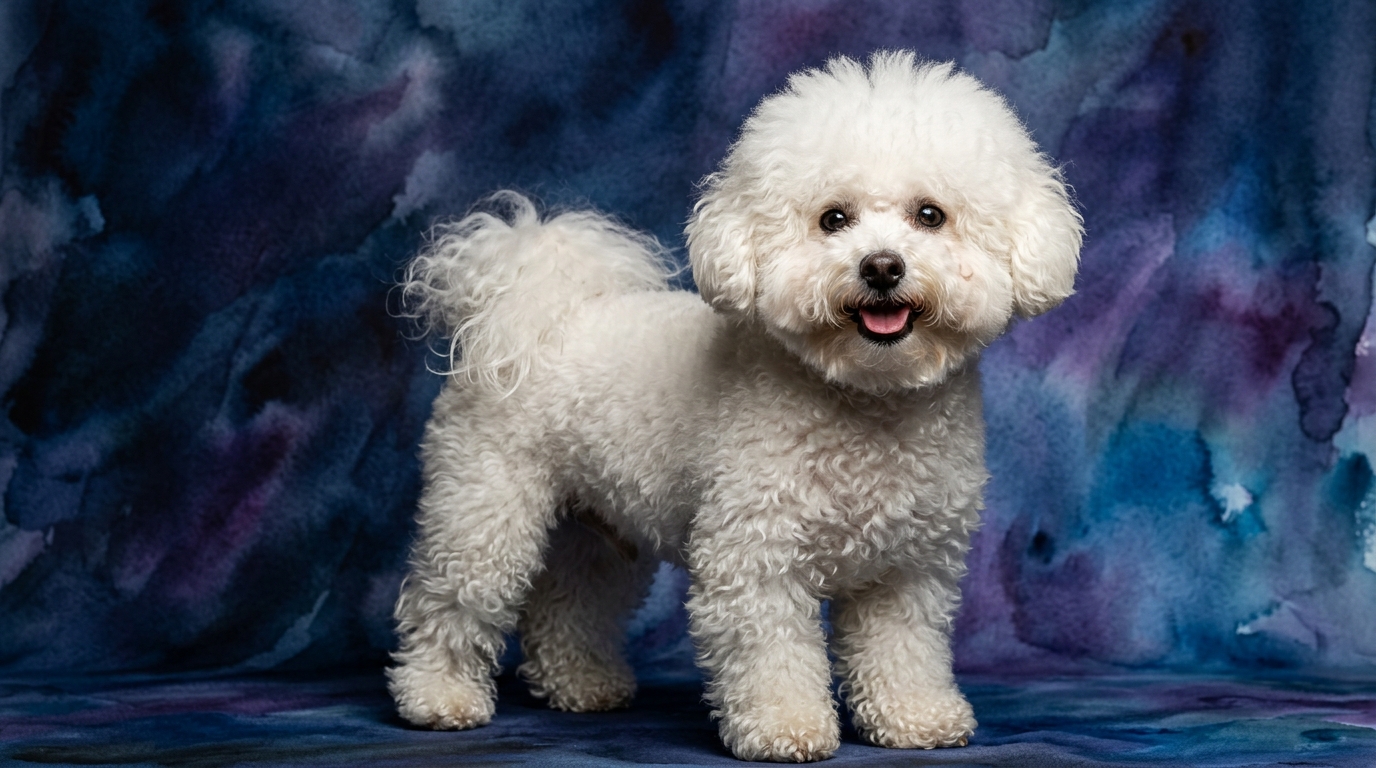

Side-by-Side Cognitive Profiles: Bichon Frisé vs. English Toy Spaniel
The Bichon Frisé, a member of the Non-Sporting Group and ranked #45 by Coren, presents a profile marked by exceptional social acumen. Its Problem Solving is rated 3/5, indicating an average capacity for navigating moderately complex tasks, often relying on charming persistence to achieve goals like accessing treats or favored toys. Training Speed also sits at 3/5, suggesting they are responsive to consistent, positive reinforcement, picking up new commands at a steady pace. A significant differentiator is their Social Intelligence, scoring a remarkable 5/5, which signifies an outstanding ability to read and respond to human emotions and social cues. Their Instinctive Drive is lower at 2/5, meaning their motivations are primarily centered around companionship rather than traditional work, and their Memory is 3/5, allowing for average recall of routines and experiences.
The English Toy Spaniel, a delightful Toy breed not included in Coren's rankings, shares several cognitive similarities with the Bichon. Its Problem Solving is also 3/5, demonstrating a moderate aptitude for figuring out puzzles or overcoming minor obstacles, often through observation and trial-and-error. Similarly, its Training Speed is 3/5, indicating it learns new commands at an average pace, responding best to gentle and consistent methods. The English Toy Spaniel's Social Intelligence is rated 3/5, showing a solid understanding of basic social cues and an ability to form strong bonds, though perhaps with less nuance than the Bichon. Its Instinctive Drive is slightly higher at 3/5, suggesting a moderate inherent curiosity for exploring scents or engaging in self-directed play, and its Memory is 3/5, allowing for average retention of learned behaviors and daily patterns.
Where the Bichon Frisé Excels Cognitively
The Bichon Frisé's undisputed cognitive strength lies in its exceptional Social Intelligence, scoring a perfect 5 out of 5. This translates into a profound ability to interpret and react to human emotional states with remarkable accuracy. A Bichon doesn't just observe; it actively processes subtle shifts in tone, body language, and even facial expressions, often adjusting its own demeanor to offer comfort or elicit joy. For instance, if an owner is feeling sad, a Bichon might instinctively offer a gentle nudge or curl up close, demonstrating a deep empathetic connection that transcends mere learned behavior. This heightened social awareness makes them incredibly intuitive companions, capable of forming extraordinarily rich and responsive bonds with their families, effectively becoming an emotional barometer for the household.
Where the English Toy Spaniel Shows a Unique Edge
While both breeds share identical Problem Solving, Training Speed, and Memory scores, the English Toy Spaniel edges out the Bichon Frisé in Instinctive Drive, scoring a 3/5 compared to the Bichon's 2/5. This subtle difference suggests the English Toy Spaniel may possess a slightly more pronounced innate curiosity or a greater inclination towards exploring its environment through scent and gentle investigation. This isn't to say they are driven hunters, but rather that their curiosity might lead them to follow a scent trail in the garden with more focused interest or engage with a new toy with a touch more inherent exploratory zeal than a Bichon. This moderate drive can translate into a slightly more independent streak in certain situations, prompting them to investigate novel stimuli or engage in self-directed play with a bit more inherent motivation.
Training Dynamics: Which Breed Learns with Greater Ease?
On paper, both the Bichon Frisé and the English Toy Spaniel share a Training Speed score of 3/5, suggesting they learn new commands at a similar, average pace. However, the Bichon Frisé's superior Social Intelligence (5/5 vs. 3/5 for the English Toy Spaniel) often gives it an advantage in practical training scenarios. A Bichon's keen ability to interpret human intentions and a strong desire to maintain social harmony means they are typically more motivated by praise and connection with their handler. They actively seek to understand what is expected of them and derive immense satisfaction from pleasing their human companions, making them highly responsive to positive reinforcement.
This high social attunement means Bichons are often more forgiving of handler errors and quicker to re-engage, making the overall training experience feel smoother and more collaborative. While the English Toy Spaniel is also receptive to training, its comparatively lower social intelligence might mean it's slightly less driven by the nuances of human approval, potentially requiring a bit more explicit motivation or repetition to achieve the same level of consistent responsiveness. Both will benefit from positive, patient methods, but the Bichon's social drive can make the process feel more intuitive for both dog and owner.
Matching Breeds to Lifestyles: Active vs. Relaxed Owners
Neither the Bichon Frisé nor the English Toy Spaniel are breeds suited for owners seeking a high-octane adventure partner; both are primarily companion dogs thriving in a domestic setting. However, their cognitive profiles offer subtle distinctions for activity levels. The Bichon Frisé, with its lower Instinctive Drive (2/5) and exceptionally high Social Intelligence (5/5), thrives on interactive companionship and moderate, playful engagement. They enjoy short walks, games of fetch in the living room, and being an active participant in family life, but their energy is largely directed towards social interaction rather than exploring vast territories or engaging in strenuous physical tasks. They are ideal for owners who enjoy consistent, gentle play and intellectual stimulation through social bonding.
The English Toy Spaniel, while also a calm companion, possesses a slightly higher Instinctive Drive (3/5) and a more moderate Social Intelligence (3/5). This means they might appreciate a bit more structured exploration during walks, perhaps enjoying sniffing out new scents or a gentle chase in a secure yard. They are content with a relaxed pace of life but may find slightly more personal fulfillment in mild, self-directed activities that tap into their innate curiosity. For a relaxed owner who enjoys gentle strolls and a dog that can entertain itself quietly with a toy for periods, the English Toy Spaniel's profile aligns well. For owners whose primary interaction is through constant, empathetic engagement and playful antics, the Bichon is a perfect fit.
The Verdict
Choose the Bichon Frisé if your ideal companion is a highly empathetic, socially intuitive dog that thrives on constant interaction and mirrors your emotions, making every moment a shared experience.
Opt for the English Toy Spaniel if you appreciate a gentle, adaptable companion with a moderate independent streak, content with a relaxed pace and a subtle, inherent curiosity for its immediate world.
🧠 Find Your Pet's IQ Score
Our Pet IQ Lab assessment covers 25+ tests across 5 cognitive dimensions — personalized to your breed.
Take the Full IQ Test →Frequently Asked Questions
Are Bichon Frisé dogs difficult to house train?
Bichons have an average Training Speed (3/5), meaning they respond well to consistent, positive house-training methods, but require patience. Their strong desire to please and high social intelligence can aid in the process, as they are attuned to their owner's expectations.
Do English Toy Spaniels need a lot of mental stimulation?
English Toy Spaniels have average scores across most cognitive dimensions, suggesting they benefit from moderate mental stimulation. Interactive toys, short training sessions, and gentle exploration on walks are typically sufficient to keep them content.
Which breed is better with children, based on their IQ?
The Bichon Frisé's exceptional Social Intelligence (5/5) makes them highly adaptable and intuitive with family members, including children, as they can readily interpret social cues. The English Toy Spaniel (3/5 Social Intelligence) is also good but may not possess the same level of nuanced empathetic response.