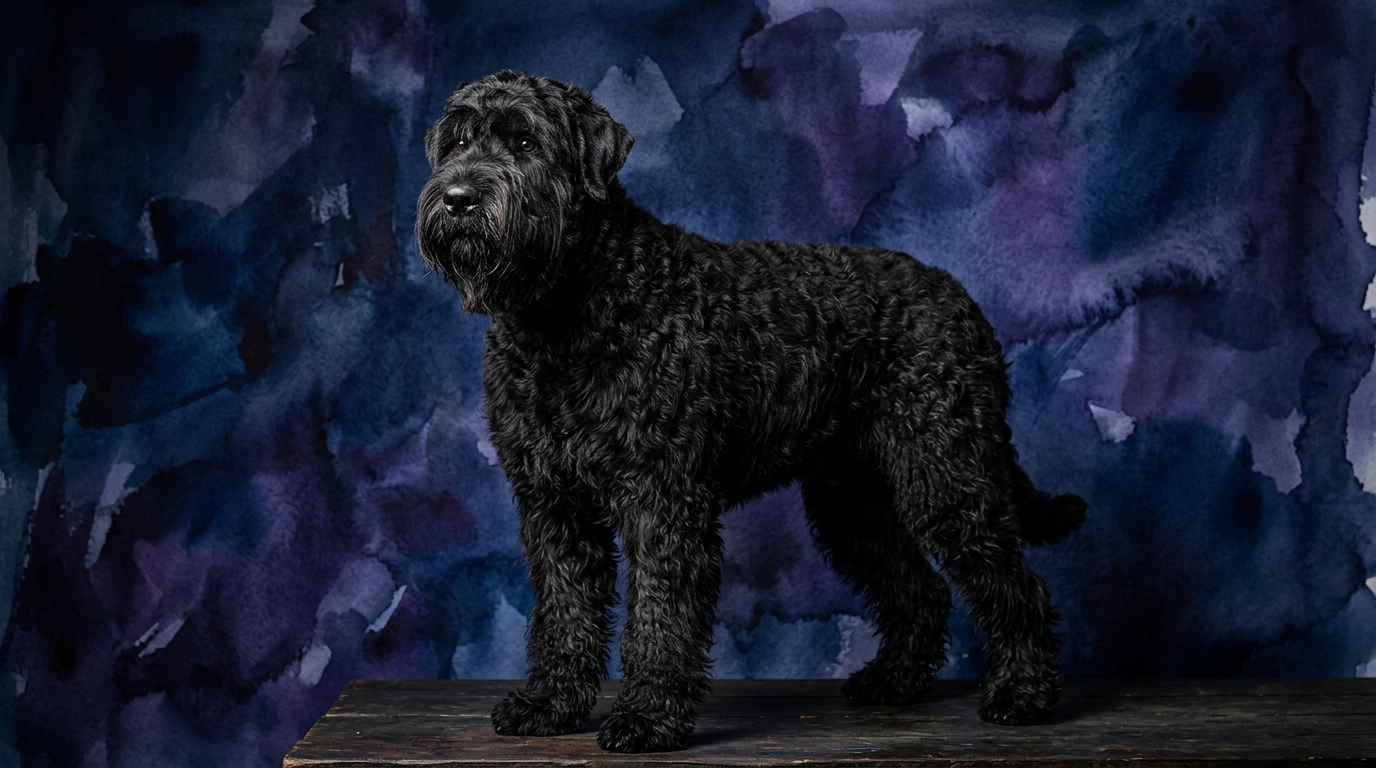

Side-by-Side IQ Profile: Deconstructing Identical Scores
At first glance, the Black Russian Terrier (BRT) and the Rhodesian Ridgeback (RR) present a curious case of cognitive parity in our Pet IQ Lab. Both breeds register a consistent 3 out of 5 across all five measured dimensions: Problem Solving, Training Speed, Social Intelligence, Instinctive Drive, and Memory. This uniform scoring suggests a balanced, capable intellect, but the devil, as they say, is in the details of their application and evolutionary purpose.
The Black Russian Terrier, a product of Soviet military breeding, falls under the Working Group. Our 'Not Coren-ranked' designation for the BRT simply means they haven't been extensively evaluated in the same standardized obedience trials as many other breeds, rather than indicating a lack of capacity. For the BRT, a 3/5 in Problem Solving implies an ability to navigate complex situations, particularly those related to guarding and protection, often requiring independent decision-making. Their 3/5 Training Speed indicates a moderate pace for acquiring new commands, coupled with a strong will that necessitates consistent, clear instruction. Social Intelligence at 3/5 suggests they are adept at reading their immediate family group and potential threats, but are not inherently universally gregarious. Their Instinctive Drive, also 3/5, is powerfully channeled towards protection and territorial defense. Finally, a 3/5 Memory means they retain learned behaviors and social hierarchies effectively over time.
The Rhodesian Ridgeback, a member of the Hound Group, carries a respectable Coren rank of #52, placing them in the average category for obedience and working intelligence. Their 3/5 in Problem Solving reflects an aptitude for navigating challenges in the field, such as tracking prey or finding optimal paths. The 3/5 Training Speed indicates they can learn efficiently, though their independent hound nature might require creative motivation. Social Intelligence at 3/5 means they form strong bonds with their families and can understand social cues, but might be reserved with strangers. Their 3/5 Instinctive Drive is predominantly focused on prey drive, scent work, and endurance, stemming from their history as lion hunters. A 3/5 Memory ensures they recall hunting strategies, commands, and their environment effectively.
Where the Black Russian Terrier Excels Cognitively
Despite the identical numerical scores, the Black Russian Terrier's cognitive strengths lean into their foundational purpose: robust protection and unwavering loyalty to their specific human unit. Their 3/5 Problem Solving manifests as a discerning ability to assess potential threats and react appropriately, often requiring them to make nuanced judgments in ambiguous situations without direct handler commands. This isn't just about aggression; it's about evaluating intent and demonstrating controlled, measured responses to perceived dangers, which requires a specific form of cognitive processing for risk assessment.
The BRT's 3/5 Instinctive Drive, while numerically matching the Ridgeback's, is distinctly oriented towards territoriality and guarding. This translates to a profound awareness of their environment and the individuals within it, allowing them to remember specific routines of people and objects with a protective lens. Their 3/5 Social Intelligence is highly tuned to their family, enabling them to pick up on subtle cues from their primary handlers and respond with an almost intuitive understanding of their needs, especially in a protective context. This makes their memory particularly strong for established rules and boundaries within their domain.
Where the Rhodesian Ridgeback Shows Cognitive Edge
The Rhodesian Ridgeback's cognitive prowess, while also scoring 3/5 across the board, shines in areas reflecting their heritage as a tracking and hunting companion. Their 3/5 Problem Solving skills are particularly adept at navigating complex terrain, identifying scent trails, and strategizing to outmaneuver prey, often requiring sustained focus and independent decision-making over long distances. This type of problem-solving is less about static guarding and more about dynamic pursuit and environmental interpretation.
The Ridgeback’s 3/5 Instinctive Drive is profoundly linked to their prey drive and exceptional olfactory capabilities, which translates into a cognitive advantage in scent discrimination and endurance. They possess a remarkable capacity to filter out irrelevant stimuli to focus on a particular scent, a complex cognitive task. Their Coren rank of #52, while not top-tier, indicates a solid capacity for understanding and executing commands in varied environments, suggesting their 3/5 Training Speed is effective when leveraged with their inherent drive. Their 3/5 Memory is particularly effective for recalling intricate landscapes and the location of specific scents, crucial for their hunting roles.
Which is Easier to Train and Why
When considering trainability, the identical 3/5 Training Speed scores for both breeds belie significant differences in their underlying behavioral drivers. The Black Russian Terrier, with its powerful protective instincts and strong-willed nature, often thrives on a clear, consistent, and confident leader. Training a BRT involves establishing a strong hierarchical bond and leveraging their innate desire to please their primary handler within a structured framework. While they learn commands at a moderate pace, the challenge lies in proofing these commands against their natural guarding instincts, which can make them less pliable in novel or distracting environments if not properly socialized and trained from an early age. Their social intelligence, focused on their inner circle, makes them very responsive to their family's expectations, but less inclined to follow commands from strangers.
The Rhodesian Ridgeback also possesses a strong will and an independent streak, characteristic of many hounds. Their 3/5 Training Speed means they are capable of learning, but their strong prey drive and keen sense of smell can be significant distractions. Training an RR often requires more patience, positive reinforcement, and creative engagement to overcome their tendency to follow their nose. While they are highly social and bond deeply with their families, their social intelligence can sometimes be used to 'negotiate' rather than simply comply, especially if a more enticing scent or visual stimulus presents itself. Recall can be a particular challenge for the Ridgeback due to their ingrained hunting drive, demanding consistent, high-value rewards and extensive practice in varied settings. Neither breed is 'easy' in the sense of being passively compliant; both require dedicated, knowledgeable owners who understand their distinct motivations.
Which Suits Active Owners vs. Relaxed Owners
Neither the Black Russian Terrier nor the Rhodesian Ridgeback are suitable for truly 'relaxed' or sedentary owners. Both breeds demand substantial physical exercise and, crucially, significant mental stimulation to prevent boredom and destructive behaviors. An owner who prefers minimal daily engagement beyond a short walk would find either breed overwhelming and potentially problematic. These are working breeds at heart, and their cognitive abilities need outlets.
For active owners, the choice hinges on the *type* of activity preferred. An owner who enjoys structured obedience, protection sports, long walks, and a dog that is a constant, watchful companion would align well with the Black Russian Terrier. The BRT thrives on having a 'job' and a clear routine, channeling their protective instincts into productive activities. Conversely, an owner who loves long-distance running, hiking, scent work, or activities that engage a dog's incredible stamina and tracking abilities would find the Rhodesian Ridgeback an excellent partner. The RR excels in endurance-based activities and problem-solving related to navigation and scent, thriving on adventures that stimulate their hound senses.
The Verdict
Choose the Black Russian Terrier if you seek a dedicated, discerning guardian and enjoy structured training that channels powerful protective instincts within a family-focused dynamic.
Opt for the Rhodesian Ridgeback if you are an active individual who values an independent, enduring companion for outdoor adventures and enjoys engaging their keen tracking and problem-solving abilities.
🧠 Find Your Pet's IQ Score
Our Pet IQ Lab assessment covers 25+ tests across 5 cognitive dimensions — personalized to your breed.
Take the Full IQ Test →Frequently Asked Questions
Do identical IQ scores mean these breeds are equally 'smart'?
Identical IQ scores of 3/5 in the Pet IQ Lab suggest both breeds possess a balanced, capable intellect across dimensions. However, their 'smartness' manifests differently based on their historical roles and inherent drives, meaning they excel in different cognitive applications rather than being identical in every aspect of intelligence.
Which breed is better for first-time dog owners?
Neither the Black Russian Terrier nor the Rhodesian Ridgeback is typically recommended for first-time dog owners. Both breeds possess strong wills, significant exercise requirements, and specific training needs that demand experienced handling and consistent commitment to proper socialization and leadership.
How does a Coren rank compare to the Pet IQ Lab scores?
Coren rank primarily measures obedience and working intelligence, reflecting how quickly a dog understands and executes commands. Pet IQ Lab scores offer a broader cognitive profile across five dimensions, including problem-solving, social intelligence, and instinctive drive, providing a more holistic view beyond just obedience performance.