
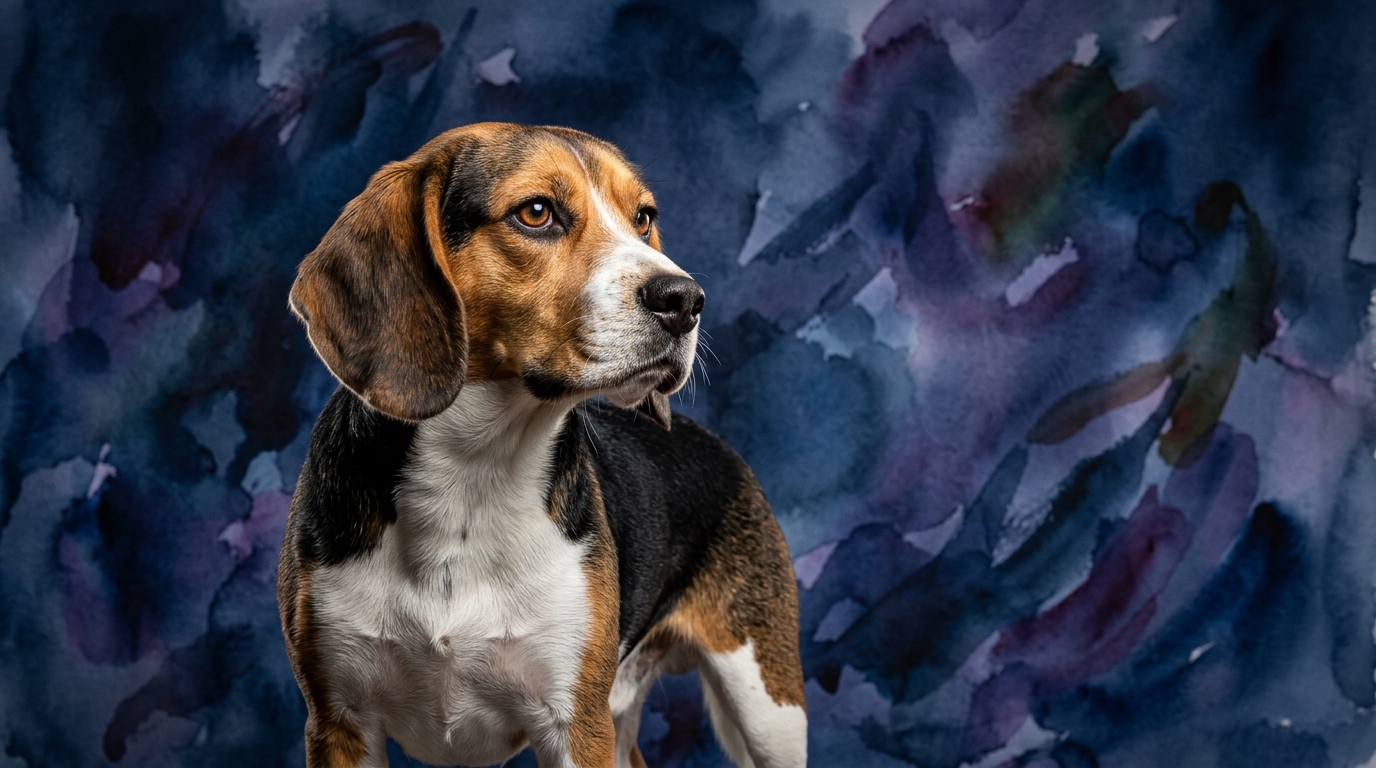
Side-by-Side Cognitive Profiles: Bloodhound vs. Beagle
The Cosmic Pet Pet IQ Lab utilizes five key dimensions to map a breed's cognitive architecture, providing a nuanced understanding of their intellectual aptitudes. For the Bloodhound, ranked #74 by Coren, its profile highlights an extreme specialization, while the Beagle, ranked slightly higher at #72, presents a more balanced yet still highly instinctive picture. Let's unpack these scores to understand what they mean for each breed.
Starting with Problem Solving, the Bloodhound earns a perfect 5/5, indicating an exceptional capacity to navigate complex scenarios and deduce solutions, particularly when scent-related. This reflects their unparalleled ability to follow the most intricate of trails, overcoming obstacles through sustained focus and analytical processing of olfactory information. The Beagle, with a respectable 4/5 in Problem Solving, also exhibits strong abilities to figure things out, especially in pursuit of a scent or a treat, though perhaps with less of the Bloodhound’s profound, single-minded dedication to a singular, challenging puzzle.
Training Speed presents a significant divergence. The Bloodhound scores 1/5, reflecting a considerable challenge in teaching new commands quickly or consistently. Their profound, intrinsic motivation is often tethered to their scent drive, making extrinsic motivators or general obedience exercises secondary to their natural calling. In contrast, the Beagle achieves a 2/5 for Training Speed, suggesting a slightly greater willingness to engage in structured learning, although they are far from being the easiest students due to their own strong independent nature and susceptibility to olfactory distractions.
Social Intelligence further differentiates these two hounds. The Bloodhound scores 2/5, indicating a generally lower inclination towards reading subtle human cues or prioritizing interpersonal harmony. While they form deep bonds with their families, their engagement with the broader social environment is often secondary to their sensory world. The Beagle, with a 3/5 in Social Intelligence, demonstrates a greater aptitude for group dynamics, understanding social structures, and interacting cooperatively with humans and other animals, contributing to their reputation as generally affable companions.
Both breeds share a top score of 5/5 for Instinctive Drive, which is unsurprising given their heritage as scent hounds. For the Bloodhound, this translates into an almost obsessive, unwavering pursuit of scent, an innate, powerful urge that dictates much of their behavior and cognitive focus. The Beagle's equally potent instinctive drive also revolves around scent, propelling them to explore and follow intriguing odors, often leading them to ignore human commands in favor of their nose. This shared high score underscores their deep-seated biological imperative to track.
Finally, Memory scores reveal another Bloodhound advantage. Earning a 5/5, the Bloodhound possesses an extraordinary capacity to recall specific scents, complex trail patterns, and the locations of various stimuli, which is crucial for their tracking precision. This allows them to effectively 'map' their environment through scent. The Beagle, with a 4/5 in Memory, also displays strong recall, particularly for rewarding experiences or familiar routines, though perhaps without the Bloodhound's encyclopedic recall for intricate scent details.
Where the Bloodhound Excels Cognitively
The Bloodhound’s intellectual strengths lie predominantly in areas directly supporting its primary function: tracking. Their 5/5 score in Problem Solving means they can dissect and interpret an olfactory puzzle with unmatched precision and endurance. Faced with a cold trail or complex scent environment, a Bloodhound can systematically work through the problem, filtering extraneous odors and tenaciously adhering to the target scent, a cognitive feat requiring intense focus and analytical processing. This problem-solving skill isn't about solving abstract puzzles, but rather navigating the intricate, ephemeral world of airborne and ground-based molecular information.
Their 5/5 Memory score further enhances this specialization. A Bloodhound can retain a vast library of individual scents and their associated contexts, allowing them to differentiate between countless odorous signatures and recall specific trails they've encountered, even after significant time has passed. This translates to an enduring capacity to 'remember' a person's unique smell, making them invaluable in search and rescue or law enforcement roles where past scent encounters are critical for success. This memory is highly associative, linking specific odors with outcomes or locations, a powerful tool in their sensory toolkit.
Where the Beagle Shines Cognitively
The Beagle’s cognitive advantages lean towards a more socially adaptable and somewhat more responsive intellect compared to the Bloodhound. Their 3/5 Social Intelligence score indicates a greater attunement to human emotional states and social cues. This means a Beagle is generally more inclined to seek out interaction, respond to attention, and engage in cooperative play, making them more amenable to integration into a diverse family unit. They can more readily pick up on household routines and the moods of their human companions, adapting their behavior accordingly.
Furthermore, the Beagle’s 2/5 Training Speed, while still modest, is comparatively superior to the Bloodhound's. This slightly faster processing and willingness to respond to instruction means that, with consistent, positive reinforcement, a Beagle can learn a broader range of commands and tricks with less repetition than a Bloodhound. Their cognitive processing allows for a quicker association between actions and rewards, making the training process, though still challenging due to their instinctive drive, generally more fluid and rewarding for the owner focused on general obedience rather than highly specialized work.
Training Dynamics: Bloodhound vs. Beagle
When considering ease of training, the differences between these two breeds are stark and directly linked to their IQ profiles. The Bloodhound’s 1/5 Training Speed signifies that teaching them basic obedience or new commands can be a protracted and often frustrating endeavor. Their exceptional Problem Solving and Memory are almost exclusively dedicated to their instinctive 5/5 Drive for scent, meaning their attention is very difficult to divert towards human-centric tasks. Owners frequently report that a Bloodhound, once on a scent, becomes virtually impervious to calls or commands, demonstrating a profound single-mindedness that overrides social cues.
The Beagle, with its 2/5 Training Speed, offers a somewhat less arduous training journey. While their 5/5 Instinctive Drive still means they can be easily distracted by compelling odors and possess an independent streak, their 3/5 Social Intelligence makes them more receptive to human interaction and the desire to please, at least when not overwhelmed by a scent. Beagles are often food-motivated, which can be leveraged in training, and they tend to form associations with rewards more readily than the highly specialized Bloodhound. However, managing their powerful nose and ensuring consistent recall requires persistent effort and creative strategies to make training engaging enough to compete with the allure of a captivating smell.
Family Pet Suitability: Active vs. Relaxed Owners
For active owners seeking a companion that aligns with their energetic lifestyle, both breeds offer engagement, but with different caveats. Active owners who are specifically interested in scent work, tracking sports, or can provide extensive, focused scent-based enrichment would find the Bloodhound a profoundly rewarding companion. Their immense stamina and unparalleled instinctive drive mean they thrive when given a 'job' that engages their primary cognitive strengths. However, for active owners whose activities are more generalized — like long runs or hikes without a scent-specific purpose — the Bloodhound's independent nature and lower social intelligence (2/5) might mean they don't engage in these activities in the same cooperative way, often preferring to follow their nose rather than human direction. They require an owner who understands and respects their profound need for independent olfactory exploration and can manage their stubbornness.
For more relaxed owners, or those seeking a companion for general family life and moderate activity, the Beagle generally presents a more adaptable option. Their 3/5 Social Intelligence means they are more naturally inclined to participate in family activities, enjoy companionship, and adapt to a household routine. While they still possess a powerful 5/5 Instinctive Drive and require daily exercise to prevent boredom and destructive behaviors, their energy levels are often more manageable than a Bloodhound’s, and their slightly faster training speed (2/5) means they can be molded into a more generally obedient pet with consistent effort. However, 'relaxed' does not mean 'sedentary' for a Beagle; they still require regular walks, playtime, and mental stimulation to keep their curious minds and active bodies content, but perhaps less specialized engagement than their larger tracking counterpart.
The Verdict: When to Choose Each Hound
The Verdict
Choose a Bloodhound if you are a dedicated, patient individual or family deeply invested in scent work, tracking, or search and rescue activities, and are prepared for a companion whose primary cognitive focus is olfactory exploration and problem-solving, even if it means a slower training process. You must be able to manage their profound single-mindedness and provide extensive, specialized outlets for their exceptional memory and instinctive drive.
Opt for a Beagle if you seek a generally affable and socially engaged family pet that is moderately easier to train and integrate into daily life, while still possessing a strong, curious instinctive drive that requires regular physical and mental enrichment. You should be prepared for a dog with an independent streak, easily distracted by scents, but one that ultimately thrives on companionship and consistent, positive guidance.
🧠 Find Your Pet's IQ Score
Our Pet IQ Lab assessment covers 25+ tests across 5 cognitive dimensions — personalized to your breed.
Take the Full IQ Test →Frequently Asked Questions
Why is the Bloodhound's Training Speed so low despite its high Problem Solving score?
The Bloodhound's problem-solving prowess is almost exclusively directed towards scent-related tasks, driven by its intense instinctive drive. General obedience or commands often don't provide the same profound intrinsic motivation, making them less inclined to quickly learn or consistently perform tasks that aren't tied to their primary genetic purpose.
Can a Beagle be trained for advanced scent work like a Bloodhound?
While Beagles possess a strong instinctive drive and excellent noses, they typically lack the Bloodhound's specialized 5/5 problem-solving and memory for intricate, cold trails. Beagles can excel in some scent sports or detection, but the endurance and methodical precision of a Bloodhound for complex, long-duration tracking remains unparalleled due to their specific cognitive architecture.
Which breed is better with children?
The Beagle, with its 3/5 Social Intelligence and generally more adaptable nature, often integrates more smoothly into family dynamics and is typically considered more tolerant and playful with children, assuming proper socialization and supervision. The Bloodhound, while typically gentle, may be less inclined to engage in typical child's play, preferring quiet companionship or solitary scent exploration over interactive games.