
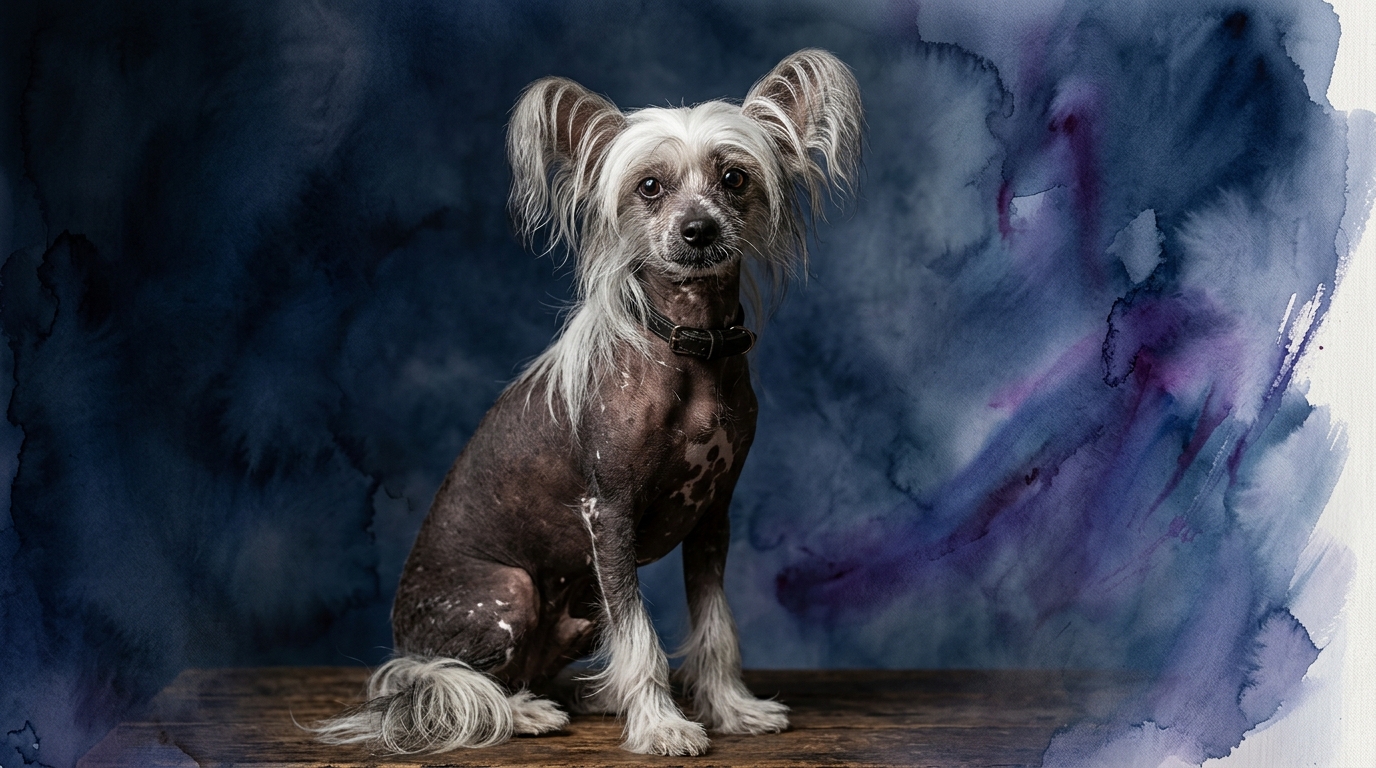
Side-by-Side IQ Profile: Bloodhound vs. Chinese Crested
The Bloodhound, a majestic hound breed, exhibits a cognitive profile deeply specialized for its historical purpose. Its Problem Solving ability scores a remarkable 5/5, indicating an exceptional capacity to navigate complex environmental puzzles, particularly those involving scent discrimination and trail following. This isn't about solving abstract puzzles, but rather an unparalleled ability to deconstruct and follow intricate scent pathways, often over vast distances and varied terrain. Complementing this is a perfect 5/5 in Instinctive Drive, which fuels their unwavering focus and persistence on a task once engaged, primarily their olfactory pursuits. Their Memory also rates a top-tier 5/5, reflecting an extraordinary ability to retain complex scent patterns and spatial information related to their investigative work. However, this specialized cognition comes with trade-offs: their Training Speed is a low 1/5, meaning they require extensive repetition and patience, often prioritizing their innate drives over human commands, and their Social Intelligence scores 2/5, suggesting a more independent nature, less attuned to subtle human emotional cues or social intricacies.
In stark contrast, the Chinese Crested, a delicate toy breed, presents a much more balanced and generalized cognitive blueprint. Across the board, this breed scores a consistent 3/5 in Problem Solving, Training Speed, Social Intelligence, Instinctive Drive, and Memory. A 3/5 in Problem Solving indicates a moderate capacity to learn routines, figure out simple manipulatives like treat puzzles, or adapt to new household scenarios with some guidance. Their 3/5 Training Speed suggests they are reasonably receptive to learning new commands, requiring a moderate number of repetitions to grasp concepts without being either lightning-fast or exceptionally slow. Similarly, their Social Intelligence at 3/5 means they are generally responsive to human interaction, capable of forming strong bonds and picking up on owner moods, though perhaps not with the profound empathy seen in some companion breeds. Their Instinctive Drive, also 3/5, is present but not overwhelming, typically manifesting as a general curiosity or a moderate desire for play, rather than a specialized, intense drive. Finally, a 3/5 in Memory signifies a good ability to recall learned behaviors, routines, and familiar faces, suitable for a companion animal's daily life.
Where the Bloodhound Excels Cognitively
The Bloodhound's cognitive superiority lies squarely within its highly specialized sensory processing and application. Their 5/5 Problem Solving isn't about abstract logic, but about an unparalleled ability to interpret and follow a scent trail, which is an intensely complex multi-variate problem. This involves differentiating between countless odors, filtering out distractions, and reconstructing a path over time. This skill is directly powered by their 5/5 Instinctive Drive, an unwavering, almost obsessive compulsion to pursue a scent, which allows them to overcome physical obstacles and fatigue that would deter most other breeds. Their 5/5 Memory is equally crucial, enabling them to recall intricate scent patterns and geographical markers from previous experiences, improving their tracking efficiency and accuracy. This combination makes them the undisputed champions of olfactory detective work, capable of feats of tracking that remain unmatched in the canine world, demonstrating a unique form of cognitive genius.
Where the Chinese Crested Shows Its Cognitive Strengths
The Chinese Crested's cognitive strengths lie in its adaptability and balanced social aptitude, especially when compared to the Bloodhound's specialized profile. Their 3/5 in Training Speed, while not exceptional, is significantly higher than the Bloodhound's 1/5, meaning they generally pick up new commands and routines with greater ease and fewer repetitions. This makes them more amenable to consistent behavioral shaping and learning a wider variety of household manners. Furthermore, their 3/5 Social Intelligence indicates a better capacity for nuanced interaction and responsiveness to human cues. They are typically more engaged with their owners, seeking connection and comfort, which translates into an easier integration into a family setting and a more harmonious co-existence where subtle communication is valued. While they don't possess the Bloodhound's singular drive, their moderate and adaptable cognitive scores make them well-suited for a versatile companion role, capable of learning a range of tasks and thriving on human companionship.
Trainability: Bloodhound vs. Chinese Crested
When it comes to trainability, the Chinese Crested generally presents a much smoother experience for the average owner due to its 3/5 Training Speed and 3/5 Social Intelligence. They are typically more eager to please and less distracted by intense innate drives, making them more responsive to positive reinforcement methods. A Chinese Crested is likely to learn basic commands like 'sit' or 'stay' in a moderate number of sessions, and generalize these commands to different environments with reasonable consistency. Their higher social intelligence means they are more likely to seek interaction and guidance from their handler, making the training process a cooperative effort.
Conversely, the Bloodhound's 1/5 Training Speed and 2/5 Social Intelligence present significant challenges. Their profound instinctive drive (5/5) often overrides any desire to comply with human commands, especially if a compelling scent is present. A Bloodhound might require hundreds of repetitions to reliably perform a basic command, and even then, their focus can easily be diverted by an olfactory stimulus. Their lower social intelligence means they are less motivated by social praise and more by their own internal drives, requiring immense patience, consistency, and a deep understanding of their unique motivations from their trainer. While capable of learning, their learning process is slow and often requires specialized techniques to harness their formidable instincts rather than suppress them.
Suitability for Active vs. Relaxed Owners
The Bloodhound's cognitive profile makes it an ideal, albeit demanding, match for active owners who understand and can cater to its intense needs. Owners who thrive on outdoor adventures, especially those involving long hikes, scent work, or even search-and-rescue training, will find the Bloodhound's 5/5 Instinctive Drive and Problem Solving to be an incredible asset. These dogs require substantial mental and physical engagement that taps into their tracking abilities; a simple walk around the block will not suffice for their cognitive satisfaction. Their lower social intelligence means they are generally content to work independently on a task, making them less demanding of constant interactive play, but demanding of purposeful activity.
The Chinese Crested, with its balanced 3/5 scores across all cognitive dimensions, is far better suited for relaxed owners seeking a devoted companion. Their moderate activity levels and adaptable nature mean they are happy with regular walks, indoor play, and plenty of cuddle time. Their higher social intelligence makes them excellent companions for those who enjoy a close, interactive bond with their pet, and they thrive on being part of the family's daily life. They are less likely to become destructive or anxious if their physical and mental stimulation isn't intensely specialized, making them a more forgiving and adaptable choice for individuals or families with a less rigorous schedule.
The Verdict
Choose the Bloodhound if you are an experienced, highly active owner dedicated to harnessing and directing an unparalleled scenting ability through consistent, patient training and specialized activities.
Opt for the Chinese Crested if you seek a balanced, adaptable, and moderately trainable companion dog that thrives on social interaction and a more relaxed, consistent home environment.
🧠 Find Your Pet's IQ Score
Our Pet IQ Lab assessment covers 25+ tests across 5 cognitive dimensions — personalized to your breed.
Take the Full IQ Test →Frequently Asked Questions
Do Bloodhounds make good family pets despite their low social intelligence score?
Bloodhounds can be affectionate and gentle family pets, especially with children, but their 2/5 social intelligence score suggests they might be more independent and less attuned to subtle family dynamics. They require owners who appreciate their distinct personality and understand their primary drive is scent, not constant human interaction, ensuring their specialized needs are met.
Are Chinese Cresteds prone to common 'toy breed' behavioral issues given their moderate instinctive drive?
While Chinese Cresteds have a moderate 3/5 instinctive drive, they are generally not prone to extreme behavioral issues often associated with under-stimulated toy breeds. Their balanced profile means they enjoy play and interaction but are not typically hyperactive, making them less likely to develop destructive habits if given adequate attention and moderate exercise.
How does the Bloodhound's 5/5 memory specifically benefit its tracking ability?
The Bloodhound's 5/5 memory allows it to retain intricate details of scent trails, including the aging of a scent, environmental factors affecting dispersion, and the spatial layout of previous tracks. This remarkable recall enables them to work more efficiently, recognize patterns in scent, and learn from past experiences to improve their current tracking performance, even on cold trails.