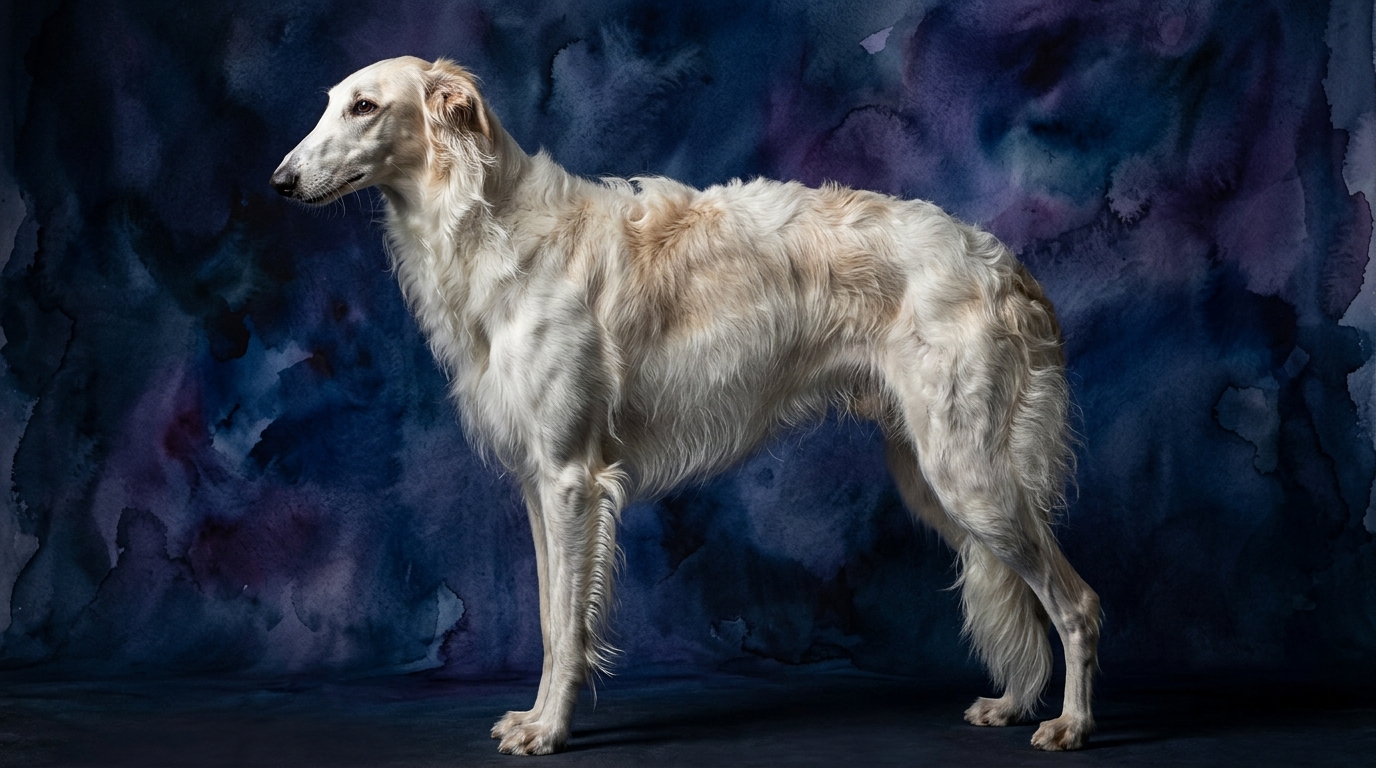

Side-by-Side IQ Profile: Borzoi vs. Chow Chow
The Cosmic Pet Pet IQ Lab assigns both the Borzoi and the Chow Chow a Coren rank of #75 and #76 respectively, and identical scores across five key cognitive dimensions. This fascinating alignment invites us to explore how these similar scores manifest uniquely in breeds with such distinct evolutionary paths and temperaments.
Problem Solving (3/5): For the Borzoi, this score suggests a capacity for effective navigation and strategy during a chase, quickly assessing terrain and target movement to optimize pursuit. Their problem-solving is often rooted in instinctual hunting scenarios, requiring rapid, independent decision-making in dynamic environments. The Chow Chow's 3/5 in problem-solving manifests differently, reflecting their ability to independently manage their territory and resources, often making nuanced judgments about perceived threats or changes in their environment without direct instruction. They might figure out complex household routines or access desired items through observation and persistence.
Training Speed (3/5): Both breeds demonstrate an average pace for acquiring new commands. For the Borzoi, learning often occurs quickly when tasks align with their natural drives or are made exceptionally rewarding, though their sighthound nature means compliance can be selective if a more compelling stimulus arises. The Chow Chow's identical score reflects their capacity to learn readily, but their independent temperament means their willingness to perform is largely contingent on understanding the command's purpose and respecting the trainer. Consistency and clear, respectful communication are vital for both, though their motivations for engagement differ.
Social Intelligence (3/5): A 3/5 social intelligence score for the Borzoi indicates an awareness of social cues within their trusted circle, showing responsiveness to their family's moods and intentions, though they often maintain a reserved demeanor with strangers. Their social interactions are typically polite and observant. The Chow Chow's identical score points to a keen understanding of their immediate family dynamics and boundaries, often exhibiting a subtle yet profound loyalty; however, their social aptitude outside this circle is characterized by aloofness and a strong sense of personal space, making them discerning in new introductions.
Instinctive Drive (3/5): This 3/5 score for the Borzoi primarily reflects their powerful prey drive, an innate impulse to pursue and capture moving objects, which is a fundamental aspect of their sighthound heritage. This drive is a core motivator and can influence their focus and behavior in various settings. For the Chow Chow, the 3/5 instinctive drive is largely expressed through their guarding and territorial instincts, a legacy of their roles as protectors. This manifests as a strong vigilance over their home and family, coupled with a natural self-sufficiency and a tendency to be wary of outsiders.
Memory (3/5): Both breeds exhibit a solid capacity for memory. The Borzoi's memory enables them to recall complex routes, specific commands, and the layout of familiar environments, aiding in their performance during pursuits or training sessions. They remember pleasant experiences and negative associations. The Chow Chow's 3/5 memory allows them to retain routines, boundaries, and the identities of family members and accepted visitors over long periods. Their memory contributes to their consistent behavior and their ability to anticipate household events, reinforcing their independent nature.
Where the Borzoi Wins Cognitively
The Borzoi’s cognitive strengths are deeply intertwined with their history as swift, independent hunters. Their ability to process visual information rapidly and make split-second decisions in pursuit of prey is a standout cognitive advantage. This translates into exceptional spatial reasoning and a remarkable capacity for navigating complex, open environments, quickly assessing distances and trajectories. Their problem-solving, while rated 3/5, is particularly refined in dynamic, fast-paced scenarios where quick, autonomous action is required, such as lure coursing where they must anticipate the movement of a mechanical lure. They excel at tasks requiring bursts of focused attention and agile mental shifts, demonstrating a unique sighthound intelligence that prioritizes swift, effective action over sustained, meticulous thought.
Where the Chow Chow Wins Cognitively
The Chow Chow’s cognitive advantages stem from their ancient role as a versatile working dog, often guarding and protecting without constant human direction. Their strength lies in discerning judgment and a profound understanding of social hierarchies and territorial boundaries. A Chow Chow’s 3/5 problem-solving is adept at assessing subtle environmental changes or potential threats, making independent decisions to protect their space or family. They exhibit a strong capacity for observation and learning through experience, often understanding household rules and routines implicitly without extensive formal training. Their memory contributes to their consistent application of these learned boundaries, making them reliable guardians who remember who belongs and who does not, demonstrating a quiet, self-assured cognitive prowess focused on stability and protection.
Which is Easier to Train and Why
Determining which breed is 'easier' to train is nuanced, given their identical 3/5 training speed. For the Borzoi, training can be swift for tasks that either appeal to their natural prey drive or are made incredibly rewarding. They are capable of learning a wide array of commands and tricks, but their sighthound independence means they might choose to prioritize a distant squirrel over a 'come' command if their motivation isn't higher. Effective Borzoi training requires making compliance more interesting and gratifying than environmental distractions, often through positive reinforcement and engaging, varied sessions that prevent boredom.
The Chow Chow, while also learning at a 3/5 pace, presents a different training challenge. Their self-sufficient and often aloof temperament means they aren't inherently driven by a strong desire to please. They will learn commands, but their execution depends heavily on respect for the trainer and their perception of the command's value. Training a Chow Chow demands immense patience, unwavering consistency, and a profound understanding of their independent nature. They often require clear, firm boundaries and a trainer who can motivate them without force, relying on mutual respect rather than eager obedience. Therefore, while both learn at a similar rate, the *approach* to training differs significantly: Borzoi need compelling motivation to overcome instinct, while Chow Chows need compelling reasons to comply with a request they might deem unnecessary.
Which Suits Active Owners vs. Relaxed Owners
When considering owner lifestyles, the Borzoi generally aligns better with active individuals or families who understand and can accommodate their specific exercise needs. Despite their calm indoor demeanor, Borzoi require regular, vigorous bursts of physical activity, ideally in a secure, large area where they can stretch their legs and satisfy their instinct to run. Owners who enjoy activities like lure coursing, long hikes, or providing ample, safe off-leash opportunities will find the Borzoi a rewarding companion. Their mental stimulation also benefits from activities that engage their sighthound senses.
In contrast, the Chow Chow is a more suitable match for relaxed owners who appreciate a dignified, less overtly demanding canine presence. While they certainly need daily walks and benefit from mental engagement, their exercise requirements are moderate compared to a Borzoi. They are content with a predictable routine and often prefer quiet observation from a comfortable spot. Owners who enjoy a serene home environment and value a dog’s independent spirit without requiring constant interaction or high-energy play will find the Chow Chow a harmonious fit. Their mental stimulation often comes from monitoring their territory and engaging in established household rhythms.
The Verdict
Choose the Borzoi if you are an active owner prepared to manage their strong prey drive and provide ample, safe opportunities for them to run, appreciating a graceful yet independent companion who forms deep, albeit reserved, bonds.
Opt for the Chow Chow if you seek a dignified, self-possessed companion who thrives on routine and clear boundaries, valuing a dog with a strong protective instinct and a less overtly demonstrative but profoundly loyal disposition.
🧠 Find Your Pet's IQ Score
Our Pet IQ Lab assessment covers 25+ tests across 5 cognitive dimensions — personalized to your breed.
Take the Full IQ Test →Frequently Asked Questions
Do Borzoi and Chow Chow learn commands at the same rate?
According to The Cosmic Pet Pet IQ Lab, both Borzoi and Chow Chow have a Training Speed score of 3/5, suggesting they learn new commands at a similar average pace. However, the *ease* of training can differ due to their distinct temperaments; Borzoi need compelling motivation to overcome their prey drive, while Chow Chows require respect and a perceived purpose to comply.
How do their social intelligence scores translate to family life?
Both breeds score 3/5 in Social Intelligence, meaning they are attuned to their immediate family's dynamics. Borzoi are generally polite and observant within their trusted circle, though reserved with strangers. Chow Chows show deep loyalty to their family but are notably aloof and discerning with outsiders, valuing personal space and clear boundaries.
Which breed is more prone to independent decision-making?
Both breeds exhibit a significant degree of independent decision-making, reflected in their 3/5 Problem Solving and Instinctive Drive scores. The Borzoi's independence often manifests in rapid, autonomous choices during pursuit, while the Chow Chow's independence is rooted in their self-sufficient guarding instincts and discerning judgment over their territory and family.