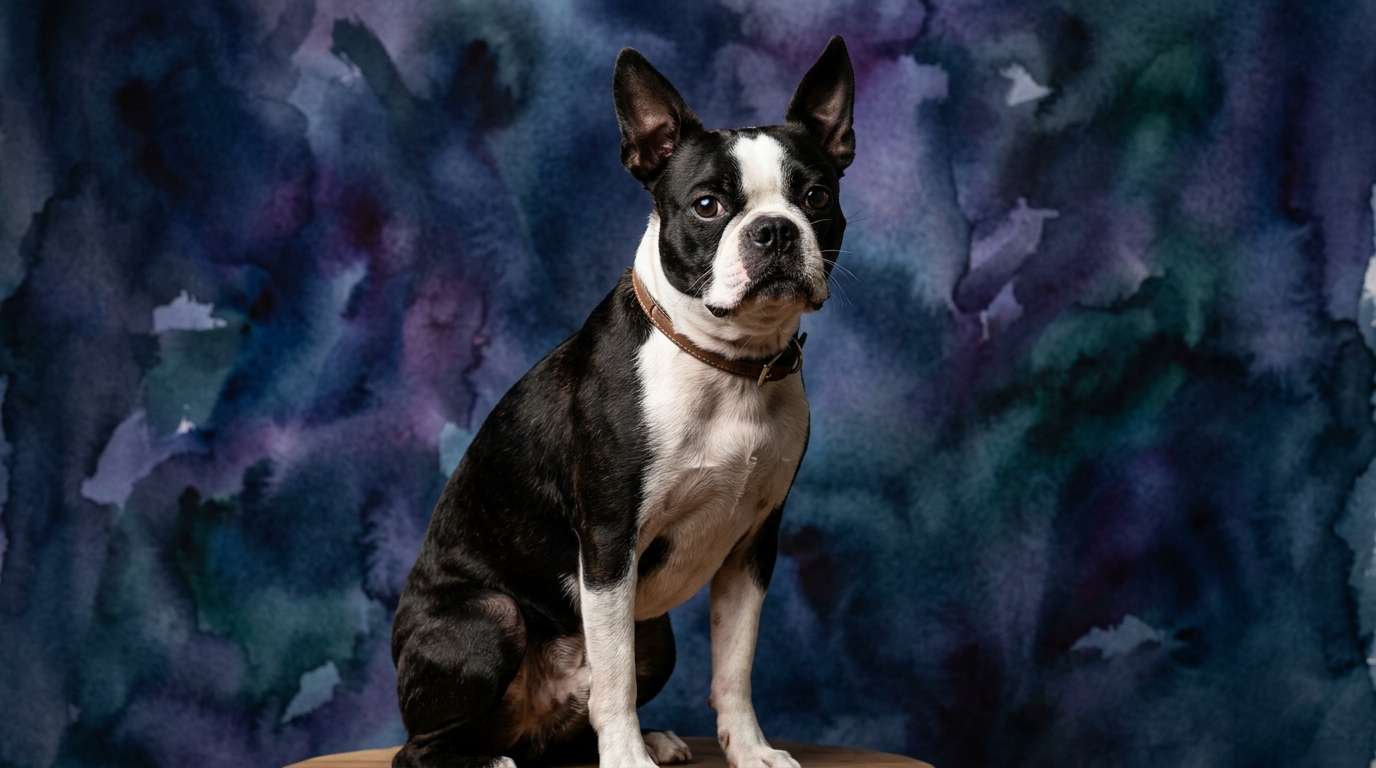

Side-by-Side IQ Profile: Boston Terrier vs. Rat Terrier
**Boston Terrier (Non-Sporting Group, Coren Rank #54)**: This 'American Gentleman' possesses a nuanced cognitive makeup. Their **Problem Solving (3/5)** capacity is moderate, allowing them to navigate common household challenges and understand basic cause-and-effect, often by observing and learning through repetition rather than devising complex, novel strategies. In terms of **Training Speed (3/5)**, Boston Terriers acquire new commands at a moderate pace, requiring consistent, positive reinforcement to solidify learning, yet they are attentive and generally eager to engage with their handlers. Their **Social Intelligence (4/5)** is a significant strength, showcasing a high degree of understanding and responsiveness to human emotions and subtle cues, making them remarkably empathetic and attuned companions. With a **Instinctive Drive (2/5)** that is lower, they are less compelled by primal urges like hunting or intense territoriality, making them more focused on companionship. Finally, their **Memory (3/5)** is moderate, enabling them to retain learned routines, commands, and experiences over a reasonable period with consistent reinforcement.
**Rat Terrier (Terrier Group, Not Coren-ranked)**: Hailing from a working background, the Rat Terrier exhibits a balanced and determined cognitive profile. Their **Problem Solving (3/5)** ability is moderate, often driven by curiosity and persistence to figure out how to access desired items or navigate obstacles, demonstrating a practical, goal-oriented approach. Regarding **Training Speed (3/5)**, Rat Terriers learn at a moderate pace, similar to the Boston Terrier, benefiting from engaging and varied sessions that cater to their active minds and prevent boredom, effectively building a diverse skill set. Their **Social Intelligence (3/5)** is moderate; they form strong bonds and understand family dynamics, but may not exhibit the same nuanced empathy or constant attunement to human emotional states as their Boston counterparts. A **Instinctive Drive (3/5)** that is moderate reflects their heritage, manifesting as a natural inclination for chasing, exploring, and digging, which requires appropriate outlets and management. Their **Memory (3/5)** is also moderate, supporting their capacity for learning complex sequences and recalling training, especially when linked to rewarding outcomes in various dog sports and working tasks.
Where the Boston Terrier Wins Cognitively
The Boston Terrier’s most pronounced cognitive advantage lies in its superior social intelligence (4/5 compared to the Rat Terrier’s 3/5). This means they are often more adept at interpreting human body language, vocal tones, and emotional states, making them highly responsive and emotionally intuitive companions. A Boston Terrier is more inclined to offer comfort or adjust its behavior based on a subtle shift in its human's mood, fostering a remarkably deep and empathetic bond. Additionally, their lower instinctive drive (2/5 versus the Rat Terrier's 3/5) provides a cognitive benefit within a domestic environment, leading to fewer distractions from primal urges like tracking scents or chasing small animals. This allows them to remain more consistently engaged in human-centric activities and interactions, making them less prone to independent, instinct-driven pursuits.
Where the Rat Terrier Wins Cognitively
The Rat Terrier's cognitive strengths are rooted in its balanced, slightly more independent, and driven profile. While both breeds share equivalent scores in problem-solving (3/5), training speed (3/5), and memory (3/5), the Rat Terrier's moderate instinctive drive (3/5 compared to the Boston's 2/5) provides a distinct advantage in specific contexts. This drive fuels a natural curiosity, determination, and a willingness to independently explore and investigate. This makes them particularly well-suited for activities that tap into their working heritage, such as scent work, agility, or engaging in tasks requiring persistent focus. Their cognitive approach often involves more self-directed engagement when stimulated by an interesting environment, demonstrating a robust internal motivation that can be effectively channeled into structured, goal-oriented activities.
Which is Easier to Train, and Why?
Both the Boston Terrier and Rat Terrier share a "Training Speed" score of 3/5, suggesting they acquire new commands at a moderate pace. However, the nuances of their social intelligence and instinctive drives create different training experiences. The Boston Terrier, with its higher social intelligence (4/5), often appears easier to train for general obedience and companion behaviors. Their strong desire to please and their sensitivity to human cues make them highly motivated by social reinforcement and praise, leading to cooperative and responsive learning in structured, human-focused environments. Conversely, the Rat Terrier’s moderate instinctive drive (3/5) means they can be more easily distracted by environmental stimuli such as scents or movement, requiring a trainer to be more engaging and persistent to maintain focus, especially in outdoor settings. While equally capable of learning, the Rat Terrier often thrives when training incorporates their natural drive, such as through fetch, agility, or scent games, where their persistence and focus are intrinsically rewarded, rather than solely relying on social approval.
Which Suits Active Owners vs. Relaxed Owners
The cognitive profiles of these breeds distinctly align with different owner lifestyles. The Rat Terrier, with its moderate instinctive drive (3/5) and balanced problem-solving and training speed, is generally a better match for active owners who enjoy engaging in structured activities or outdoor adventures. Their inherent drive means they thrive on consistent mental and physical stimulation, excelling in dog sports like agility, earthdog trials, or advanced obedience, and require regular, purposeful exercise that taps into their working heritage. A more relaxed owner might find their inherent curiosity and need for engagement challenging to consistently satisfy without dedicated effort. In contrast, the Boston Terrier, with its lower instinctive drive (2/5) and higher social intelligence (4/5), can adapt more readily to relaxed owners, provided they still receive consistent mental engagement and companionship. They are content with moderate daily walks and enjoy being an integral part of family life, often preferring to cuddle on the couch after a short play session. While they still need activity, their cognitive makeup makes them generally less demanding of intense, high-drive outlets, making them excellent companions for those seeking a more socially oriented and less independently driven partner.
The Verdict
Choose a Boston Terrier if you prioritize a deeply empathetic, highly socially intelligent companion who thrives on close interaction and adapts well to a more relaxed, family-centric lifestyle with moderate activity.
Choose a Rat Terrier if you are an active owner seeking a determined, curious, and moderately driven partner who excels in engaging, purposeful activities and enjoys exploring the world with you.
🧠 Find Your Pet's IQ Score
Our Pet IQ Lab assessment covers 25+ tests across 5 cognitive dimensions — personalized to your breed.
Take the Full IQ Test →Frequently Asked Questions
Do Boston Terriers get bored easily if not mentally stimulated?
While their instinctive drive is lower, Boston Terriers still require regular mental engagement due to their moderate problem-solving and memory. They thrive on interactive play, puzzle toys, and consistent, positive training sessions to prevent boredom and maintain their cognitive sharpness.
Can a Rat Terrier be a good apartment dog despite its drive?
Yes, a Rat Terrier can adapt to apartment living, but it critically depends on the owner's commitment to providing sufficient mental and physical outlets. Daily structured exercise, engaging training, and opportunities for scent work or puzzle games are essential to channel their moderate instinctive drive in a confined space.
Which breed is more likely to exhibit independent problem-solving behaviors?
Both breeds score 3/5 in problem-solving, but the Rat Terrier's moderate instinctive drive often fuels more independent investigation and persistence in figuring things out, especially if it involves pursuing a scent or reaching a desired object. The Boston Terrier might rely more on human guidance or social cues when encountering a challenge.