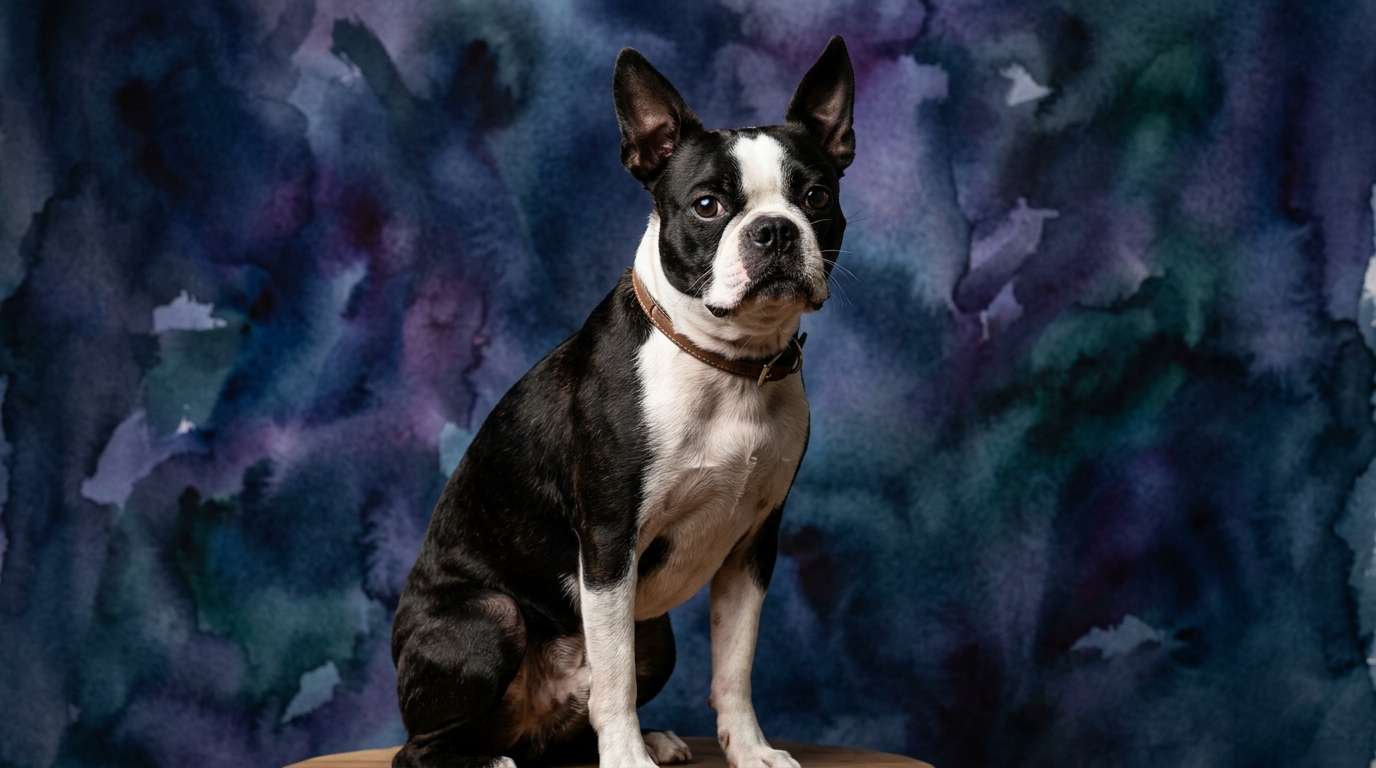

Side-by-Side IQ Profile: Boston Terrier vs. Soft Coated Wheaten Terrier
The Cosmic Pet Pet IQ Lab employs five key dimensions to map a dog's cognitive landscape, offering a nuanced view beyond generalized notions of 'smartness.' For the Boston Terrier, a breed often celebrated for its charming demeanor and Coren rank #54, its IQ breakdown paints a picture of a socially attuned companion. Their Problem Solving is rated 3/5, indicating a moderate ability to navigate novel situations or figure out simple puzzles, demonstrating adaptable rather than ingenious thinking. Training Speed also sits at 3/5, suggesting they grasp new commands and routines at an average pace, responsive but occasionally requiring consistent reinforcement. Where the Boston truly shines is in Social Intelligence, earning a 4/5; they are highly perceptive of human emotions and social cues, often anticipating their owner's moods or intentions. Their Instinctive Drive is a modest 2/5, reflecting their primary role as companions rather than working dogs, with minimal prey drive or strong urges for independent exploration. Finally, their Memory is a solid 3/5, allowing them to retain learned behaviors and routines effectively.
In contrast, the Soft Coated Wheaten Terrier, though not Coren-ranked, presents a profile rooted in its working terrier heritage. Its Problem Solving ability mirrors the Boston at 3/5, capable of adapting to various situations and figuring out practical solutions, perhaps with a touch more independent thought. Training Speed is also a 3/5, meaning they are capable learners but, true to their terrier nature, can exhibit an independent streak that requires engaging and patient methods. Social Intelligence for the Wheaten is 3/5; they are friendly and interactive, forming strong bonds, but might not possess the same nuanced emotional sensitivity as the Boston. Their Instinctive Drive, however, is a higher 3/5, reflecting a moderate urge to chase, dig, and explore, a remnant of their farm dog duties. Like the Boston, their Memory is rated 3/5, allowing them to recall training and experiences consistently.
Where the Boston Terrier Wins Cognitively
The Boston Terrier's standout cognitive advantage lies squarely in its superior Social Intelligence, scoring a 4/5 compared to the Wheaten's 3/5. This higher rating means Bostons are exceptionally adept at reading and responding to human emotional states and subtle cues. Owners often report their Bostons seeming to 'understand' their feelings, offering comfort during distress or mirroring their joyful energy. This perceptive quality translates into a dog that is remarkably in tune with its human family, often anticipating routines, responding to changes in voice tone, and adapting its behavior to suit the household's mood. For instance, a Boston might instinctively lie down quietly when its owner is stressed, or become more playful when sensing happiness, without direct prompting. Their lower Instinctive Drive (2/5) further enhances this connection, as they are less prone to being distracted by external stimuli like scents or passing squirrels, allowing them to maintain focus on human interaction and communication. This combination fosters a deeply integrated and emotionally responsive companion experience, making the Boston an unparalleled choice for individuals seeking a dog that truly 'gets' them on an emotional level.
Where the Soft Coated Wheaten Terrier Wins Cognitively
The Soft Coated Wheaten Terrier's cognitive edge can be found in its slightly elevated Instinctive Drive, rated 3/5 versus the Boston's 2/5. While not an extreme difference, this higher drive provides the Wheaten with a greater intrinsic motivation for exploration, scent-tracking, and engaging with its environment in a more hands-on manner. This means a Wheaten is often more naturally inclined to investigate new smells, pursue a rolling ball with persistent enthusiasm, or enjoy structured activities like scent work or agility that tap into their natural curiosity and drive to 'do something.' Their Problem Solving, while rated similarly at 3/5, often manifests with a terrier's characteristic tenacity; a Wheaten might spend more sustained effort trying to figure out how to retrieve a toy stuck under furniture or navigate a complex obstacle course, driven by that internal spark. This slight cognitive advantage in drive translates into a dog that thrives on purposeful activity and finds satisfaction in engaging with the world through its senses and physical capabilities, making them excellent partners for owners who appreciate a spirited companion eager for adventure and engaging tasks.
Which is Easier to Train and Why
Both the Boston Terrier and the Soft Coated Wheaten Terrier share a 3/5 rating for Training Speed, indicating they are capable learners. However, the 'ease' of training can feel quite different due to their other cognitive dimensions. The Boston Terrier, with its superior Social Intelligence (4/5) and lower Instinctive Drive (2/5), often presents as an 'easier' dog to train for many owners. Their strong desire to please and their attentiveness to human cues mean they are highly motivated by praise and positive interaction, making them eager participants in training sessions. They are less likely to be sidetracked by environmental distractions, focusing intently on their handler, which allows for quicker command acquisition in many settings. Their compact size also contributes to easier physical management during early training stages, making consistent reinforcement more straightforward.
The Soft Coated Wheaten Terrier, while equally capable of learning, may require a more nuanced and engaging training approach. Their moderate Instinctive Drive (3/5) means they can be more easily distracted by interesting scents, sounds, or the urge to explore, requiring trainers to be creative and consistent to hold their attention. Their independent terrier spirit means they respond best to training that feels like a game and offers ample rewards beyond just praise, such as treats or beloved toys. While they are friendly, their 3/5 Social Intelligence means they might not be as deeply motivated by the sheer desire to please as a Boston, necessitating a trainer who can make learning intrinsically rewarding and fun. Patience, humor, and a variety of positive reinforcement techniques are key to unlocking the Wheaten's trainability, making the process less about 'ease' and more about engaging their spirited nature.
Which Suits Active Owners vs. Relaxed Owners
For owners with a more relaxed lifestyle, the Boston Terrier often makes an ideal companion. Their lower Instinctive Drive (2/5) means they are generally content with moderate daily exercise, such as leashed walks around the neighborhood or indoor play sessions. They are not dogs that demand constant, high-intensity activity, making them excellent choices for urban dwellers or those who prefer a calmer pace. Their high Social Intelligence (4/5) ensures they thrive on close human companionship and are happiest when integrated into family life, often preferring to be near their owners rather than pursuing independent adventures. A relaxed owner who enjoys teaching tricks, engaging in quiet cuddle sessions, and having a dog that is deeply attuned to their presence will find a Boston Terrier exceptionally rewarding.
Conversely, the Soft Coated Wheaten Terrier, with its moderate Instinctive Drive (3/5), is better suited for more active owners. While not requiring extreme athleticism, Wheatens thrive on regular, engaging exercise that allows them to utilize their natural terrier instincts for exploration and play. Daily brisk walks, runs, hikes, or structured playtime in a securely fenced yard are essential to keep them mentally and physically stimulated. Owners who enjoy outdoor activities, dog sports like agility or obedience, or simply have the time and energy for consistent interactive play will find the Wheaten's spirited nature a wonderful match. They need outlets for their curiosity and physical energy, and an active owner can provide the varied experiences that prevent boredom and channel their drive positively.
The Verdict
Choose a Boston Terrier if you prioritize a deeply emotionally perceptive and attentive companion, thriving on close human connection within a more relaxed, urban living environment.
Opt for a Soft Coated Wheaten Terrier if you seek a spirited, engaging companion with a moderate drive for exploration and outdoor activity, and are prepared for consistent, creative training methods.
🧠 Find Your Pet's IQ Score
Our Pet IQ Lab assessment covers 25+ tests across 5 cognitive dimensions — personalized to your breed.
Take the Full IQ Test →Frequently Asked Questions
Are Boston Terriers good apartment dogs due to their IQ?
Yes, Boston Terriers often excel in apartment living, largely due to their high social intelligence and lower instinctive drive. They thrive on human companionship and their moderate exercise needs are easily met with walks and indoor play, making them adaptable to smaller spaces as long as they receive ample attention.
Do Soft Coated Wheaten Terriers need a lot of mental stimulation?
Soft Coated Wheaten Terriers benefit significantly from mental stimulation due to their moderate problem-solving abilities and instinctive drive. Engaging them with puzzle toys, training new tricks, or participating in dog sports helps prevent boredom and channels their natural curiosity and energy constructively.
How do their social intelligence scores impact family dynamics?
The Boston Terrier's 4/5 social intelligence means they are highly attuned to family emotions, often acting as sensitive companions who adapt to household moods. The Wheaten's 3/5 social intelligence indicates they are friendly and interactive, forming strong bonds, but might be less subtly perceptive of nuanced emotional shifts, thriving more on direct engagement.