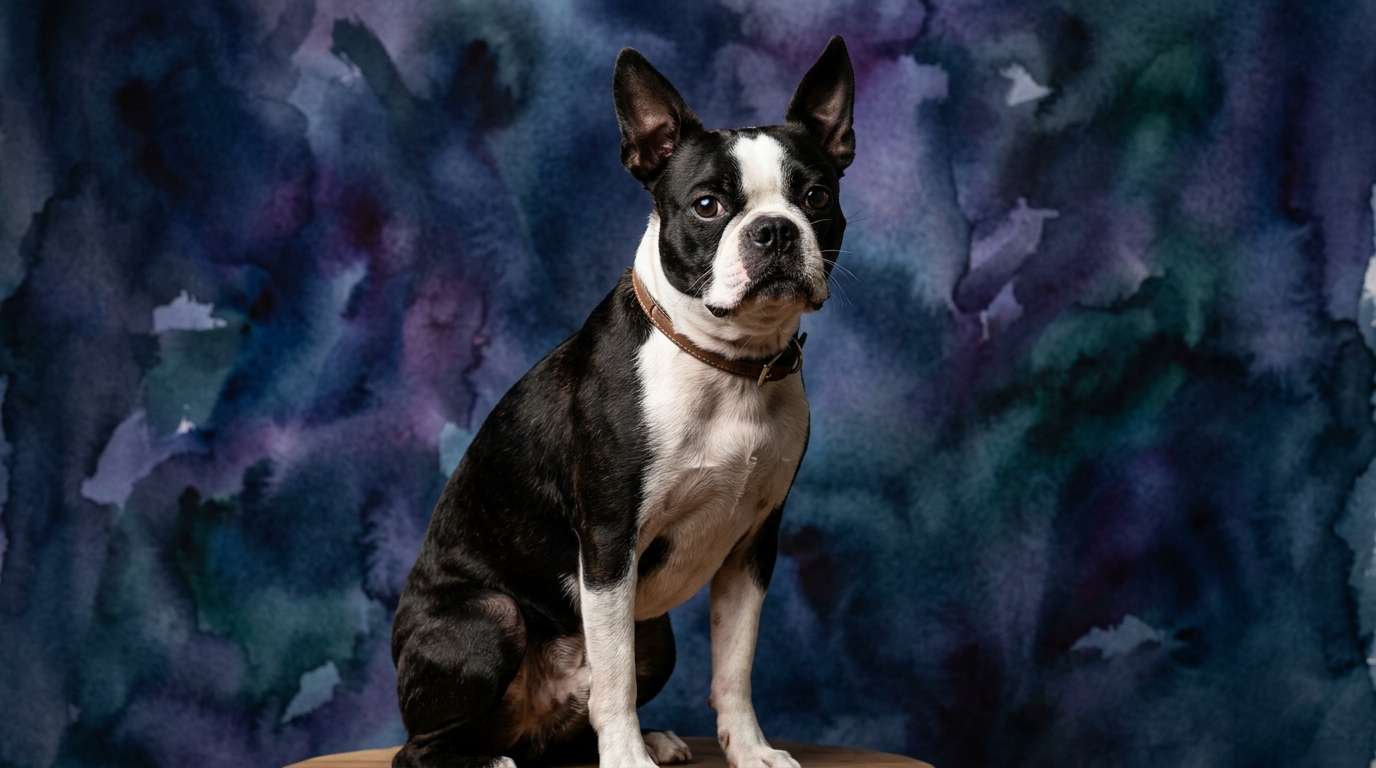

Side-by-Side IQ Profile: Boston Terrier vs. Sussex Spaniel
At The Cosmic Pet Pet IQ Lab, we analyze canine intelligence across five key dimensions to provide a detailed cognitive blueprint for each breed. The Boston Terrier, a Non-Sporting breed with a Coren rank of #54, shows a balanced cognitive profile. It scores 3/5 in Problem Solving, indicating a moderate ability to navigate challenges like puzzle toys or novel situations, and a 3/5 in Training Speed, suggesting it learns new commands at a steady, consistent pace. Its Social Intelligence stands out at 4/5, reflecting a strong intuition for human emotions and social cues, while its Instinctive Drive is lower at 2/5, meaning less inclination for traditional working tasks. Memory for the Boston Terrier is rated at 3/5, indicating reliable retention of learned behaviors and routines.
The Sussex Spaniel, a Sporting breed ranked #62 by Coren, presents a slightly different cognitive emphasis, particularly in its drives. Like the Boston Terrier, it achieves a 3/5 in Problem Solving, demonstrating a similar capacity for figuring out moderate environmental puzzles, perhaps related to finding a hidden treat or navigating obstacles. Its Training Speed also mirrors the Boston Terrier at 3/5, requiring consistent methods for effective learning. The Sussex Spaniel’s Social Intelligence is rated at 3/5, indicating a good connection with humans, though perhaps not as overtly expressive as the Boston. Where it notably differs is its Instinctive Drive, scoring a 3/5, reflecting its heritage as a gundog with a natural inclination for scent work and retrieving. Its Memory is also rated at 3/5, ensuring it retains commands and experiences reliably, especially those linked to its purpose.
Where the Boston Terrier Wins Cognitively
The Boston Terrier’s most pronounced cognitive advantage lies in its superior Social Intelligence, scoring a 4/5 compared to the Sussex Spaniel’s 3/5. This higher rating signifies an enhanced capacity to perceive and interpret human emotions, intentions, and communication nuances. A Boston Terrier often seems to possess an innate understanding of its owner's moods, responding with appropriate comfort or playful engagement. This acute social awareness makes them exceptionally intuitive companions, capable of adapting their behavior to fit household dynamics and anticipating human needs with remarkable sensitivity. For instance, they might quickly learn to offer a comforting presence when their owner is upset or engage in quiet play when the household is calm. This finely tuned social radar also contributes to their adaptability in various social settings, making them generally gracious and responsive to new people and situations, fostering smoother interactions within a family unit and beyond.
Where the Sussex Spaniel Wins Cognitively
The Sussex Spaniel's cognitive strength is most evident in its Instinctive Drive, rated at 3/5, a point higher than the Boston Terrier's 2/5. This elevated drive is a direct reflection of its rich sporting heritage, signifying a more inherent and robust inclination towards tasks involving scent work, flushing game, and retrieving. While both breeds show similar problem-solving abilities, the Sussex Spaniel's cognitive energy is more naturally directed towards purposeful outdoor activities. This means they derive significant mental satisfaction and engagement from using their nose to follow a trail or enthusiastically bringing back a thrown item. For example, a Sussex Spaniel will often display unwavering focus when following a scent, demonstrating a cognitive persistence rooted in their ancestral purpose. This focused drive can make them exceptionally dedicated partners in activities that tap into these natural instincts, providing mental stimulation that is deeply rewarding for the breed.
Which is Easier to Train and Why
Both the Boston Terrier and the Sussex Spaniel share a 3/5 rating in Training Speed and Problem Solving, suggesting they learn at a comparable pace and can tackle similar cognitive challenges. However, the Boston Terrier often feels 'easier' to train for general obedience due to its higher Social Intelligence (4/5). A Boston Terrier's exceptional attunement to human cues and a strong desire to please its owner can make training sessions more cooperative and engaging. They are often highly motivated by praise, attention, and the positive reinforcement of human interaction, quickly understanding what behaviors elicit approval. This responsiveness to human feedback means they often grasp new commands with fewer repetitions, as they are actively seeking to align with their owner's expectations.
The Sussex Spaniel, while equally capable of learning, might present different training considerations. Its slightly lower Social Intelligence (3/5) means it might not be as overtly focused on human approval, and its higher Instinctive Drive (3/5) can sometimes lead to distractions, particularly when outdoor scents are present. For example, during a 'stay' command, a Sussex might be more inclined to follow an interesting smell than maintain eye contact with its trainer, requiring more consistent redirection. Training a Sussex Spaniel often benefits from methods that incorporate their natural drives, such as using retrieve games to teach 'come' or 'fetch', making the learning process more intrinsically rewarding for them. Therefore, while both breeds are trainable with patience and consistency, the Boston Terrier's inherent social nature often translates into a more straightforward and intuitive training experience for the average owner, especially in a home environment.
Which Suits Active Owners vs. Relaxed Owners
For individuals or families who prefer a more relaxed, companion-centric lifestyle, the Boston Terrier often emerges as the more suitable choice. Their lower Instinctive Drive (2/5) means they are generally content with moderate daily exercise, such as short walks, indoor play, or a romp in a secure yard. They do not typically demand extensive outdoor adventures or continuous mental 'work' to feel fulfilled. Their high Social Intelligence (4/5) means they thrive on close human interaction and are often happiest simply being near their owners, making them excellent companions for those who enjoy quiet evenings at home or leisurely strolls. Boston Terriers adapt well to apartment living and are generally less prone to destructive behaviors born of unfulfilled working instincts, provided their social needs are met.
Conversely, the Sussex Spaniel is an ideal match for more active owners, especially those who appreciate and can engage with a dog's natural working heritage. Their higher Instinctive Drive (3/5) means they truly flourish when given opportunities to use their nose and retrieve in varied environments. Owners who enjoy activities like long hikes, scent work games, or even participation in dog sports such as tracking, field trials, or agility will find the Sussex Spaniel an enthusiastic and dedicated partner. These dogs gain significant cognitive satisfaction from fulfilling their innate drives, making them less suitable for purely sedentary lifestyles. An owner who can provide consistent opportunities for exploration and purpose-driven activity will find the Sussex Spaniel’s focused energy and robust constitution deeply rewarding, leading to a well-adjusted and happy companion.
The Verdict: When to Choose Each Breed
Understanding the subtle differences in cognitive profiles between the Boston Terrier and the Sussex Spaniel is key to finding the right companion. The Boston Terrier, with its higher social intelligence and lower instinctive drive, is an excellent choice for individuals or families seeking a deeply connected, intuitive companion who thrives on human interaction and adapts well to a more relaxed, often urban, lifestyle. They are ideal for those who appreciate a dog that is exceptionally attuned to their emotions and content with moderate daily activity, preferring companionship over strenuous outdoor pursuits.
The Sussex Spaniel, characterized by its stronger instinctive drive and robust build, is better suited for active owners who relish engaging in outdoor activities that leverage a dog’s natural working abilities. If you enjoy long walks, scent games, or participating in dog sports, and can provide consistent opportunities for your dog to explore and fulfill its innate retrieving and tracking instincts, the Sussex Spaniel will be a happy, purposeful, and devoted partner. This breed thrives when given a 'job' that aligns with its heritage, making it a rewarding choice for those who embrace an active, outdoor-oriented lifestyle.
The Verdict
Choose the Boston Terrier if you prioritize a highly socially intelligent companion who thrives on close human connection, adapts well to a more relaxed urban or indoor lifestyle, and offers intuitive emotional responsiveness.
Choose the Sussex Spaniel if you are an active owner seeking a purposeful canine partner with a strong instinctive drive for outdoor activities like scent work and retrieving, who will flourish with opportunities to engage their natural working heritage.
🧠 Find Your Pet's IQ Score
Our Pet IQ Lab assessment covers 25+ tests across 5 cognitive dimensions — personalized to your breed.
Take the Full IQ Test →Frequently Asked Questions
Are Boston Terriers good with children?
Boston Terriers, with their high social intelligence and generally amiable nature, often integrate well into families with children, displaying patience and a playful demeanor. Supervision is always recommended to ensure respectful interactions from both dog and child, fostering a safe environment.
Do Sussex Spaniels require a lot of grooming?
Sussex Spaniels have a thick, wavy coat that benefits from regular grooming to prevent mats and tangles, especially on their feathering. Brushing several times a week is recommended, along with occasional trims, to maintain coat health and cleanliness.
Can a Sussex Spaniel live in an apartment?
While adaptable, a Sussex Spaniel's higher instinctive drive means they prefer environments with more space for exploration and scent work, making apartment living less ideal unless daily extensive outdoor activity is guaranteed. They thrive best with access to a yard or regular outdoor excursions.