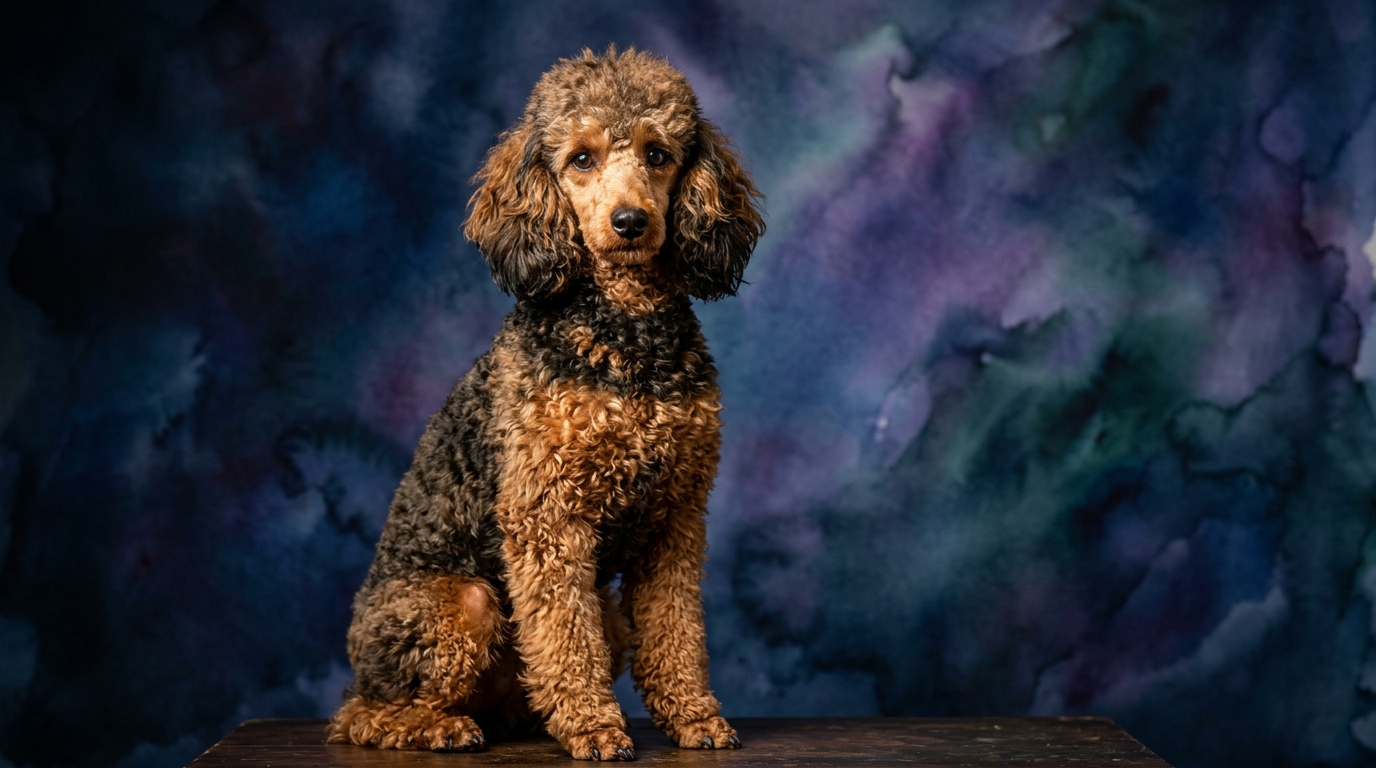

Side-by-Side Cognitive Profiles
**Poodle (Standard)**
**Problem Solving (5/5):** The Standard Poodle often approaches novel situations with a strategic mindset, capable of deconstructing complex tasks into manageable steps. They demonstrate a remarkable capacity for abstract reasoning, figuring out how to manipulate objects to achieve a goal or understanding multi-stage puzzles. This manifests as a dog that can quickly learn to open latches, navigate elaborate obstacle courses, or even infer solutions to challenges without direct instruction, showcasing exceptional cognitive flexibility.
**Training Speed (5/5):** Standard Poodles exhibit an exceptional ability to form associations between commands and actions with minimal repetition. They process new information rapidly, often grasping complex routines after only a few attempts, making them highly responsive to instruction and eager to engage in learning new behaviors. Their quick uptake means training sessions can be dynamic and cover a wide range of skills efficiently, solidifying their reputation for rapid learning.
**Social Intelligence (5/5):** These dogs possess a profound understanding of human communication, accurately interpreting subtle vocal inflections, body language, and emotional states. They are adept at adapting their behavior based on social cues, often anticipating owner intentions or responding empathetically to moods. This attunement fosters deep bonds and facilitates nuanced interactions, making them highly communicative and perceptive companions.
**Instinctive Drive (4/5):** While not solely defined by a singular, intense hunting drive, the Standard Poodle retains a versatile working heritage, often displaying a keen interest in retrieving, scent work, or water activities. Their drive is frequently channeled into cooperative tasks, showing a strong desire to work alongside their human partners rather than purely independent action, making them eager participants in various dog sports and collaborative tasks.
**Memory (5/5):** Standard Poodles maintain an extensive recall of learned commands, past experiences, and complex sequences over long periods. They can remember intricate routines, recognize people and places after extended absences, and retain problem-solving strategies, which significantly contributes to their consistent performance in advanced training and daily life, underpinning their overall cognitive capacity.
**Sussex Spaniel**
**Problem Solving (3/5):** The Sussex Spaniel tends to excel at practical, repetitive tasks directly related to its historical role, rather than abstract or novel puzzles. They can solve problems that involve methodical searching or persistence, but may require more guidance or trial-and-error for multi-step or conceptual challenges. Their problem-solving is often tied to their innate drive and physical environment, focusing on tangible outcomes.
**Training Speed (3/5):** Sussex Spaniels require consistent, clear, and patient training, often needing more repetitions than some other breeds to solidify new commands. They are capable of learning, but their processing speed for novel information is moderate, benefiting greatly from positive reinforcement and structured, predictable sessions. Their learning style is often described as steady and deliberate, valuing consistency over rapid acquisition.
**Social Intelligence (3/5):** These spaniels form strong attachments to their families and understand basic social cues, responding to familiar voices and routines. While capable of bonding, their social interactions might be less nuanced or expressive compared to breeds that prioritize complex human-canine communication. They appreciate companionship but might not constantly seek to interpret every subtle human emotion, preferring a more straightforward interaction.
**Instinctive Drive (3/5):** The Sussex Spaniel's instinctive drive is very specific: a methodical, persistent, and ground-scenting approach to flushing game in dense cover. This drive is focused and enduring, characterized by a steady pace and thoroughness, rather than high-speed pursuit. Their hunting style is unique and reflects a specialized cognitive application, demonstrating a determined, unwavering focus on their task.
**Memory (3/5):** Sussex Spaniels reliably retain learned information and routines when consistently reinforced. They remember familiar people, places, and established commands. However, their capacity for recalling extensive, complex sequences or infrequently practiced tasks might be moderate, meaning regular refreshers help maintain their knowledge base effectively and consistently.
Where Poodle (Standard) Wins Cognitively
The Standard Poodle's cognitive strengths are evident across a spectrum of intellectual domains, particularly in areas demanding adaptability and abstract thought. Their 5/5 Problem Solving score means they readily grasp multi-stage tasks, such as navigating a complex agility course with novel obstacles or learning a sequence of entirely new tricks that require chaining behaviors. This breed demonstrates a remarkable capacity for inferential reasoning, often understanding not just *what* to do, but *why*, allowing them to generalize learned concepts to new situations. Their top-tier Social Intelligence allows for exceptionally nuanced communication; a Poodle can often pick up on subtle shifts in an owner's mood or anticipate a request before it's even fully articulated, fostering a deeply interactive relationship. Furthermore, their superior Memory ensures that these complex lessons and social cues are retained over long periods, making them consistent performers in advanced obedience or service roles, where precise recall of numerous commands is crucial for success.
Where Sussex Spaniel Wins Cognitively
While the Sussex Spaniel's cognitive profile differs from the Poodle's, it possesses distinct strengths rooted in its specialized working heritage. Their 3/5 Instinctive Drive, though not as high as some sporting breeds, is uniquely focused and persistent, particularly in scenting and flushing game. This isn't about speed, but about methodical thoroughness and endurance in dense cover – a cognitive application that demands sustained focus and an unwavering commitment to a task. They exhibit a quiet determination, a self-reliance in their work that allows them to systematically cover ground without constant human direction. Their cognitive advantage lies in this unwavering persistence and their ability to stay on task for extended periods, unaffected by distractions that might deter other breeds. This steadfastness, combined with their calm temperament, represents a specialized form of practical intelligence, enabling them to excel in their intended role where sustained, methodical effort is paramount and valued.
Which is Easier to Train and Why
Evaluating ease of training requires considering both the learner's aptitude and the trainer's approach. The Standard Poodle, with its 5/5 Training Speed, 5/5 Problem Solving, and 5/5 Social Intelligence, is often perceived as significantly easier to train. They possess an innate eagerness to learn and please, quickly forming associations between commands and actions. Their acute social intelligence means they are highly attuned to human cues, often anticipating what is desired, and their robust memory ensures lessons stick with minimal refresher. This allows for rapid progression through complex obedience, trick training, or specialized tasks, often making training a dynamic and engaging partnership.
Conversely, the Sussex Spaniel, with its 3/5 scores across Problem Solving, Training Speed, and Social Intelligence, requires a more patient and consistent approach. They are not unwilling learners, but they process information at a more deliberate pace. Training sessions need to be clear, highly positive, and often more repetitive to solidify commands. Their independent, methodical nature means they might not always be driven by the same desire to please as a Poodle, sometimes displaying a 'what's in it for me?' attitude. Tapping into their natural scenting and retrieving instincts can be a powerful motivator, but abstract concepts or very rapid-fire sequences will demand more effort and consistency from the trainer. Real behavioral differences include the Poodle's active seeking of mental challenge versus the Sussex's preference for purposeful, perhaps slower-paced, work.
Which Suits Active Owners vs. Relaxed Owners
The choice between a Standard Poodle and a Sussex Spaniel also hinges on an owner's lifestyle and their capacity for providing mental and physical engagement. For truly active owners, particularly those who enjoy dog sports, advanced obedience, or competitive activities, the Standard Poodle is an exceptional match. Their 5/5 Problem Solving and Memory, combined with a versatile 4/5 Instinctive Drive, means they thrive on consistent mental stimulation, whether it's learning complex routines, participating in agility, or engaging in scent work. They require owners who are prepared to channel their considerable cognitive energy into productive outlets, as an under-stimulated Poodle can devise its own, sometimes less desirable, forms of entertainment, seeking engagement through other means.
In contrast, the Sussex Spaniel, while originating as a sporting breed, often suits owners with a more relaxed pace, provided their specific needs are met. Their 3/5 Instinctive Drive is about methodical, enduring work rather than high-octane bursts. They enjoy long, purposeful walks where they can engage their nose, exploring scents at a steady pace. They are generally calm indoors after sufficient exercise, making them suitable for owners who appreciate a quiet companion but are still committed to providing daily outdoor exploration and consistent, albeit slower-paced, training. They are less prone to frantic energy bursts but still need regular engagement to prevent boredom and maintain contentment.
The Verdict
Choose the Standard Poodle if you are an owner eager for a highly interactive, mentally agile companion capable of excelling in complex training, problem-solving, and nuanced communication, thriving on consistent intellectual engagement and versatile activities.
Opt for the Sussex Spaniel if you seek a steady, dedicated companion who appreciates methodical outdoor exploration and a calmer home life, valuing persistent effort and a unique working heritage over rapid learning and abstract challenges.
🧠 Find Your Pet's IQ Score
Our Pet IQ Lab assessment covers 25+ tests across 5 cognitive dimensions — personalized to your breed.
Take the Full IQ Test →Frequently Asked Questions
Do Sussex Spaniels require as much grooming as Poodles?
No, Sussex Spaniels typically require less intensive grooming than Standard Poodles. Their coat is dense and flat, needing regular brushing to prevent mats, especially around the ears and feathering, but not the specialized clipping and styling often associated with Poodles.
Can a Sussex Spaniel be a good family dog despite its working background?
Yes, Sussex Spaniels can be wonderful family dogs. They are generally known for their calm and affectionate nature with their families, often being quite patient with children, provided they are socialized well and their moderate exercise needs are consistently met, contributing to a harmonious household.
Are Standard Poodles prone to specific behavioral issues if not mentally stimulated?
Yes, Standard Poodles, with their high cognitive capacity, can develop undesirable behaviors like excessive barking, destructive chewing, or anxiety if not given sufficient mental and physical outlets. They require consistent engagement to channel their intelligence constructively and maintain well-being.