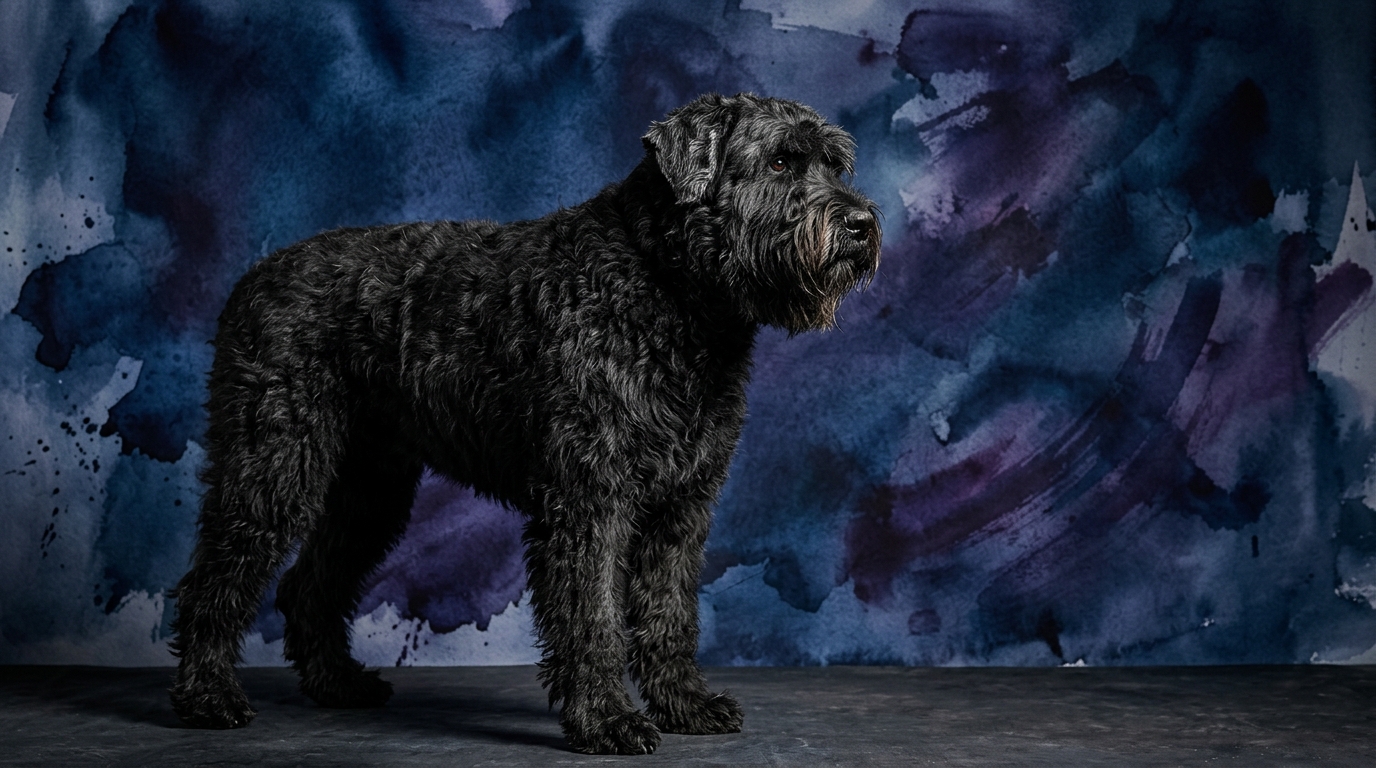

Side-by-Side IQ Profile: Bouvier des Flandres vs. Briard
**Bouvier des Flandres (IQ: Problem Solving 3/5, Training Speed 3/5, Social Intelligence 3/5, Instinctive Drive 3/5, Memory 3/5)**
The Bouvier des Flandres approaches novel challenges methodically. They evaluate options, relying on learned behaviors and independent thought, rather than instantaneous innovation. This solid score reflects practical intelligence geared towards real-world tasks. Bouviers are responsive to training, demonstrating a willingness to learn, though progress might be steady. They thrive on consistency and clear communication, absorbing commands effectively. Patience and positive reinforcement are key. This breed exhibits balanced social awareness, understanding human cues without being overly effusive or aloof. They form strong bonds and interpret social hierarchies, making them attentive companions. True to their herding lineage, Bouviers possess a moderate, discernible instinctive drive to guard and protect. This drive is typically manageable and can be channeled with appropriate training. Bouviers have reliable memory, retaining learned commands, routines, and experiences. This contributes to consistent behavior and ability to build upon previous training.
**Briard (Coren rank #30, IQ: Problem Solving 4/5, Training Speed 4/5, Social Intelligence 3/5, Instinctive Drive 3/5, Memory 4/5)**
Briards display an agile, creative approach to problem-solving. They figure things out independently, often devising clever solutions. Their higher score suggests inherent curiosity and quicker cognitive processing in new situations. Ranked #30 by Coren, the Briard learns new commands with impressive speed and enthusiasm. They grasp concepts quickly, often requiring fewer repetitions. This faster acquisition rate is rewarding for dedicated trainers. Similar to the Bouvier, the Briard shares balanced social intelligence. They are attuned to human family moods and intentions, forming deep attachments and understanding social dynamics. Briards also possess a moderate instinctive drive, characteristic of herding breeds. This manifests as protective instincts and a natural tendency to 'herd' movement, controllable with consistent guidance. The Briard exhibits superior memory for commands, routines, and complex sequences. They recall details with notable clarity, aiding rapid learning and allowing reliable performance of intricate tasks.
Where Bouvier des Flandres Wins Cognitively
While the Briard often showcases a quicker cognitive response, the Bouvier des Flandres excels in steadfast, enduring intelligence. Their Problem Solving score of 3/5 points to a deliberate, thoughtful approach. A Bouvier meticulously evaluates situations, perhaps taking longer, but often with a robust, less impulsive outcome. This methodical nature translates into a predictable working partner, less prone to surprising, unconventional tactics. Their 3/5 in Training Speed, combined with 3/5 in Memory, suggests that once a lesson is learned, it's deeply ingrained. This means less 'unlearning' from established protocols. For owners valuing unwavering reliability and commitment to learned tasks, the Bouvier's cognitive profile offers an advantage. Their cognitive 'stick-to-itiveness' ensures adherence to systems with remarkable consistency, making them exceptionally dependable in established routines.
Where Briard Wins Cognitively
The Briard clearly outperforms the Bouvier des Flandres in raw processing speed and adaptability. Their 4/5 in Problem Solving signifies a dog quicker to assess novel situations and more likely to innovate. Briards often demonstrate remarkable capacity for 'thinking on their feet,' finding creative solutions to new challenges. This cognitive flexibility makes them incredibly engaging. Furthermore, their 4/5 in Training Speed indicates rapid absorption of new information. Fewer repetitions are needed, and they progress through complex curricula quickly. Paired with their superior 4/5 Memory, Briards learn quickly and retain vast information, building an impressive repertoire. This cognitive edge allows them to excel in demanding dog sports, advanced obedience, or roles requiring quick decision-making.
Which is Easier to Train and Why
Considering ease of training, the Briard generally presents a more straightforward path due to its higher scores in Training Speed (4/5) and Memory (4/5). Their quick grasp of new concepts means faster progression through training levels, often showing keen desire to learn. A Briard's ability to quickly associate commands with actions, coupled with excellent retention, makes training fluid and rewarding, especially for complex sequences. They are less likely to forget learned material. The Bouvier des Flandres, with 3/5 in both Training Speed and Memory, requires a more patient, consistent approach. While certainly trainable, they may need more repetitions to internalize commands and generalize behaviors. Their methodical nature demands deliberate, unwavering commitment from the trainer, focusing on clarity and repetition. Consequently, a Briard's inherent cognitive agility often makes the training journey feel less arduous.
Which Suits Active Owners vs. Relaxed Owners
The distinction between these breeds becomes clearer when aligning their cognitive profiles with owner lifestyles. The Briard, with its 4/5 Problem Solving and Training Speed, thrives with active owners enjoying mental and physical challenges. This breed needs regular opportunities to use its sharp mind beyond just physical exercise. Owners who enjoy dog sports or complex trick training will find the Briard a willing partner. Their cognitive agility means they can become bored or destructive if not sufficiently stimulated, making them less suitable for truly relaxed owners. In contrast, the Bouvier des Flandres, with consistent 3/5 scores, suits owners appreciating a steady, reliable companion without constant demand for novel intellectual engagement. While needing exercise, a Bouvier's deliberate cognitive pace means they are less agitated by predictable routines. They are content with established structures, fitting active owners prioritizing consistent companionship over constant innovation, or those with a more relaxed lifestyle providing moderate, consistent activity.
The Verdict
Choose the Bouvier des Flandres if you value unwavering reliability and a methodical approach to learning, preferring a consistent companion that excels in established routines over rapid innovation. This breed thrives with owners who offer patient, clear guidance and appreciate a dog that commits deeply to learned behaviors.
Opt for the Briard if you seek a cognitively agile and quickly adaptable partner for advanced training, dog sports, or roles demanding swift problem-solving. This breed is ideal for active owners who enjoy providing extensive mental stimulation and appreciate a dog that learns with impressive speed and retains information robustly.
🧠 Find Your Pet's IQ Score
Our Pet IQ Lab assessment covers 25+ tests across 5 cognitive dimensions — personalized to your breed.
Take the Full IQ Test →Frequently Asked Questions
Is the Coren ranking a definitive measure of a dog's overall intelligence?
Stanley Coren's ranking primarily assesses 'working and obedience intelligence,' focusing on how quickly a dog learns commands and obeys them. While valuable, it doesn't encompass all facets of intelligence like problem-solving, social understanding, or instinctive drives, which are equally important for a complete cognitive profile.
How does 'instinctive drive' differ between these two herding breeds?
Both breeds score 3/5 in instinctive drive, indicating a moderate, manageable herding and protective inclination. While present, this means their natural instincts can be effectively channeled and integrated into family life with consistent training, rather than being overwhelmingly dominant or absent.
Can a Bouvier des Flandres excel in dog sports despite a lower training speed score?
Absolutely. While their training speed is 3/5 compared to the Briard's 4/5, Bouviers are still capable and willing learners. Their methodical nature means they may take longer to master a skill, but once learned, their reliability and dedication can make them formidable competitors in various dog sports.