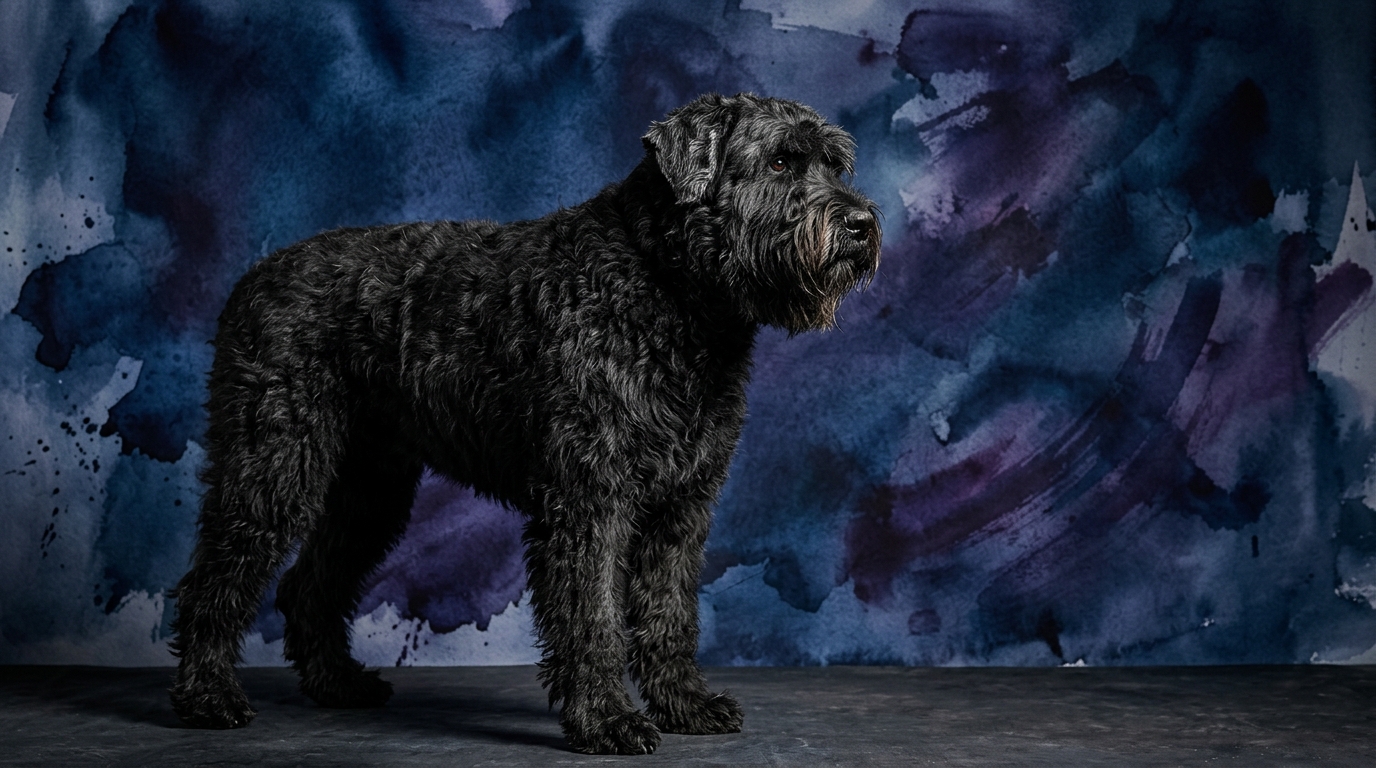

Side-by-Side Cognitive Profiles: Bouvier des Flandres
The Bouvier des Flandres, a sturdy herding breed, presents a balanced yet robust cognitive profile across the board. In Problem Solving, they score a solid 3 out of 5, indicating they can navigate moderate challenges and learn from experience, though they might not always seek out novel solutions proactively. Their Training Speed also sits at 3 out of 5, meaning they are receptive to learning commands at a steady pace, requiring consistent and patient instruction to solidify new behaviors.
Social Intelligence for the Bouvier is rated 3 out of 5, suggesting they form strong bonds and understand human cues well, but might not always be the first to initiate complex social interactions or adapt instantly to rapidly changing group dynamics. Their Instinctive Drive, also 3 out of 5, reflects their working heritage; they possess a moderate urge to herd, guard, or perform tasks, making them purposeful but not hyper-driven. Finally, their Memory is a reliable 3 out of 5, enabling them to retain learned behaviors and recognize familiar people and places consistently, supporting their steady training progression and stable temperament.
Side-by-Side Cognitive Profiles: Miniature Poodle
In contrast, the Miniature Poodle showcases a cognitive profile marked by specific peaks in certain areas, setting it apart significantly. Their Problem Solving ability is rated an impressive 5 out of 5, indicating a strong capacity for abstract thought, strategic planning, and quickly figuring out complex novel situations. This high score means they often enjoy mental puzzles and can independently devise solutions to obstacles.
Their Training Speed mirrors this at 5 out of 5, signifying an exceptional ability to grasp new commands rapidly, often with fewer repetitions than many other breeds. The Miniature Poodle's Social Intelligence, however, is a 3 out of 5, aligning with the Bouvier. They are adept at understanding human emotions and cues, forming close family bonds, but their social engagement with strangers or in new environments might be more reserved than overtly effusive. Their Instinctive Drive, also 3 out of 5, points to a moderate inherent motivation for tasks, though for Poodles, this often translates into an eagerness for interactive play and learning rather than herding or guarding. Memory for the Miniature Poodle is an outstanding 5 out of 5, allowing them to recall a vast repertoire of commands, routines, and experiences with remarkable precision over long periods.
Where Bouvier des Flandres Wins Cognitively
While the Miniature Poodle's scores in problem-solving and training speed are higher, the Bouvier des Flandres' cognitive strength lies in its balanced and steadfast application of its abilities, particularly in real-world working scenarios. Their 3/5 in Instinctive Drive, coupled with their physical robustness, means they apply their moderate problem-solving skills to practical tasks with persistence rather than intellectual acrobatics. This balance contributes to a dog that is less prone to overthinking or becoming easily frustrated by complex, abstract problems, preferring instead to methodically work through tangible challenges.
The Bouvier's consistent 3/5 scores across all dimensions suggest a cognitive profile optimized for reliability and resilience in its traditional roles. Their moderate social intelligence and instinctive drive, combined with a steady memory, create a dog that is dependable without being overly sensitive or demanding of constant novelty. This makes them particularly well-suited for owners seeking a practical, grounded companion who processes information reliably and applies learned behaviors consistently, rather than a dog that constantly seeks new mental stimulation for its own sake.
Where Miniature Poodle Wins Cognitively
The Miniature Poodle truly shines in its exceptional Problem Solving and Memory capabilities, both rated 5 out of 5. This combination allows them to quickly analyze new situations, formulate strategies, and retain the solutions for future use. For instance, a Poodle might rapidly figure out how to open a child-proof gate or devise a complex sequence of actions to retrieve a favorite toy, demonstrating a level of abstract reasoning that sets them apart.
Furthermore, their 5/5 Training Speed means they absorb new commands and routines with astonishing swiftness, often requiring only a few repetitions to master a task. This rapid learning curve means owners can introduce a wider variety of behaviors and progress through training stages much faster. Their superior memory ensures these learned skills are not easily forgotten, leading to a responsive and adaptable companion capable of performing intricate sequences of commands with precision and enthusiasm.
Which is Easier to Train and Why
Based on their respective cognitive profiles, the Miniature Poodle (Training Speed 5/5) is demonstrably easier to train than the Bouvier des Flandres (Training Speed 3/5). The Poodle's rapid assimilation of new information means commands often click quickly, requiring fewer repetitions and less time to achieve proficiency. This makes the training process incredibly rewarding and efficient, allowing owners to move onto more complex tasks or variations sooner. Their high problem-solving ability also means they can generalize learned behaviors to new contexts more readily and adapt to changes in commands or environments with minimal confusion.
Conversely, training a Bouvier des Flandres, while entirely achievable, demands more patience and consistency. Their 3/5 training speed means new concepts take longer to embed, and owners must be prepared for more repetition and a slower progression through training stages. While they possess a reliable memory (3/5), it's not on the same level as the Poodle's 5/5, meaning skills might need periodic refreshing. The Bouvier's more moderate problem-solving approach also suggests they might require more guidance in novel situations, making clear, consistent instruction paramount for successful training outcomes.
Which Suits Active Owners vs. Relaxed Owners
For active owners who relish engaging their dog in mental and physical challenges, the Miniature Poodle is an excellent fit. Their high problem-solving and memory scores mean they thrive on varied activities like puzzle toys, advanced obedience, agility, or even trick training. These dogs require consistent mental stimulation to prevent boredom, which, if neglected, can manifest as undesirable behaviors. Their moderate instinctive drive means they enjoy participating in owner-led activities without being overwhelmingly intense, making them versatile partners for hiking, jogging, or dog sports.
The Bouvier des Flandres, with its balanced cognitive profile and moderate instinctive drive (3/5), tends to suit active owners who appreciate a more grounded, purposeful companion. While they benefit from regular physical exercise and mental engagement, their needs are often met through consistent routines, structured walks, and opportunities to "work" alongside their owner, even if that work is simply supervising the yard. They are not typically driven by an incessant need for novel mental puzzles or high-speed sports, making them a good match for owners who prefer a steady, reliable partner for outdoor adventures or practical tasks around the home. They can also adapt to a more relaxed pace provided their foundational needs for exercise and companionship are met.
The Verdict
Choose the Bouvier des Flandres if you appreciate a steadfast, balanced companion who processes information reliably and thrives on consistent routines and practical companionship, and you are prepared for a steady, patient training approach.
Opt for the Miniature Poodle if you seek a highly adaptable, quick-witted partner eager to master complex commands and participate in mentally stimulating activities, and you are ready to provide consistent mental engagement.
🧠 Find Your Pet's IQ Score
Our Pet IQ Lab assessment covers 25+ tests across 5 cognitive dimensions — personalized to your breed.
Take the Full IQ Test →Frequently Asked Questions
Do Bouvier des Flandres dogs require a lot of mental stimulation?
While Bouviers are not as driven by complex mental puzzles as some breeds, their 3/5 problem-solving and instinctive drive mean they benefit from consistent mental engagement. This can include structured training sessions, opportunities for supervised exploration, or purposeful tasks that engage their herding background. Neglecting their moderate need for activity can lead to boredom.
Are Miniature Poodles prone to behavioral issues if not mentally challenged?
Yes, Miniature Poodles, with their 5/5 problem-solving and memory, require consistent mental engagement. Without sufficient mental stimulation, they can become bored and channel their cognitive energy into undesirable behaviors such as excessive barking, destructive chewing, or developing obsessive habits. Regular training, puzzle toys, and interactive play are essential.
How do their social intelligence scores impact interactions with children or other pets?
Both breeds have a 3/5 social intelligence score, indicating they can form strong family bonds and understand social cues. This means they are generally capable of coexisting peacefully with children and other pets, provided they are properly socialized from a young age and interactions are supervised. Neither breed is inherently prone to being overly exuberant or overly reserved in family settings, fostering stable social dynamics.