
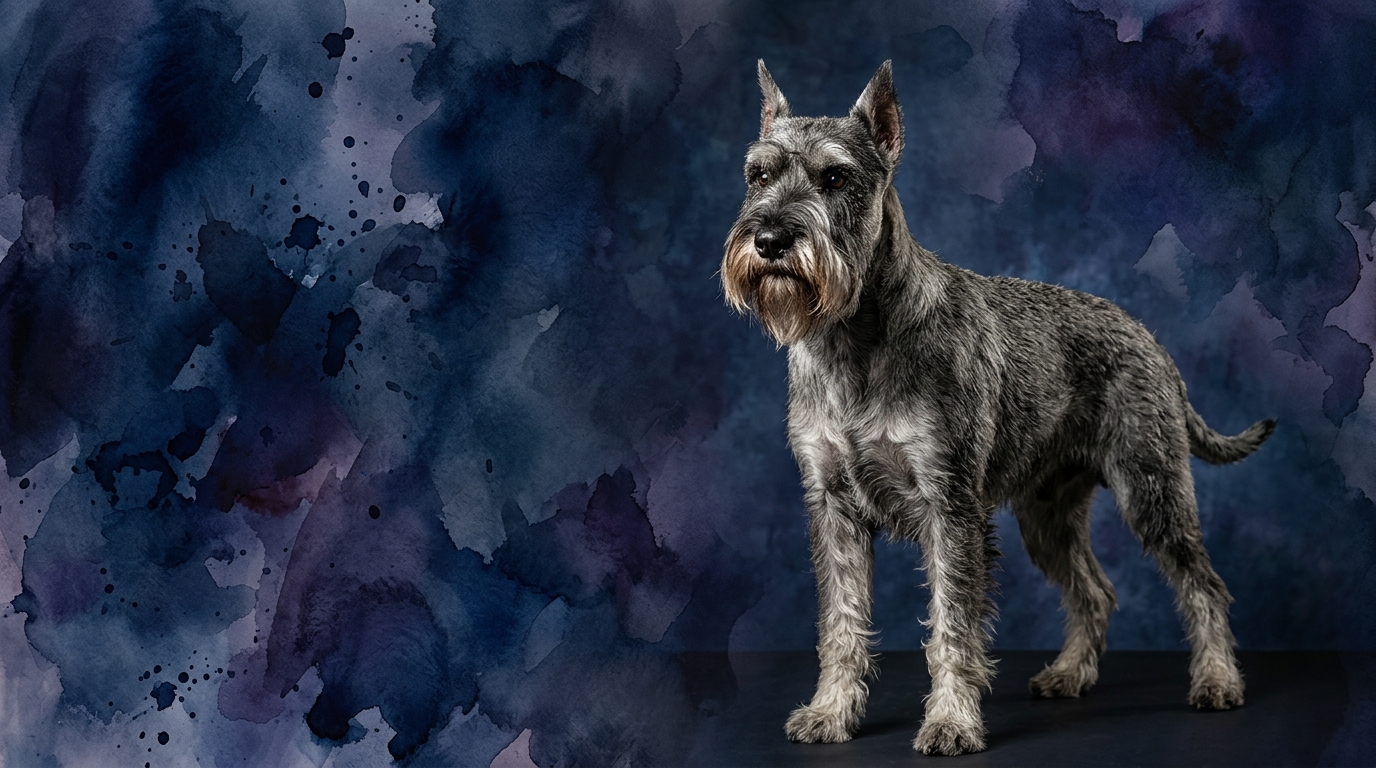
Side-by-Side IQ Profile: Briard vs. Standard Schnauzer
The Briard, a venerable French herding dog, holds Coren rank #30, signifying a respectable aptitude for learning and obedience. Their Problem Solving score of 4/5 reflects an ability to navigate complex herding scenarios, often requiring independent judgment to manage livestock without direct human command, demonstrating a thoughtful, analytical approach to environmental challenges. Training Speed, also rated 4/5, indicates they are quick to grasp new concepts, but their independent spirit means successful training often hinges on clear, consistent motivation and a perceived purpose for the task. Social Intelligence, at 3/5, points to a breed deeply devoted to its family while maintaining a discerning, sometimes reserved, demeanor towards strangers, processing new social interactions carefully before engaging. An Instinctive Drive of 3/5 highlights their moderate but present herding and protective instincts, guiding their responses in situations involving their perceived flock or territory. Finally, a Memory score of 4/5 ensures they retain learned behaviors and past experiences with significant accuracy, building upon previous lessons and interactions.
The Standard Schnauzer, a robust German working dog, boasts a slightly higher Coren rank of #22, suggesting a swifter acquisition of new commands compared to the Briard. Their Problem Solving capacity, rated 4/5, manifests as a resourceful and often direct approach to overcoming obstacles, whether it's figuring out how to open a gate or retrieve a desired item, driven by a strong desire to "do." With a Training Speed of 4/5, they are generally eager and rapid learners, thriving on engagement and mental stimulation, though their strong will can sometimes present a challenge requiring consistent, firm, and fair handling. Social Intelligence, at 3/5, indicates a breed that is fiercely loyal to its inner circle, exhibiting a watchful and discerning nature around unfamiliar individuals, quickly assessing new social dynamics. Their Instinctive Drive, also 3/5, underscores a strong working ethic, coupled with inherent protective and territorial tendencies that guide their interactions with their environment and perceived responsibilities. A Memory score of 4/5 ensures these dogs have excellent retention for both positive and negative experiences, making early, consistent training particularly impactful.
Where the Briard Wins Cognitively
While both breeds exhibit strong cognitive abilities, the Briard's distinct herding heritage lends itself to a particular cognitive strength: nuanced, independent decision-making in fluid, expansive environments. Their Problem Solving, rated 4/5, often manifests as a patient, strategic assessment of situations, especially when managing livestock or protecting their family. This isn't about brute force or speed, but rather a thoughtful, often indirect approach to achieving a goal, anticipating movements and reactions, which is a hallmark of sophisticated herding intellect. Their memory, also 4/5, is particularly adept at recalling intricate patterns and long sequences of events, allowing them to build complex mental maps of their territory and routines, contributing to their reliable protective instincts and ability to track changes over time. This cognitive style is less about immediate task completion and more about sustained, intelligent oversight.
Where the Standard Schnauzer Wins Cognitively
The Standard Schnauzer, with its working background and Coren rank of #22, often edges out the Briard in the speed and directness of practical task acquisition and execution. Their Problem Solving, also 4/5, tends to be more immediate and results-oriented; they excel at figuring out how to manipulate objects or overcome physical barriers to achieve a tangible outcome, often driven by their strong "work" ethic. This isn't to say they lack thought, but their cognitive process is frequently geared towards efficient, purposeful action. Their slightly higher Coren ranking suggests that, on average, they may require fewer repetitions to solidify new commands and behaviors, indicating a marginal advantage in the initial pace of formal obedience training. Furthermore, their keen discernment in social situations, while rated 3/5 like the Briard, often presents as a quicker, more decisive assessment of new people or environments, making them exceptionally alert and responsive guardians.
Which is Easier to Train and Why
Determining which breed is 'easier' to train is less about raw capacity and more about the trainer's approach and understanding of each breed's specific cognitive drivers. Both breeds share a 4/5 rating for Training Speed, indicating a high aptitude for learning. The Standard Schnauzer's inherent working drive often translates into an eagerness to engage in structured activities and a desire to please a respected leader. They thrive on clear, consistent direction and find satisfaction in completing tasks, making them responsive to traditional obedience methods, provided those methods are varied enough to prevent boredom. Their direct problem-solving approach means they often understand the 'cause and effect' of training quickly, but their tenacity can also lead to stubbornness if they perceive a command as illogical or if the trainer isn't consistently firm. This means training a Schnauzer often involves channeling their considerable will and purpose effectively. In contrast, the Briard, while equally quick to learn, often approaches training with a more thoughtful, independent mindset rooted in their herding history. They might not always jump to obey purely for the sake of it; instead, they often need to understand the 'why' behind a command or feel a partnership in the training process. This requires a trainer who is patient, highly engaging, and capable of making training feel like a collaborative problem-solving exercise, rather than a series of strict commands. While they retain information exceptionally well, their willingness to perform can be more contingent on their perceived value of the activity. Therefore, a Schnauzer might be perceived as 'easier' for an owner who prefers a more direct, task-oriented training relationship, while a Briard might be 'easier' for an owner who enjoys a more nuanced, collaborative, and mentally stimulating training journey.
Suitability for Active vs. Relaxed Owners
When considering lifestyle compatibility, both the Briard and the Standard Schnauzer undeniably fall into the category of breeds best suited for active owners, though their cognitive needs dictate different types of activity. Neither breed is content with a purely relaxed, sedentary lifestyle; such an environment would likely lead to cognitive understimulation and potential behavioral issues. The Briard's cognitive profile, particularly its problem-solving and memory applied to herding, means it thrives when given opportunities for independent thought and complex navigation. Owners who can provide activities like advanced obedience, agility, herding trials, or even long, varied hikes where the dog can explore and 'manage' its environment will find the Briard's intelligence truly shines. They enjoy having a job that requires them to think and adapt, rather than just follow. A relaxed owner, by contrast, might struggle with a Briard's need for mental engagement, potentially leading to a frustrated dog who invents its own (often undesirable) cognitive challenges. The Standard Schnauzer's robust working drive and direct problem-solving aptitude also demand an active owner who can provide structured physical and mental outlets. They excel in activities like competitive obedience, tracking, earthdog trials, or even vigorous daily runs combined with puzzle toys and regular training sessions that tap into their innate desire for purpose. Their quick learning and strong will mean they need consistent engagement to prevent boredom and channel their energy constructively. A relaxed owner might find a Schnauzer's persistent need for activity and mental challenge overwhelming, potentially resulting in a dog that becomes destructive or excessively vocal due to unfulfilled cognitive and physical requirements. In essence, both breeds require an owner who understands that 'active' extends beyond physical exercise to encompass consistent, stimulating mental work that aligns with their specific cognitive strengths.
The Verdict
Opt for the Briard if you seek a thoughtful, patient, and protective companion who thrives on independent problem-solving and a collaborative training relationship that values nuanced understanding.
Select the Standard Schnauzer for a spirited, direct, and task-oriented partner eager for structured activities and clear, consistent guidance, excelling in purposeful engagement.
🧠 Find Your Pet's IQ Score
Our Pet IQ Lab assessment covers 25+ tests across 5 cognitive dimensions — personalized to your breed.
Take the Full IQ Test →Frequently Asked Questions
Do Briards and Standard Schnauzers learn at the same pace?
While both breeds score 4/5 in Training Speed, suggesting rapid learning, the Standard Schnauzer's higher Coren rank hints at a slightly faster initial acquisition of commands. However, the Briard's thoughtful approach means it learns deeply and retains information exceptionally well, just perhaps requiring more convincing motivation.
How do their social interaction styles differ?
Both breeds rate 3/5 in Social Intelligence, meaning they are loyal to family and reserved with strangers. The Briard often takes a more measured, watchful approach, assessing new individuals carefully. The Standard Schnauzer tends to be more overtly discerning and decisive in its assessment, quickly identifying friend or foe.
Which breed is better for complex problem-solving?
Both score 4/5 in Problem Solving, but their styles differ. The Briard excels at nuanced, independent decision-making in fluid environments, like herding. The Standard Schnauzer typically uses a more direct, results-oriented approach to overcome obstacles and achieve tangible goals, driven by its strong working ethic.