
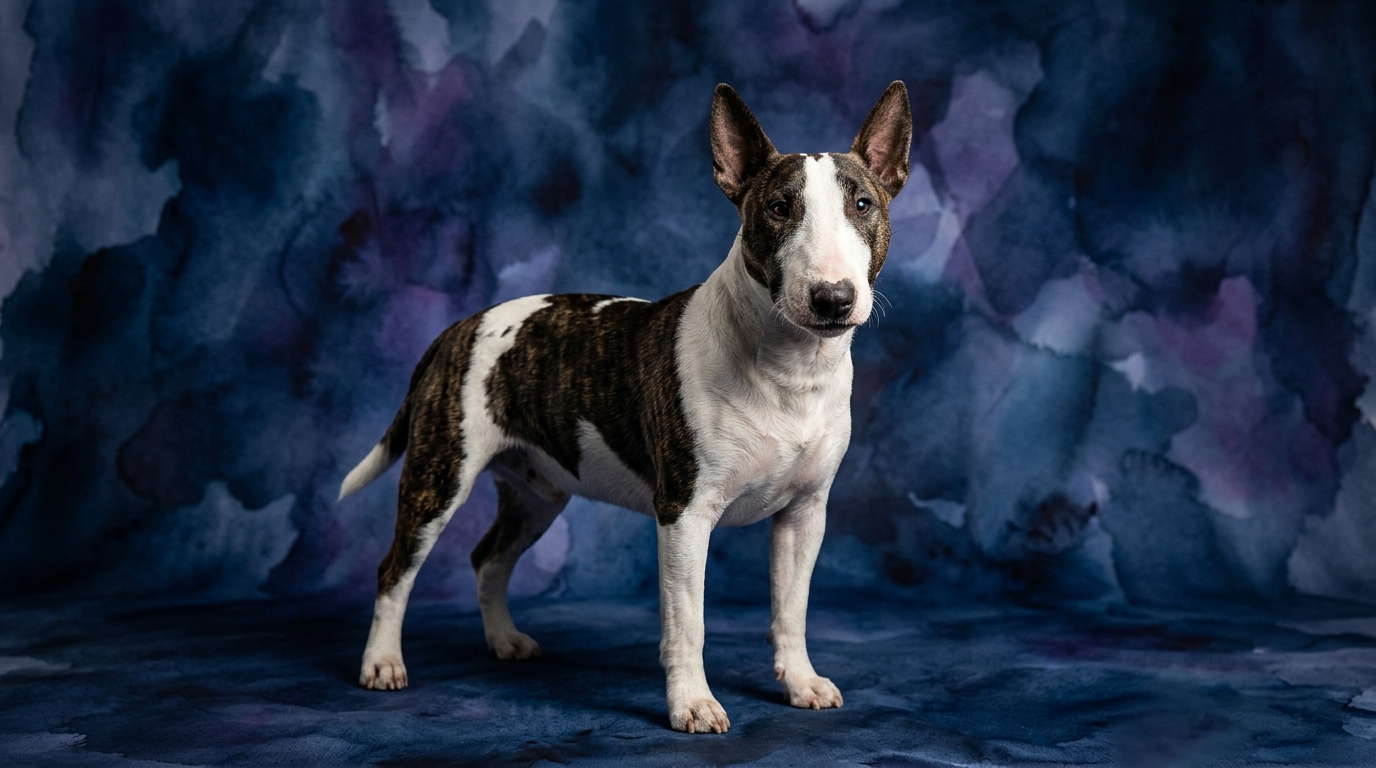
Side-by-Side IQ Profile: Bull Terrier vs. Miniature Bull Terrier
Both Bull Terriers and Miniature Bull Terriers exhibit identical Pet IQ Lab scores across five crucial cognitive dimensions, each rated 3/5: Problem Solving, Training Speed, Social Intelligence, Instinctive Drive, and Memory. This striking similarity underscores a shared foundational intellect within the breed type, indicating that inherent cognitive capacity isn't primarily dictated by size. However, the practical manifestation and application of these shared traits often diverge due to their physical differences.
Their **Problem Solving (3/5)** involves a moderate ability to navigate novel situations, often relying on persistence to achieve goals like accessing a favored toy. **Training Speed (3/5)** suggests they learn effectively with consistent, positive reinforcement, though their independent terrier spirit means they aren't instant responders. They require clear motivation and repetition to solidify behaviors, rather than exhibiting rapid, one-time learning.
**Social Intelligence (3/5)** reflects their capacity to understand human cues and integrate into family life, forming strong bonds. However, their energetic nature means early and broad socialization is vital for refining interactions with diverse individuals and other animals. Their **Instinctive Drive (3/5)** is present but balanced, manifesting as a moderate inclination for chasing, digging, and exploration, requiring appropriate outlets to channel these natural behaviors constructively.
Finally, their **Memory (3/5)** is reliable, allowing them to recall learned commands, routines, and experiences over extended periods. This solid memory means that once a behavior, whether desired or undesirable, is established, it tends to stick. Therefore, consistent training and early habit formation are crucial for both breeds.
Where the Bull Terrier Cognitively Shines
The standard Bull Terrier, with its greater physical stature, often applies its cognitive abilities with a more pronounced physical impact. While raw IQ scores are identical, a Bull Terrier's robust strength and stamina can translate into a more sustained application of its 3/5 instinctive drive during outdoor pursuits, such as prolonged tracking or exploring expansive environments. This physical capacity allows for a broader, more enduring expression of their innate drives.
Their larger size also influences how their 3/5 problem-solving manifests. A Bull Terrier might physically manipulate larger objects or push through more significant barriers to achieve a goal, like repositioning furniture to access a desired spot. This isn't a difference in *intellectual capacity* but in the *scale* at which that intellect is physically expressed, making their cognitive efforts visibly more forceful in certain contexts. Their Coren rank of #66 further suggests a historical capacity for structured learning consistently observed across the breed.
Where the Miniature Bull Terrier Cognitively Excels
The Miniature Bull Terrier, despite shared IQ scores, often demonstrates a more agile and sometimes more focused application of its cognitive abilities, largely due to its compact size. Their 3/5 problem-solving might involve finding intricate solutions to access small spaces or retrieve objects from tight spots where their larger relative simply couldn't fit. This often makes their persistence appear more concentrated and precise.
Furthermore, their smaller stature can subtly enhance their 3/5 social intelligence application. While equally capable of interpreting human cues, a Miniature Bull Terrier might be perceived as less intimidating, potentially facilitating broader exposure to diverse social settings. This practical advantage can lead to more varied social learning opportunities, refining their understanding of different social dynamics without implying a superior cognitive trait. Their lack of a specific Coren rank doesn't imply lesser intelligence, but rather that their cognitive contributions might have been less frequently evaluated in large-scale obedience trials.
Training Dynamics: Which is Easier and Why?
Given identical 3/5 ratings for Training Speed and Memory, training both breeds hinges on managing their physical attributes and individual temperaments. Both require unwavering consistency and positive reinforcement due to their independent terrier spirit. They learn effectively, but also quickly discern inconsistencies, making every interaction a potential learning moment for desired or undesired behaviors.
The Miniature Bull Terrier's smaller size can simplify the physical management aspects of training. Impulse control for leash manners or preventing jumping, for example, is less physically demanding for an owner. While their 3/5 instinctive drive is equally present, a Miniature Bull Terrier's "zoomies" or chasing instincts might be easier to physically contain than a full-sized Bull Terrier's, reducing opportunities for unwanted behaviors to become ingrained.
Matching Breeds to Lifestyles: Active vs. Relaxed Owners
Both Bull Terriers and Miniature Bull Terriers, with their 3/5 instinctive drive, demand regular mental and physical engagement to thrive and prevent boredom. Active owners who enjoy daily walks, structured training sessions, and interactive play will find both breeds responsive and rewarding companions. Their reliable 3/5 memory ensures they benefit from consistent routines and ongoing cognitive challenges.
For owners with a less intensely active lifestyle, the Miniature Bull Terrier often presents a slightly more adaptable choice. While still requiring dedicated exercise and mental enrichment, their smaller size means their activity needs can sometimes be met with slightly less strenuous outings or more contained indoor play. Neither breed suits a truly sedentary owner; both require a committed, engaged partnership.
The Verdict
Select the Bull Terrier if you appreciate a physically imposing companion whose cognitive efforts translate into substantial presence and you are prepared for its robust energy and training needs. It excels when its innate persistence can be channeled into larger-scale tasks or extended outdoor adventures.
Opt for the Miniature Bull Terrier if you desire the distinct personality and cognitive traits of the Bull Terrier but in a more compact, potentially more agile package, suitable for navigating smaller spaces or for owners who prefer a less physically demanding companion.
🧠 Find Your Pet's IQ Score
Our Pet IQ Lab assessment covers 25+ tests across 5 cognitive dimensions — personalized to your breed.
Take the Full IQ Test →Frequently Asked Questions
Do Bull Terriers and Miniature Bull Terriers have the same cognitive abilities?
Based on our Pet IQ Lab ratings, both breeds share identical scores across Problem Solving, Training Speed, Social Intelligence, Instinctive Drive, and Memory, all rated 3/5. This suggests a very similar underlying cognitive framework within the breed type, with differences often manifesting in the *application* of these abilities due to physical size.
Is one breed more prone to specific cognitive challenges like stubbornness?
Both breeds can exhibit a degree of independent thought, often perceived as stubbornness, stemming from their Terrier heritage and moderate training speed (3/5). This isn't a cognitive deficit, but rather a characteristic requiring consistent, engaging, and positive reinforcement-based training to channel their focus effectively.
How does their "Instinctive Drive" rating of 3/5 influence their daily life?
A 3/5 instinctive drive means both breeds have a moderate but noticeable inclination towards activities like chasing, digging, and exploring. This drive necessitates regular outlets through structured play, scent work, or appropriate chew toys to keep them mentally stimulated and prevent them from applying these instincts to unwanted household behaviors.