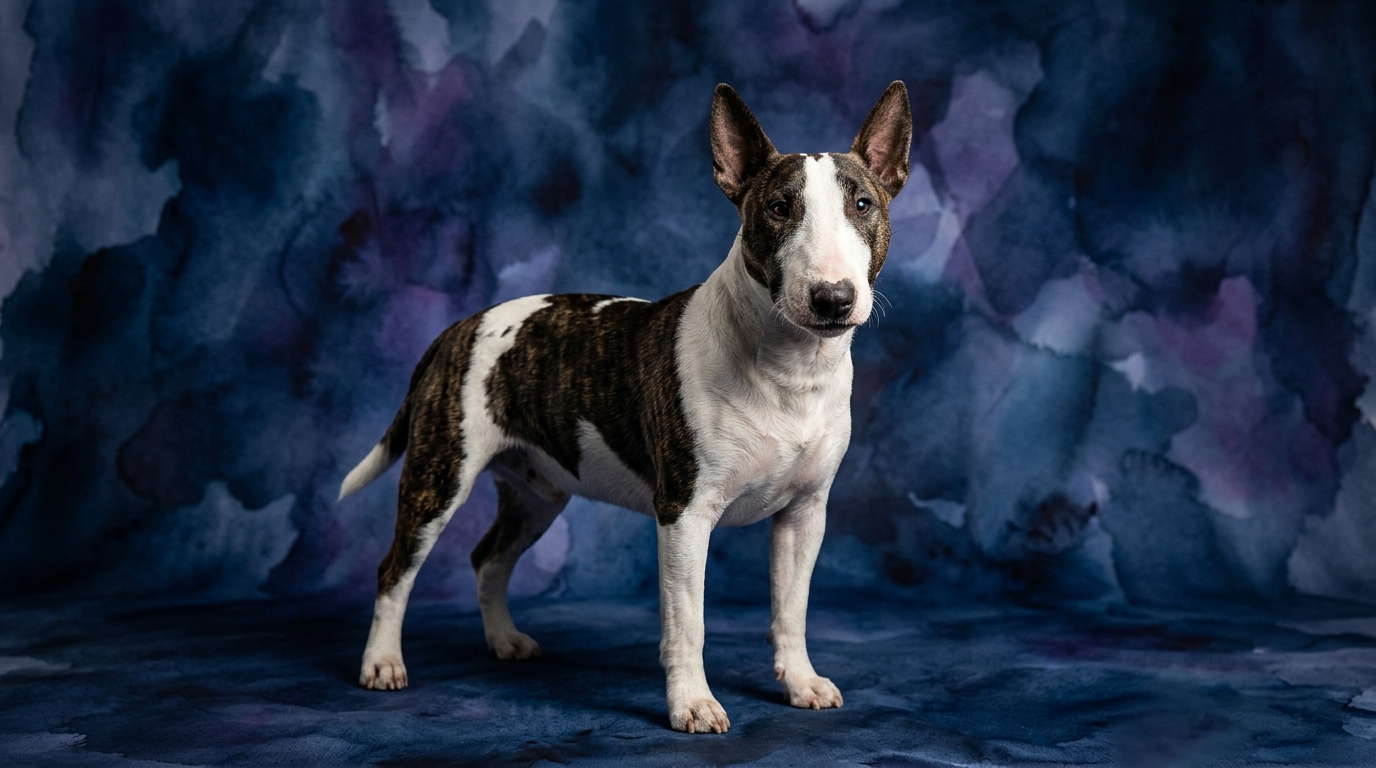
Miniature Bull Terrier at a glance
| IQ Rank / Score | 15/25 |
|---|---|
| Trainability | ★★★☆☆ (3/5) |
| Social Intelligence | ★★★☆☆ (3/5) |
| Lifespan | 12-16 years |
| Shedding | Low to moderate |
| Exercise Needs | Moderate (30-45 min/day) |
| Origin | England |
The Determined Ingenuity of the Mini Bull Terrier
At the core of the Miniature Bull Terrier's cognitive identity lies a remarkable blend of determined ingenuity driven by playfulness and an independent will. These spirited dogs don't just solve problems; they often approach challenges with a mischievous flair, finding creative, sometimes unexpected, solutions that serve their own agenda or simply provide amusement. Their intelligence isn't solely measured by eager obedience, but by their strategic engagement, often weighing the perceived reward against the effort or against their innate desires for fun or independence. This unique mental agility, coupled with their tenacious terrier spirit, means that while they possess a high capacity for learning, they also exhibit a strong sense of self, often choosing to comply only when they see value, consistency, or fun in the task. Their cleverness frequently shines through in their ability to outsmart obstacles, manipulate situations to their advantage, or invent new games, all while maintaining their characteristic 'clownish' charm. This primary angle highlights that their intelligence is deeply intertwined with their distinct personality, making them both endlessly entertaining and uniquely challenging companions who demand mental stimulation as much as physical exercise.
Unlike breeds primarily bred for biddability or repetitive tasks, the Miniature Bull Terrier's cognitive processes are geared towards exploration, problem-solving for self-gratification, and expressing a strong individual character. This makes them less prone to 'robot-like' adherence to commands and more inclined to engage in collaborative problem-solving, where their human is seen as a partner in crime rather than just an instructor. Their determination means they will persist with a task they deem interesting, sometimes to the point of stubbornness, making redirection and motivational techniques crucial for effective training and mental enrichment. They thrive on novelty and mental puzzles that challenge their wit, often displaying a surprisingly sophisticated understanding of cause and effect when it benefits their objectives. This profound independence and strategic thinking are defining characteristics of their intelligence, differentiating them from many other breeds.
A Noble History: Beyond the Fighting Pits
The Miniature Bull Terrier shares its lineage with the larger Bull Terrier, a breed with a fascinating and often misunderstood history that speaks volumes about their cognitive evolution. While their ancestors were indeed rooted in the bull-and-terrier crosses used in blood sports, a surprising scientific and historical fact reveals a deliberate shift in breeding priorities. In the mid-19th century, James Hinks, the 'Father of the Bull Terrier,' set out to refine the breed not just for physical prowess, but specifically for a unique temperament.
Hinks intentionally bred for a 'gentleman's companion,' aiming to create a 'White Cavalier' that combined tenacity with a dignified, protective, and even playful nature, rather than overt aggression. This was a pioneering effort in selective breeding for complex cognitive and emotional traits, demonstrating an early understanding that temperament was not merely a byproduct but a definable characteristic that could be molded over generations. The Miniature Bull Terrier inherited this refined disposition, embodying strength and determination alongside a loving, clownish spirit. This historical dedication to breeding for specific psychological attributes underscores the depth of their inherent intelligence and capacity for companionship, proving that their cleverness and unique personality are not accidental but are the result of deliberate human intervention aimed at cultivating a specific mental and emotional profile, far removed from their earlier, darker heritage.
Problem-Solving & Adaptability in the Mini Bull Terrier
Miniature Bull Terriers exhibit a robust capacity for problem-solving, earning their high IQ score in this domain. Their terrier heritage imbues them with a tenacious spirit, ensuring they rarely give up on a challenge they find motivating. Whether it's figuring out how to open a childproof gate, retrieve a hidden toy, or navigate a complex obstacle course, they approach tasks with a blend of determination and cleverness. They are not content with simple solutions and will often experiment with different approaches until they succeed, demonstrating remarkable cognitive flexibility and persistence.
However, their problem-solving prowess is often intrinsically linked to their independent nature and desire for self-gratification. They excel at puzzles and tasks that directly reward them, whether with food, a favorite toy, or engaging playtime. This means that while they are highly capable, they may not apply their intelligence to tasks they perceive as arbitrary or unrewarding. Their adaptability shines in novel environments, where their natural curiosity and confident demeanor drive them to explore and quickly understand new surroundings. They can assess situations rapidly and adjust their behavior, making them resourceful companions in various settings, provided they are given appropriate mental stimulation and their problem-solving urges are channeled constructively.
Learning & Training Dynamics: Navigating the Independent Spirit
While Miniature Bull Terriers possess high intelligence and are quick to grasp new concepts, their 'training speed' score of 3 reflects the unique challenges presented by their independent and often strong-willed temperament. They learn quickly when motivated, but consistently applying that learning in a reliable, obedient manner requires specific strategies. Unlike breeds that live to please, Mini Bulls are more inclined to weigh the value of compliance against their own desires or perceived fun. This means that rote repetition without engagement can quickly lead to boredom and a refusal to participate.
Effective training for a Miniature Bull Terrier demands creativity, consistency, and positive reinforcement that makes learning feel like a game. They respond best to short, engaging sessions filled with variety, high-value rewards, and enthusiastic praise. Punishment or harsh methods are counterproductive, as they can lead to stubbornness, fear, or a complete shutdown. Owners must be patient, firm, and inventive, understanding that 'no' from a Mini Bull Terrier isn't necessarily a lack of understanding, but often a declaration of independence. Early and consistent socialization, coupled with clear boundaries and rules, are crucial to shaping their intelligent but sometimes impetuous nature into a well-mannered companion. Their capacity to learn is high; their willingness to always perform on command is what requires skilled and dedicated training.
Social & Emotional Intelligence in the Miniature Bull Terrier
The Miniature Bull Terrier's social intelligence, scored at 3, paints a nuanced picture of their interactions. They are deeply affectionate and loyal with their chosen family, often forming strong, almost familial bonds that border on human-like understanding. They are adept at reading their owner's moods and can offer comfort or solicit play with surprising intuition, demonstrating a high degree of emotional attunement within their inner circle. Their clownish antics often serve as a way to engage and entertain their humans, showcasing a sophisticated understanding of social interaction designed to elicit positive responses.
However, their social grace can be more selective outside of their immediate family. They can be reserved or even aloof with strangers, and their strong personalities mean they may not always be harmonious with other dogs, especially if not well-socialized from a young age. Their inherent self-confidence and terrier tenacity can sometimes translate into stubbornness or possessiveness in social settings. While they certainly have the capacity for empathy and complex social bonds, their independent streak and selective nature mean their social intelligence is often directed towards deepening their core human relationships rather than being broadly applied to all social encounters. Proper socialization is therefore paramount to ensure their intelligence is used for positive interactions, fostering acceptance and appropriate behavior in diverse social environments.
Instinctive Cognition: A Deep-Seated Drive
The Miniature Bull Terrier's instinctive drive, rated at 4, is a powerful force shaping their cognitive landscape. As true terriers, they possess a strong prey drive, an ancient instinct to hunt and chase small, fast-moving objects. This instinct influences their focus and problem-solving, often manifesting as intense concentration during games involving chasing balls or toys, or a determined pursuit of squirrels in the backyard. This drive is not merely physical; it involves complex cognitive processes of tracking, anticipating prey movement, and strategic planning for capture.
Beyond prey drive, they exhibit other strong terrier instincts, such as digging with fervent enthusiasm, often to unearth imaginary rodents or simply for the pure satisfaction of excavation. Their territorial instincts can also be pronounced, leading to alert guarding behaviors and a keen awareness of their surroundings. These deeply ingrained cognitive programs mean that while Miniature Bull Terriers are adaptable, their fundamental nature is governed by these powerful, ancestral urges. Understanding and appropriately channeling these drives through structured play, scent work, or supervised digging areas is crucial for their mental well-being and to prevent undesirable behaviors. Their instinctive cognition is a testament to their heritage, influencing everything from their play patterns to their interactions with the world.
Memory & Recall: Sharp Minds, Lasting Impressions
Miniature Bull Terriers boast an excellent memory, scoring a 4 in this cognitive domain. They are highly adept at remembering commands, routines, and the locations of favorite toys or treats. Once they learn a command or a routine, it tends to stick, often requiring less refresher training than one might expect given their independent nature. This strong recall applies not only to positive associations, such as where their treats are kept or the daily walk schedule, but also to negative experiences. They remember perceived injustices or unpleasant encounters, which can influence their future interactions and behaviors.
Their memory extends beyond simple commands to complex associations and social cues. They remember specific people, other dogs, and places, and can often recall past events, like a particularly fun park visit or a stressful vet trip. This robust memory is a double-edged sword: it allows them to quickly build a repertoire of learned behaviors and routines, making them capable students, but it also means that early positive experiences and consistent, fair training are paramount. A Mini Bull Terrier will remember the training methods used, the tone of voice, and the emotional context of their learning, emphasizing the importance of patience and positive reinforcement for long-term behavioral success and a strong bond.
Optimizing Your Mini Bull Terrier's Cognitive Potential
To truly unlock and celebrate the Miniature Bull Terrier's unique intelligence, owners must commit to consistent mental stimulation and thoughtful training. Their determined ingenuity thrives on challenges, making puzzle toys, interactive feeders, and scent games excellent tools to engage their minds. Incorporate variety into their routines, as their sharp minds and independent spirits can quickly become bored with monotonous tasks, leading to mischievous self-entertainment. Agility, obedience, or even trick training can be incredibly rewarding, provided sessions are kept fun, positive, and short.
Early and ongoing socialization is crucial to channel their social intelligence constructively, helping them learn appropriate interactions with people and other dogs. Understand that their 'training speed' is often a measure of their willingness to cooperate, not their ability to learn. Approach training as a partnership, using high-value rewards and enthusiastic praise to motivate their clever, independent minds. Providing a secure, stimulating environment where their instinctive drives can be safely expressed—like designated digging areas or structured chase games—will contribute significantly to their overall cognitive health and happiness. A mentally engaged Mini Bull Terrier is a happier, better-behaved companion, ready to apply their unique intelligence in countless charming ways.
3 At-Home Tests to Measure Your Miniature Bull Terrier's IQ
These tests are adapted from peer-reviewed ethology research. No equipment is needed beyond items you have at home. Run each test 5–10 times for reliable results.
The Myth: "Miniature Bull Terriers are stubborn and difficult to train, indicating low intelligence."
✅ Miniature Bull Terriers are highly intelligent and quick learners; their 'stubbornness' is often an expression of their independent thinking and preference for tasks they find engaging. They respond best to positive reinforcement, consistency, and training that appeals to their desire for fun and problem-solving, rather than rote obedience, proving their intelligence requires a different approach, not more effort due to dullness.
Miniature Bull Terrier vs. Similar Breeds
🧠 What's Your Dog's IQ Score?
Our full Pet IQ Lab assessment includes 12+ tests across 5 cognitive dimensions, calibrated for Miniature Bull Terriers specifically.
Take the Full IQ Test →Frequently Asked Questions
How smart is a Miniature Bull Terrier?
Our Pet IQ Lab framework scores cognition across five dimensions (max 25). The Miniature Bull Terrier totals 15/25 — above-average for a domestic dog. The full article breaks down each dimension with at-home tests.
Are Miniature Bull Terriers easy to train?
Miniature Bull Terriers can learn most cues, but expect to repeat lessons and keep sessions short. They score 3/5 on Training Speed in our breed profile.
Are Miniature Bull Terriers good with children and other pets?
Miniature Bull Terriers can live well with families when socialized early. Their Social Intelligence scores 3/5, so supervise interactions with small children and introduce new pets gradually.
Do Miniature Bull Terriers need a lot of mental stimulation?
Miniature Bull Terriers benefit from 10-15 minutes of focused enrichment a day: food puzzles, short training drills, or novel toys rotated weekly.
How much exercise does a Miniature Bull Terrier need?
Miniature Bull Terriers do well with 20-40 minutes of daily walks and play plus a few short training moments.
How good is a Miniature Bull Terrier's memory?
Miniature Bull Terriers score 3/5 on memory. They remember high-value associations well; less-used cues fade without refresher sessions.
What is the typical lifespan of a Miniature Bull Terrier?
Miniature Bull Terriers commonly live 12-16 years when kept at a healthy weight.
The Miniature Bull Terrier is a breed of remarkable intelligence, characterized by determined ingenuity, a playful spirit, and an unwavering independent will. Understanding and catering to their unique cognitive profile will unlock a world of clever antics and deep companionship, making them a truly rewarding, albeit challenging, member of the family.