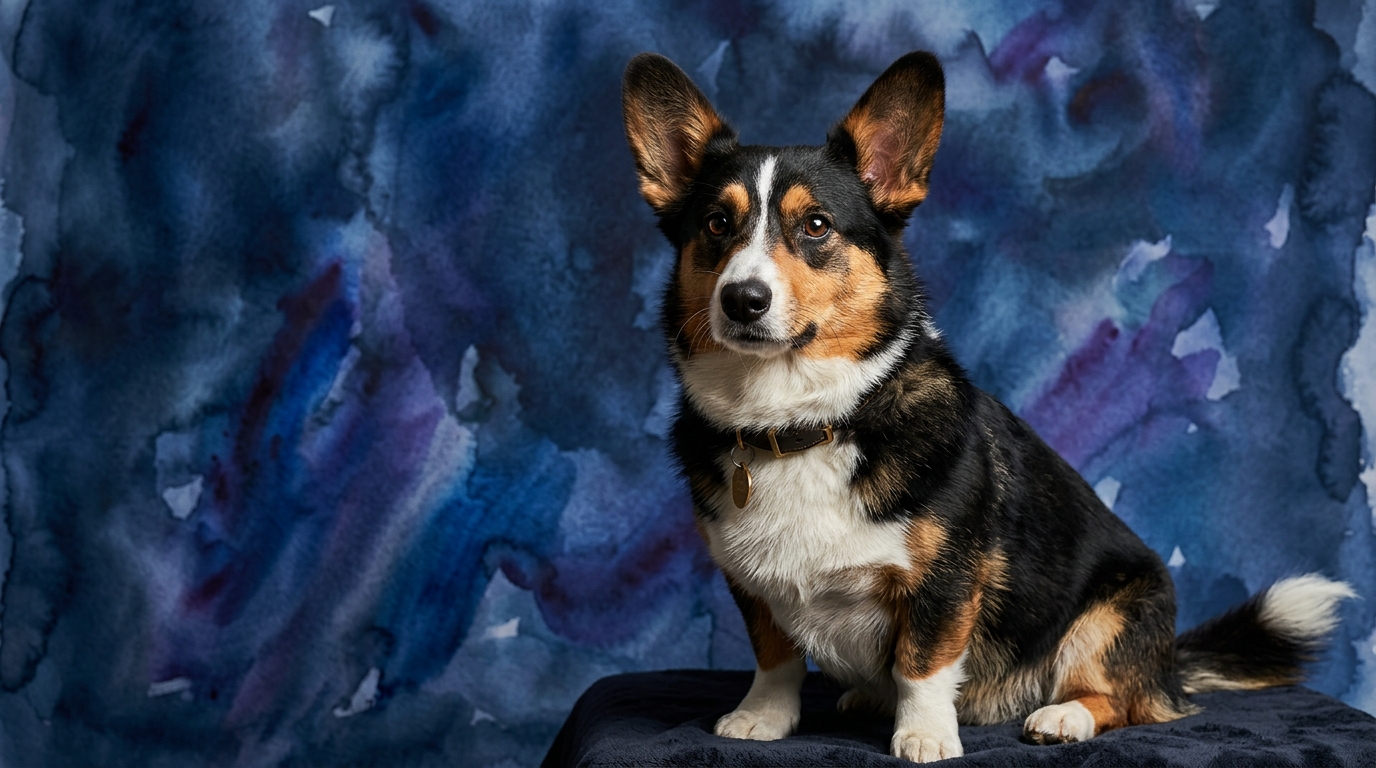

Side-by-Side IQ Profile: Cardigan Welsh Corgi vs. Briard
At The Cosmic Pet Pet IQ Lab, we evaluate canine intelligence across five key dimensions. Interestingly, both the Cardigan Welsh Corgi and the Briard share identical scores across these metrics, yet the practical implications of these scores reveal distinct cognitive styles shaped by their breed histories and physical forms.
**Problem Solving (4/5 for both):** These agile Corgis excel at navigating intricate spaces, often using clever routes or tactics to achieve goals. Their cattle-herding history demanded quick, adaptable thinking to outmaneuver large livestock, showcasing a practical, immediate problem-solving style. They might ingeniously open cabinets or manipulate toys. The Briard's 4/5 problem-solving skills are applied more strategically, often in protective roles. As guardians and herders, they needed to assess threats, manage groups, and make independent decisions over large areas. This translates to a thoughtful, observant approach, analyzing situations before acting, and developing sophisticated methods for managing their family 'flock.'
**Training Speed (4/5 for both):** With 4/5 training speed, Corgis are generally quick learners, absorbing commands and routines eagerly. Their desire to participate and food motivation make them highly receptive to positive reinforcement, allowing them to master complex sequences efficiently. Also scoring 4/5, Briards grasp information rapidly, driven by a desire for purposeful work. Their focus and strong handler bond enable efficient learning. However, their independent thinking means they may evaluate a command's *purpose* before complying, distinguishing them from breeds that obey purely by rote.
**Social Intelligence (3/5 for both):** A 3/5 score indicates moderate social intelligence for Corgis. They bond deeply with family but can be reserved or wary with strangers. Their interactions are often direct, sometimes attempting to 'herd' people, reflecting instinct rather than broad gregariousness. They read family emotions well but less so with outsiders. Similarly, the Briard's 3/5 points to a nuanced social nature. Fiercely loyal and affectionate with family, they understand their needs deeply. However, guardian instincts make them suspicious of strangers, requiring extensive socialization for appropriate responses. Their social world is often clearly divided.
**Instinctive Drive (3/5 for both):** The 3/5 instinctive drive in Corgis is primarily expressed through strong herding tendencies: gathering, chasing, and sometimes nipping at heels. They also possess a notable prey drive and are alert watchdogs, prone to barking at novel stimuli. For Briards, 3/5 instinctive drive encompasses both herding and guarding. Their deep instinct to protect leads to territoriality and a natural inclination to patrol. While herding with a 'living fence' style, their protective drive is equally prominent, making them vigilant defenders of their home and family.
**Memory (4/5 for both):** A 4/5 memory means Corgis recall commands, routines, and experiences with clarity, aiding training. They remember individuals, both friendly and suspicious, over extended periods. Briards also exhibit 4/5 memory, retaining training, boundaries, and past interactions precisely. This strong memory ensures consistent performance and accurate recognition of people and situations. They are unlikely to forget a lesson, whether positive or negative, or a perceived threat.
Where the Cardigan Welsh Corgi Wins Cognitively
Despite identical scores, the Corgi's cognitive strengths often shine in close-quarter, agile decision-making. Their low stature and robust build make them masters of navigating tight spaces and executing rapid directional changes, a spatial intelligence vital for their historical role of ducking under cattle. This physical prowess translates to mental agility, allowing swift adaptation to changing training scenarios or household dynamics, often finding clever, sometimes mischievous, solutions to immediate problems. Their compact size allows efficient application of problem-solving to intricate puzzle toys or indoor obstacles, often with focused cognitive drive.
Where the Briard Wins Cognitively
Briard cognitive advantages emerge when tasks demand endurance, independent judgment, and broad environmental awareness. Their history as guardians and herders in expansive territories cultivated a strategic intelligence focused on long-term planning and autonomous decision-making. A Briard excels at monitoring environments, assessing distant threats, and employing a 'living fence' herding style requiring understanding flock dynamics and wide-area control. This translates to a deliberate, thoughtful problem-solving approach in complex situations, prioritizing patience and comprehensive 'big picture' understanding over quick reactions.
Which is Easier to Train and Why
While both breeds share a 4/5 training speed, the practical training experience differs significantly. The Cardigan Welsh Corgi, with its eager-to-please nature and smaller size, often feels 'easier' for many owners, particularly novices. Their physical manageability during leash training or basic obedience is a key factor. However, their strong herding instinct can lead to persistent nipping at heels or chasing, demanding dedicated redirection and consistent boundary setting to prevent unwanted behaviors, requiring the owner's cognitive effort to manage these specific drives.
The Briard, despite its equal training speed, demands a more experienced, consistent handler. Its independent, protective nature necessitates early, extensive socialization to channel guardian instincts appropriately. While they learn commands quickly, their strong will and tendency to evaluate situations independently mean training builds a trusting partnership with clear communication and firm leadership. A Briard might question a command if it perceives it illogical or contrary to protective duties, requiring the trainer to provide rationale or unwavering leadership. Their larger size also necessitates greater physical control. Thus, the Corgi might feel easier due to less resistance to physical guidance and a more straightforward motivation, while the Briard demands deeper cognitive engagement from the trainer.
Which Suits Active Owners vs. Relaxed Owners
The Cardigan Welsh Corgi thrives with active engagement. Owners who provide daily walks, puzzle toys, and interactive play will find their Corgi a willing participant. Their need for mental stimulation means they appreciate consistent training and varied activities to prevent boredom-driven mischief. They can adapt to a more relaxed indoor lifestyle *if* exercise and mental enrichment are consistently met through focused bursts of activity. A truly relaxed owner offering minimal engagement might find a Corgi developing unwanted habits from under-stimulation.
The Briard is unequivocally suited for highly active owners committed to significant daily exercise and purposeful mental work. Their large size, high energy, and historical role demand extensive outdoor activity, whether long hikes, dog sports, or a 'job.' A Briard needs space to run and opportunities to utilize its strategic herding and guarding instincts. A relaxed owner unable to provide this level of physical and mental engagement will likely encounter a frustrated, potentially destructive, and difficult-to-manage Briard; they are not content to be couch potatoes without substantial prior exertion.
The Verdict
Opt for the Cardigan Welsh Corgi if you seek a compact, agile companion that thrives on interactive play and quick problem-solving within a family setting, and you are prepared to channel their keen herding instincts with consistent, positive reinforcement. They are ideal for owners who can provide regular mental challenges and enjoy a dog that is both clever and manageable in size.
Select the Briard if you are an experienced, highly active owner committed to extensive daily exercise, early socialization, and consistent leadership for a large, protective, and independent thinker. They are best suited for those who appreciate a dog with profound loyalty and a natural inclination for guarding and strategic work, thriving in environments where they have a clear purpose.
🧠 Find Your Pet's IQ Score
Our Pet IQ Lab assessment covers 25+ tests across 5 cognitive dimensions — personalized to your breed.
Take the Full IQ Test →Frequently Asked Questions
Do Cardigan Welsh Corgis and Briards have similar intelligence levels?
Based on our IQ profiles, both breeds share similar scores across problem-solving, training speed, social intelligence, instinctive drive, and memory, indicating comparable overall cognitive capacity. However, the *application* and *manifestation* of these intelligence dimensions differ significantly due to their distinct physicalities and historical roles.
Which breed is better for a first-time dog owner?
The Cardigan Welsh Corgi is generally a more suitable choice for a first-time dog owner due to its more manageable size and generally more straightforward training needs, provided the owner is prepared for their strong herding instincts. The Briard's size, protective nature, and independent thinking require a more experienced and committed handler.
How do their herding styles reflect their cognitive differences?
The Corgi's herding style involves quick nips at heels, requiring agile, reactive problem-solving in close quarters, while the Briard employs a 'living fence' approach, demanding strategic, long-range observation and independent decision-making to manage flocks. These styles highlight their distinct cognitive strengths in different operational environments.