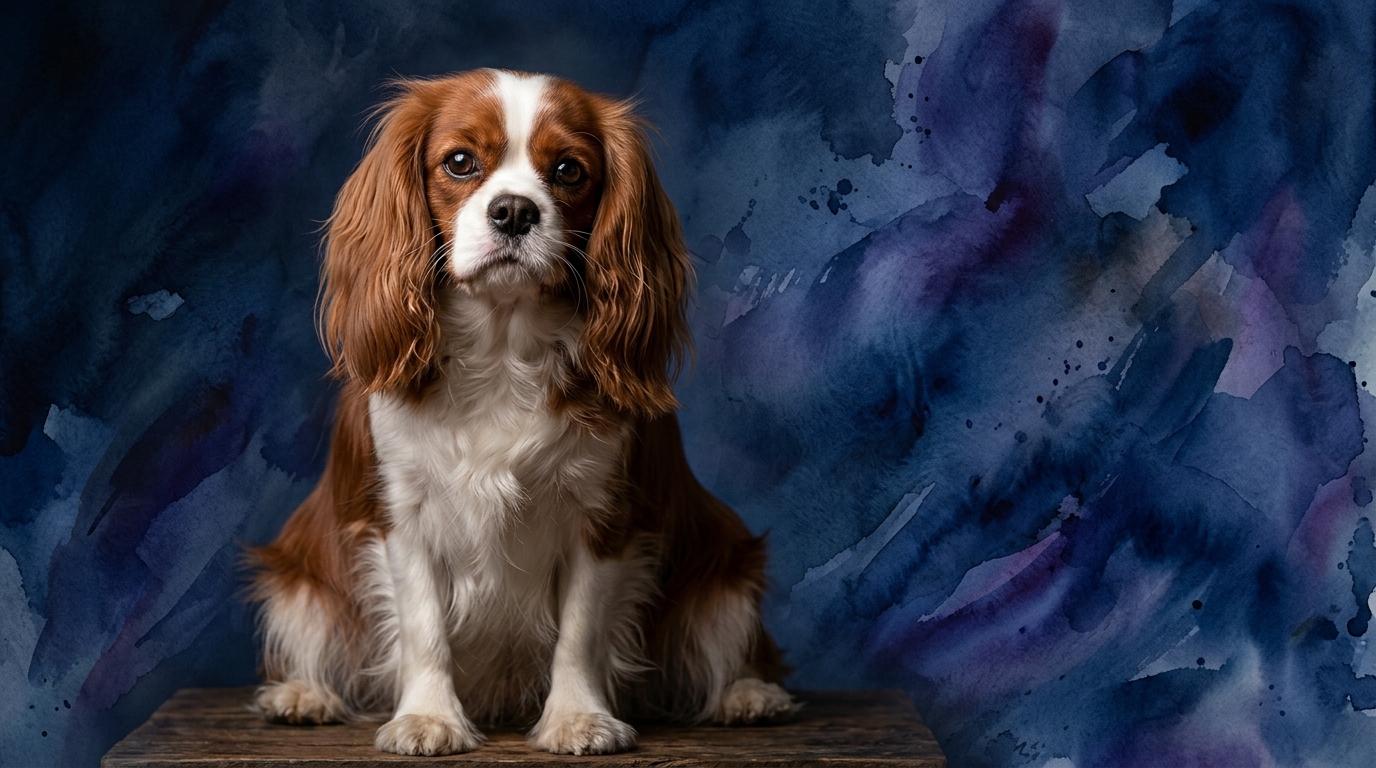

Side-by-Side IQ Profile: Cavalier King Charles Spaniel vs. Russian Toy
The Cavalier King Charles Spaniel, a breed with a Coren ranking of #44, presents a cognitive profile marked by its exceptional relational capacity. Our Pet IQ Lab assessment scores their Problem Solving at 3/5, indicating a moderate ability to navigate novel challenges and figure out solutions independently. Their Training Speed also stands at 3/5, suggesting a steady pace of learning new commands and routines. Where the Cavalier truly distinguishes itself is in Social Intelligence, earning a remarkable 5/5; this dimension reflects a profound understanding of human emotions, social cues, and an inherent desire for connection. Instinctive Drive, encompassing natural predispositions like hunting or herding, is rated at 3/5, signifying a balanced level of innate behaviors. Finally, their Memory is assessed at 3/5, showing a solid capacity to recall past experiences and learned information.
In contrast, the Russian Toy, while not included in Coren's broader ranking, offers a consistent and well-rounded cognitive blueprint across all assessed dimensions. This spirited companion scores 3/5 for Problem Solving, demonstrating a similar moderate aptitude for navigating new puzzles and situations as the Cavalier. Their Training Speed also aligns at 3/5, indicating an average pace for acquiring new skills and behavioral patterns. Social Intelligence for the Russian Toy is rated at 3/5, suggesting they are responsive to human interaction and capable of forming bonds, though perhaps with a less intense focus on human emotional states compared to the Cavalier. Instinctive Drive is likewise at 3/5, pointing to a balanced expression of inherent breed behaviors. Their Memory also scores 3/5, reflecting a reliable ability to retain information over time.
A direct comparison of these profiles highlights a striking similarity across most cognitive domains: both breeds demonstrate equivalent scores of 3/5 in Problem Solving, Training Speed, Instinctive Drive, and Memory. This suggests that in terms of raw aptitude for learning, memory retention, and intrinsic drives, they operate on a comparable baseline. The singular, yet profoundly impactful, divergence lies in their Social Intelligence scores. The Cavalier's 5/5 in this area sets it apart, indicating a significantly higher attunement to human social dynamics than the Russian Toy's respectable 3/5. This difference is pivotal in understanding their distinct interaction styles and how they integrate into human families.
Where the Cavalier King Charles Spaniel Wins Cognitively
The Cavalier King Charles Spaniel's undeniable cognitive strength resides squarely in its extraordinary Social Intelligence, achieving a perfect 5/5 score. This isn't merely about being affectionate; it represents a sophisticated ability to interpret human body language, vocal inflections, and emotional states with remarkable accuracy. A Cavalier can often pre-empt an owner's needs or mood, offering comfort or initiating play at just the right moment, not because it's been explicitly trained to do so, but because it genuinely understands the social context. This keen perception allows them to seamlessly integrate into family life, adapting their behavior to different individuals and situations, becoming truly intuitive companions.
This elevated social acumen translates into a dog that often feels like it's 'reading your mind.' They excel in roles where deep human-animal connection is paramount, such as therapy work or simply being a devoted family member who offers unconditional emotional support. For example, a Cavalier might instinctively nudge a hand when its owner is feeling down, or quietly settle beside someone who is stressed, demonstrating an empathetic response that stems directly from their high social intelligence. Their capacity to form such profound, understanding bonds is a unique cognitive advantage, creating a partnership built on mutual emotional awareness.
Where the Russian Toy Wins Cognitively
While the Russian Toy doesn't boast a higher score in any single cognitive dimension, its consistent 3/5 across the board in Problem Solving, Training Speed, Instinctive Drive, and Memory presents its own form of cognitive advantage: a robust and predictable baseline. This consistency implies a well-balanced intellect that isn't overwhelmingly driven by one specific cognitive trait, fostering a more independent problem-solving approach. Unlike a breed with extremely high social intelligence that might constantly seek human input, the Russian Toy's balanced social score of 3/5 means it's less prone to over-reliance on human cues, potentially encouraging more self-initiated exploration and resolution of minor puzzles in its environment.
Furthermore, the Russian Toy's origin as an alert companion, despite its small stature, suggests an inherent awareness and observational capacity that, combined with its 3/5 Problem Solving and Memory, makes it a capable little dog in navigating its immediate surroundings. Its cognitive profile supports a certain self-assuredness; it will learn and remember tasks efficiently and solve problems without necessarily needing constant human validation or direction. This balanced profile makes them adaptable to various routines and environments, providing a reliable and stable cognitive presence without the intense emotional mirroring seen in breeds with higher social scores.
Which is Easier to Train and Why?
When considering ease of training, both the Cavalier King Charles Spaniel and the Russian Toy share an identical Training Speed score of 3/5, suggesting they both learn new commands at an average pace. However, the *experience* of training can differ significantly due to their divergent Social Intelligence scores. The Cavalier, with its 5/5 social acumen, is profoundly attuned to its owner's moods, intentions, and desires. This high level of social understanding means they are often inherently motivated to please, making them highly responsive to praise, gentle correction, and the positive reinforcement of their owner's approval. Their desire to maintain social harmony can make the training process feel smoother and more intuitive, as they actively seek to understand and comply with human expectations, often anticipating cues.
In contrast, the Russian Toy's 3/5 Social Intelligence, while perfectly adequate for forming strong bonds, means they might not be as intensely driven by the desire to appease or as sensitive to subtle human social cues during training. They will learn at the same speed, but an owner might need to be more explicit, consistent, and creative with motivators like treats or toys to maintain their engagement. The Russian Toy's training might require a slightly more structured and less emotionally nuanced approach, as they are less likely to 'guess' what the owner wants based solely on social context. Their learning is reliable, but the trainer might need to be a clearer, more direct communicator.
Which Suits Active Owners vs. Relaxed Owners?
The choice between a Cavalier King Charles Spaniel and a Russian Toy also depends on an owner's lifestyle, though both breeds possess a moderate Instinctive Drive of 3/5. The Cavalier's profound social intelligence makes it an ideal companion for relaxed owners who desire a constant, emotionally responsive presence. They thrive on companionship and are happiest when involved in family activities, whether that's lounging on the sofa, a gentle stroll, or accompanying their owner on errands. Their moderate drive means they appreciate regular, but not overly strenuous, exercise, making them well-suited to individuals or families seeking a devoted, low-to-moderate energy companion who prioritizes shared emotional space.
The Russian Toy, with its consistent 3/5 across all cognitive dimensions, including Instinctive Drive, offers versatility for both relaxed and moderately active owners. While they are content to cuddle, their background as a lively, alert companion means they also enjoy bursts of activity, interactive play, and can keep up on walks. They might appeal more to owners who appreciate a slightly more independent spirit while still valuing companionship. Their smaller size and agility mean they can get sufficient exercise indoors or in smaller outdoor spaces, making them adaptable to apartment living. For owners who enjoy engaging in short, playful sessions or even some introductory dog sports like agility, the Russian Toy's balanced drive and problem-solving skills make them a surprisingly capable and enthusiastic participant.
The Verdict
Choose the Cavalier King Charles Spaniel if your primary desire is an exceptionally empathetic, emotionally attuned companion who thrives on deep social connection and seamlessly integrates into your family's emotional fabric.
Opt for the Russian Toy if you seek a consistently capable, spirited, and slightly more independent companion who learns reliably and engages with the world with a balanced, self-assured intellect.
🧠 Find Your Pet's IQ Score
Our Pet IQ Lab assessment covers 25+ tests across 5 cognitive dimensions — personalized to your breed.
Take the Full IQ Test →Frequently Asked Questions
Do Cavalier King Charles Spaniels need more attention than Russian Toys?
Given their 5/5 Social Intelligence, Cavalier King Charles Spaniels generally have a stronger innate need for consistent human interaction and companionship, thriving on being part of family activities. Russian Toys, with 3/5 social intelligence, appreciate company but might demonstrate a slightly more independent streak, being content with periods of self-entertainment.
Are Russian Toys difficult to house-train due to their small size?
Russian Toys have a 3/5 Training Speed and 3/5 Memory, indicating a reliable capacity for learning, including house-training, similar to Cavaliers. Their small bladder size means more frequent trips outside are necessary, but with consistent positive reinforcement and a structured schedule, they can be successfully house-trained.
Can either breed excel in dog sports or advanced obedience?
Both breeds, with 3/5 in Problem Solving, Training Speed, and Memory, possess the foundational cognitive abilities to engage in dog sports or advanced obedience. The Cavalier's high social intelligence might make them more eager to please in obedience, while the Russian Toy's agility and balanced intellect make them surprisingly capable in areas like miniature agility or rally.