
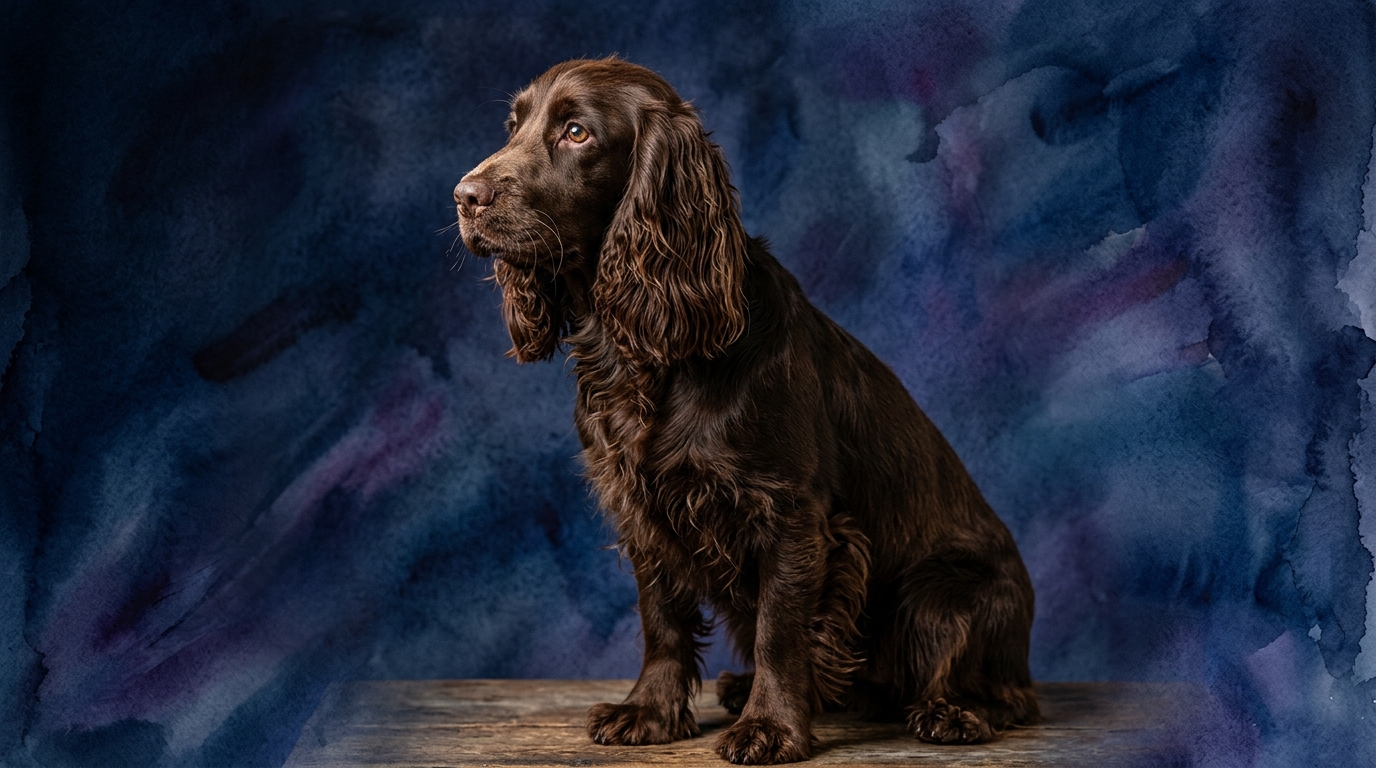
Side-by-Side IQ Profile: Chesapeake Bay Retriever vs. Field Spaniel
The Cosmic Pet Pet IQ Lab employs a five-dimensional framework to assess canine intelligence, offering a nuanced look at how different breeds process the world. Here's how the Chesapeake Bay Retriever and Field Spaniel stack up:
Chesapeake Bay Retriever (CBR) - Coren Rank #27:
Problem Solving (4/5): CBRs demonstrate a strong capacity for independent thought and figuring out complex tasks. Their ability to assess and adapt to novel obstacles, whether it's navigating a complex scent trail or strategizing how to retrieve a decoy from challenging waters, is a hallmark of their mental agility.
Training Speed (4/5): These dogs pick up new commands and routines with impressive swiftness, often requiring fewer repetitions than many other breeds. This quick learning curve is coupled with a resolute drive to work, making them exceptionally responsive to consistent, engaging training methods that tap into their desire for purpose.
Social Intelligence (3/5): While capable of forming deep bonds with their primary caregivers, CBRs typically exhibit a reserved demeanor with strangers. Their social intelligence is geared more towards understanding their immediate pack dynamics and working relationships rather than broad, effusive interactions.
Instinctive Drive (3/5): Possessing a strong, purposeful drive rooted in their heritage as waterfowl retrievers, CBRs are motivated by tasks that engage their natural instincts. This drive is focused and persistent, less about generalized exuberance and more about completing a specific objective.
Memory (4/5): Their recall of commands, routines, and spatial layouts is exceptional. A CBR will remember past experiences, both positive and negative, influencing future behaviors and demonstrating a lasting retention of learned information and familiar environments.
Field Spaniel (FS) - Not Coren-Ranked:
Problem Solving (3/5): Field Spaniels show a moderate ability to tackle new problems, often relying on learned strategies or guidance from their handler. They can navigate challenges effectively, but might require more encouragement or structured approaches to complex, multi-step tasks, thriving with a handler's guidance rather than complete self-direction.
Training Speed (3/5): These spaniels learn at a steady pace, absorbing commands and cues with good consistency. While not as rapid as some high-drive working breeds, their willingness to please and gentle disposition ensure they respond well to patient, positive reinforcement, making the training journey a rewarding partnership.
Social Intelligence (3/5): Field Spaniels are known for their gentle and amiable nature, forming strong, affectionate bonds with their families. Their social intelligence is expressed through their desire for companionship and their sensitivity to human emotions, though they can be reserved initially with new people.
Instinctive Drive (3/5): Their instinctive drive, primarily for flushing and retrieving game, is present but typically less intense and more cooperative than some other sporting breeds. They enjoy engaging in scent work and retrieving games, demonstrating a balanced enthusiasm for their natural roles.
Memory (3/5): Field Spaniels possess a good, reliable memory for commands, routines, and people. They retain information effectively over time, allowing for consistent performance once a skill is well-established, though perhaps not with the same depth of detail or independence as breeds with higher scores.
Where the Chesapeake Bay Retriever Wins Cognitively
The Chesapeake Bay Retriever clearly outpaces the Field Spaniel in two critical cognitive dimensions: problem-solving and memory, both scoring 4/5 compared to the Field Spaniel’s 3/5. This translates into a dog that can independently analyze and overcome complex environmental challenges with greater ingenuity, perhaps devising a novel approach to retrieve a distant object or deciphering an unfamiliar scent puzzle without constant handler intervention. Their superior memory means they not only grasp new tasks faster but also retain that information with remarkable accuracy over extended periods, making intricate routines, multi-stage commands, or even remembering specific locations of past retrieves more consistently reliable. For owners seeking a dog capable of complex, self-directed work, advanced competitive obedience, or specialized tasks requiring sustained mental effort, the CBR’s cognitive profile offers a distinct and powerful advantage.
Where the Field Spaniel Wins Cognitively
While the Field Spaniel doesn't boast higher individual scores in problem-solving, training speed, or memory compared to the Chesapeake Bay Retriever, its consistent 3/5 across all dimensions, including social intelligence and instinctive drive, points to a beautifully balanced cognitive profile. This equilibrium means the Field Spaniel is less likely to be overly obsessive or singularly focused in one particular cognitive area, offering a more harmonious and adaptable mental state that integrates well into a wider range of household dynamics. Their moderate instinctive drive (3/5) makes them enthusiastic participants in activities like scent games or retrieving, but without the intense, singular focus that might demand constant outlet in higher-drive breeds. This balance can be a significant 'win' for owners desiring a mentally engaged companion who is equally content with a stimulating puzzle toy as they are with a quiet snuggle on the couch, without the potential for the higher cognitive demands of a CBR to manifest as boredom or destructive behavior if not adequately challenged daily.
Which is Easier to Train and Why
The Chesapeake Bay Retriever generally presents as the easier breed to train, primarily due to its superior scores in Training Speed (4/5) and Problem Solving (4/5), coupled with a strong Memory (4/5). CBRs grasp new concepts and commands with remarkable alacrity, often requiring fewer repetitions to solidify a behavior. Their problem-solving acumen means they can deduce solutions to training challenges more independently, and their excellent memory ensures that once learned, behaviors are retained reliably. The CBR’s quicker uptake and impressive retention mean that a well-structured training program, particularly one that incorporates variety and challenge, will yield faster, more complex results, allowing for progression into advanced dog sports or working roles.
In contrast, the Field Spaniel, with 3/5 in Training Speed, will learn effectively but at a steadier, more deliberate pace, necessitating more consistent and patient repetition. While both breeds respond well to positive reinforcement, the Field Spaniel thrives on a gentler, more encouraging approach that prioritizes building confidence and a strong bond over speed. While they may take longer to master a new skill, their eagerness to please ensures that patience and consistency will ultimately result in a well-trained, responsive companion, perfectly suited for obedience, rally, or agility at a more measured pace.
Which Suits Active Owners vs. Relaxed Owners
For the truly active owner seeking a partner for demanding outdoor pursuits or competitive dog sports, the Chesapeake Bay Retriever is the more fitting choice. Their higher problem-solving and memory scores, combined with a focused instinctive drive (3/5), equip them for sustained, purposeful activity. They thrive on having a 'job' that engages both their robust body and keen mind, excelling in demanding tasks like waterfowl hunting, competitive obedience, or even search and rescue, where independent thought and unwavering physical endurance are paramount.
Conversely, the Field Spaniel, with its balanced 3/5 scores across the board and a generally amiable, somewhat more biddable temperament, is better suited for owners who enjoy consistent, moderate activity rather than intense, high-octane adventures every single day. They appreciate regular, engaging walks, playful retrieval sessions in the yard, and opportunities for scent work, but are equally content to relax calmly indoors, making them an excellent fit for individuals or families who desire an active companion that also possesses a calm, affectionate demeanor for quiet evenings and family time.
The Verdict
Choose the Chesapeake Bay Retriever if you are an experienced, active owner seeking a cognitively robust partner for challenging outdoor activities, advanced training, or competitive work, valuing independent problem-solving and rapid learning.
Opt for the Field Spaniel if you desire a gentle, affectionate companion who enjoys moderate activity and consistent training, appreciating a balanced cognitive profile that thrives on companionship and a less intense, more harmonious lifestyle.
🧠 Find Your Pet's IQ Score
Our Pet IQ Lab assessment covers 25+ tests across 5 cognitive dimensions — personalized to your breed.
Take the Full IQ Test →Frequently Asked Questions
Do Chesapeake Bay Retrievers require more mental stimulation than Field Spaniels?
Yes, with higher scores in problem-solving and memory, Chesapeake Bay Retrievers generally require more consistent and varied mental stimulation to prevent boredom and destructive behaviors. Field Spaniels also benefit from mental engagement but typically do not demand the same intensity or complexity, thriving on moderate cognitive challenges.
Are Field Spaniels good for first-time dog owners?
Field Spaniels can be a good choice for first-time owners who are committed to consistent, positive training and socialization, as their moderate training speed and amiable social intelligence make them responsive learners. Their balanced drive is less overwhelming than some higher-energy breeds, making them more manageable for novices.
How do their social intelligence scores impact their family life?
Both breeds score 3/5 in social intelligence, meaning they form strong bonds with their families. The Chesapeake Bay Retriever tends to be more reserved with strangers, while the Field Spaniel is generally more universally amiable once comfortable, making both excellent family companions, albeit with slightly different approaches to new acquaintances and visitors.