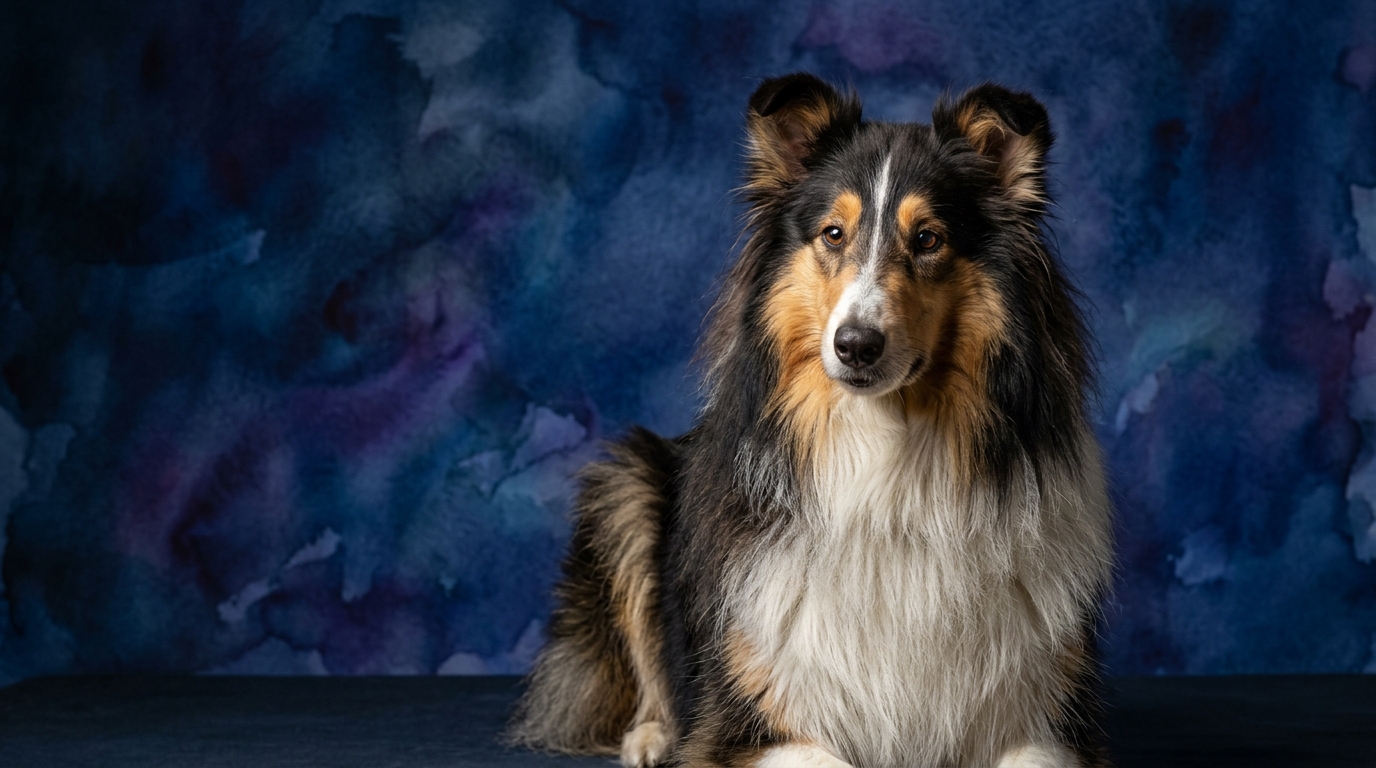
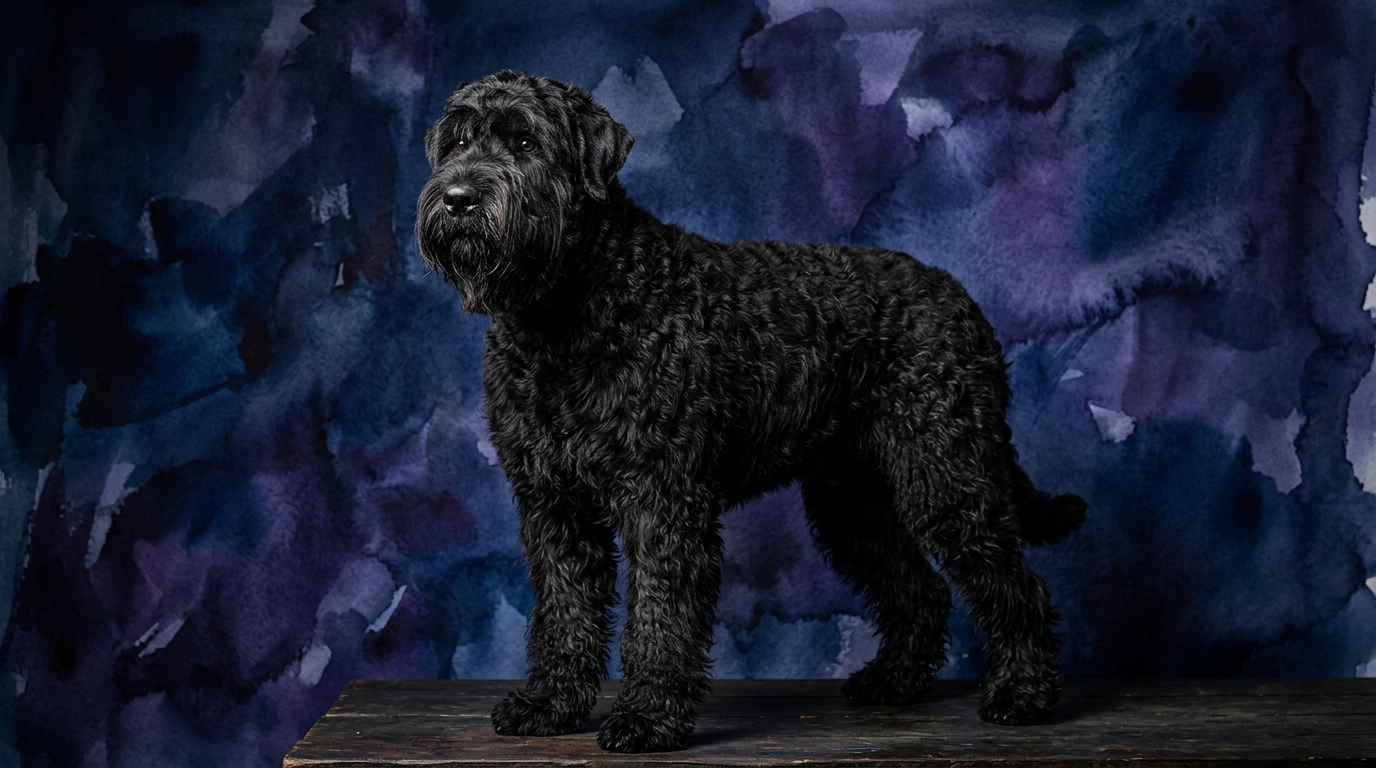
Side-by-Side IQ Profile: Collie (Rough) vs Black Russian Terrier
The Cosmic Pet Pet IQ Lab employs a five-dimensional framework to assess canine intelligence, providing a nuanced view beyond simple obedience. For the Collie (Rough), this assessment reveals a strong cognitive lean towards adaptability and retention, while the Black Russian Terrier showcases a focused, practical intellect.
The Collie (Rough), ranked #16 by Coren, exhibits impressive Problem Solving at 4/5, indicating an aptitude for independent thought and navigating complex scenarios, a trait honed by their herding duties. Their Training Speed is also high at 4/5, suggesting a quick grasp of new commands and routines. Social Intelligence for the Collie sits at 3/5, allowing them to understand human cues and form strong family bonds, though perhaps not with the subtle discernment of some companion breeds. Their Instinctive Drive is a balanced 3/5, manifesting as manageable herding behaviors in a home environment. A standout trait is their Memory, achieving a perfect 5/5, making them exceptionally reliable once a lesson is learned.
The Black Russian Terrier, a Working group breed not specifically ranked by Coren, presents a different cognitive blueprint. Their Problem Solving is rated 3/5, signifying a capacity for straightforward task resolution, often prioritizing direct action over intricate strategy. Training Speed is also 3/5, meaning they learn at a steady pace, requiring clear and consistent instruction. Like the Collie, their Social Intelligence is 3/5, reflecting a deep loyalty to their family and a discerning nature towards strangers. Their Instinctive Drive is also 3/5, but this manifests as a pronounced protective and guarding instinct, deeply embedded in their working heritage. Finally, their Memory is rated 3/5, indicating adequate retention of commands and experiences, though not with the same exceptional recall as the Collie.
Where the Collie (Rough) Wins Cognitively
The Collie (Rough) demonstrates clear cognitive advantages in areas demanding quick learning and exceptional recall. Their superior Problem Solving (4/5 versus BRT's 3/5) allows them to adapt rapidly to novel situations, often showing initiative in figuring out solutions independently. This is evident when presented with complex puzzles or multi-step tasks, where a Collie is more likely to experiment and deduce the correct sequence without extensive human intervention. Their herding legacy imbues them with a foresight that translates into anticipating changes in their environment or routine, making them proactive rather than reactive learners.
Furthermore, the Collie’s higher Training Speed (4/5 vs 3/5) means they typically acquire new commands and behaviors with fewer repetitions. This accelerated learning curve is compounded by their outstanding Memory (5/5 vs 3/5). Once a behavior is established, it is deeply ingrained, leading to remarkable long-term retention. Owners will find that a Collie rarely 'forgets' a command, even after long periods of inactivity, making them highly reliable in obedience and performance sports. This combination of swift comprehension and enduring memory makes the Collie an ideal candidate for advanced obedience, agility, or even trick training, where complex sequences and precise execution are paramount.
Where the Black Russian Terrier Wins Cognitively
While the Black Russian Terrier does not numerically outperform the Collie in any of the five IQ dimensions, its cognitive strengths are uniquely tailored to its role as a protector and guardian, making it 'win' in specific functional contexts. Their Problem Solving, rated 3/5, is pragmatic and often geared towards practical, physical outcomes. When faced with a perceived threat or a task requiring robust action, a BRT's cognitive approach is direct and resolute, rather than analytical, a valuable trait for their intended purpose.
The BRT's Instinctive Drive, rated 3/5, is a focused strength that sets it apart. While the Collie's drive is for herding and gathering, the BRT's is for protection and territorial vigilance. This drive translates into a steadfastness and courage that is a cognitive asset in situations demanding physical presence and deterrent behavior. Their Social Intelligence (3/5), though numerically equal, manifests differently; it is acutely tuned to discerning strangers and assessing potential threats, while forming exceptionally deep and loyal bonds with their immediate family. This specific cognitive filtering allows them to be reserved yet discerning, a strength for a guardian breed that requires a careful approach to new people and situations.
Which is Easier to Train and Why
Based on their cognitive profiles, the Collie (Rough) is generally easier to train than the Black Russian Terrier. The Collie's higher Training Speed (4/5) and exceptional Memory (5/5) are direct indicators of their readiness and capacity to learn. Collies often exhibit an eagerness to please and a natural inclination towards cooperative tasks, stemming from their herding history where working closely with a human partner was essential. They pick up complex command sequences quickly and retain them with remarkable consistency, making training sessions productive and rewarding. Their natural aptitude for understanding and responding to human direction streamlines the learning process, allowing owners to progress through various levels of obedience or specialized tasks with relative ease.
The Black Russian Terrier, with a Training Speed of 3/5 and Memory of 3/5, requires more repetition and a highly consistent approach. Their strong instinctive drive for protection, while a strength in their designated role, means that early and extensive socialization is crucial to channel these behaviors appropriately. Training a BRT demands a confident, experienced handler who can provide clear, firm, and fair guidance. While capable of learning, they may not exhibit the same inherent enthusiasm for abstract tasks or the rapid acquisition of complex routines as a Collie. Their focus tends to be more on practical application and establishing a clear hierarchy, making consistent reinforcement and proofing of commands vital for reliable behavior in varied environments.
Which Suits Active Owners vs. Relaxed Owners
Both the Collie (Rough) and the Black Russian Terrier require engaged owners, making neither truly suited for a 'relaxed' lifestyle in the sense of minimal interaction or exercise. However, the *type* of activity and engagement they thrive on differs significantly, guiding owners towards the best fit.
The Collie (Rough) is an excellent match for active owners who enjoy structured activities and mental challenges. While they need regular physical exercise, their cognitive profile makes them particularly receptive to dog sports like agility, obedience, rally, or even herding trials. Owners who enjoy teaching complex tricks, participating in canine enrichment games, or embarking on long, exploratory walks where the dog can engage its problem-solving abilities will find the Collie a willing and enthusiastic partner. Their energy is often more focused and cooperative, integrating well into a family that provides consistent mental and physical stimulation without necessarily demanding a 'job' in the traditional sense.
The Black Russian Terrier, on the other hand, is best suited for highly active and experienced owners who are committed to providing substantial physical exertion and consistent mental engagement to channel their powerful build and strong working drives. These dogs thrive on having a purpose and require a confident handler capable of leading and directing their robust energy. Activities like protection sports, extensive long-distance walking, hiking, or even carting can fulfill their physical needs. Owners who appreciate a formidable, loyal guardian and are prepared for the dedication required in continuous training and socialization to manage their protective instincts will find a deeply rewarding companion in the BRT. They are less suitable for owners seeking a low-maintenance companion or those unwilling to provide firm, consistent leadership and extensive physical outlets.
The Verdict: When to Choose Each Breed
Choosing between a Collie (Rough) and a Black Russian Terrier ultimately depends on an owner's lifestyle, experience, and what they seek in a canine companion. Each breed offers a distinct set of cognitive strengths and behavioral traits.
The Collie (Rough) is an ideal choice for individuals or families seeking a cooperative, highly trainable companion eager to learn complex tasks and participate enthusiastically in various dog sports or enrichment activities. Choose a Collie if you value exceptional memory, a gentle disposition, and a dog that integrates smoothly into family life with consistent mental and physical engagement.
The Black Russian Terrier is best suited for experienced, active owners prepared for a powerful, protective guardian with a strong work ethic and unwavering loyalty. Choose a BRT if you are committed to consistent training, extensive socialization, and providing ample physical and mental challenges to manage their robust build and inherent guarding instincts.
The Verdict
Choose a Collie (Rough) if you seek a cooperative, highly trainable companion with exceptional memory, eager for mental challenges and integrated family life.
Choose a Black Russian Terrier if you are an experienced, active owner committed to training a powerful, loyal guardian with strong protective instincts.
🧠 Find Your Pet's IQ Score
Our Pet IQ Lab assessment covers 25+ tests across 5 cognitive dimensions — personalized to your breed.
Take the Full IQ Test →Frequently Asked Questions
Are Collies (Rough) good with children?
Collies typically possess a moderate social intelligence (3/5) and are generally gentle with children, often forming strong bonds. However, like all breeds, early socialization and supervised interactions are crucial to ensure positive experiences for both the dog and the children.
What kind of mental stimulation do Black Russian Terriers need?
Black Russian Terriers, with their 3/5 problem-solving and strong instinctive drive, thrive on practical, purpose-driven mental tasks. They benefit from consistent obedience training, advanced problem-solving games that reinforce their working nature, and activities that channel their protective instincts in a constructive manner, such as scent work or controlled protection exercises.
How do the Herding and Working group classifications impact their intelligence?
The Herding group (Collie) often demands independent problem-solving and quick learning to manage livestock, reflected in their higher problem-solving and training speed. The Working group (BRT) typically requires strength, endurance, and a focused drive for tasks like guarding or pulling, shaping their intelligence towards practical applications, loyalty, and discernment rather than abstract learning.