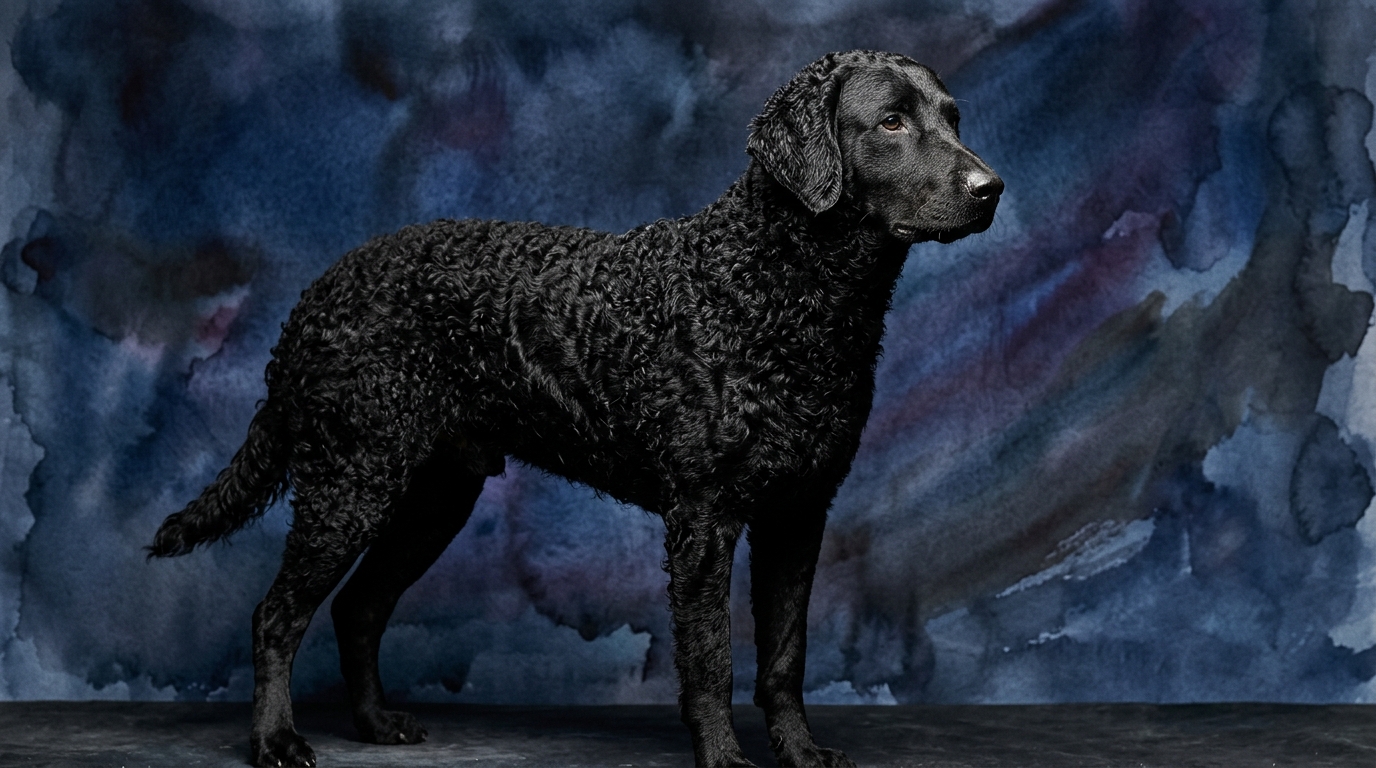

IQ Profile: A Side-by-Side Cognitive Snapshot
The Cosmic Pet Pet IQ Lab employs five key dimensions to evaluate canine intelligence, offering a nuanced perspective beyond simple obedience. Let's examine how the Curly-Coated Retriever and Russian Toy measure up.
The Curly-Coated Retriever, a distinguished sporting breed, holds a respectable Coren rank of #41. Its Problem Solving ability is rated at 3/5, suggesting a capacity for navigating practical challenges, often through trial-and-error, but perhaps not with groundbreaking innovation. Training Speed also sits at 3/5, indicating a moderate pace of learning new commands, requiring consistent and engaging methods. Social Intelligence is 3/5, meaning they can understand and respond to human cues and social dynamics, forming solid bonds without being overly intuitive or manipulative. Their Instinctive Drive, at 3/5, points to a moderate inclination for their ancestral retrieving tasks, enjoying purpose-driven activities but not being excessively driven. Crucially, their Memory shines at 4/5, allowing them to retain learned behaviors, routines, and experiences with impressive consistency over time.
The Russian Toy, a charming toy breed, is not represented on Stanley Coren's ranking, which primarily focused on working intelligence and obedience, a metric not always applicable to companion breeds. In our IQ assessment, their Problem Solving is rated 3/5, similar to the Curly-Coated Retriever. They can figure out straightforward puzzles or routines within their environment, often relying on established patterns or owner guidance. Training Speed is also 3/5, meaning they absorb new information at a steady, moderate pace, thriving with patient, positive reinforcement. Their Social Intelligence is 3/5, showing an ability to connect deeply with their primary human and understand subtle emotional shifts, though they may be more reserved with strangers. Instinctive Drive is likewise 3/5, primarily focused on companionship, play, and perhaps a playful chase, rather than a strong working purpose. Their Memory is rated 3/5, indicating a good recall for daily routines and commands, but perhaps not the same depth of retention for complex sequences as their sporting counterpart.
Cognitive Strengths: Where the Curly-Coated Retriever Shines
The Curly-Coated Retriever's standout cognitive strength lies in its Memory, scoring 4/5. This enhanced capacity for retention means they readily recall complex sequences, past training lessons, and environmental cues. For owners, this translates into a dog that not only learns new tasks but remembers them with remarkable consistency, even after breaks in practice. This robust memory underpins their suitability for diverse activities, from advanced obedience to field trials, where recalling intricate commands and navigating varied terrains efficiently is paramount. Their moderate Instinctive Drive, combined with this strong memory, allows them to apply their intelligence purposefully, excelling in tasks that require sustained focus and recall of learned behaviors, like retrieving specific items or executing multi-step commands.
Furthermore, the Curly-Coated Retriever's practical Problem Solving (3/5) is bolstered by its working background. While not necessarily inventing novel solutions, they are adept at applying learned strategies to overcome obstacles, especially when those obstacles relate to their natural drives. For instance, they might methodically work out how to open a gate to reach a 'retrieved' toy, or navigate a complex scent trail. Their overall cognitive profile lends itself to a dog that thrives on having a 'job' to do, however small, and uses its memory to perform it reliably.
Unique Intellect: The Russian Toy's Cognitive Edge
While sharing similar scores in several IQ dimensions, the Russian Toy's cognitive strengths manifest differently, often in ways that cater specifically to their role as devoted companions. Their Problem Solving (3/5) and Social Intelligence (3/5) combine to make them highly adept at navigating the human household. They might not be solving complex puzzles, but they are often quite clever at figuring out how to get their owner's attention, secure a cozy spot, or subtly communicate their needs. This involves a keen observation of human routines and moods, allowing them to anticipate events like meal times or walks with impressive accuracy.
The Russian Toy's intelligence is often expressed through their profound connection with their owner. Their social intelligence, though rated 3/5, is intensely focused, enabling them to pick up on subtle emotional cues and provide comfort or companionship with an almost intuitive understanding. Their smaller size and inherent desire for closeness mean they often develop nuanced ways of interacting within a family unit, making them exceptionally attuned to their environment and the people within it. This manifests as a particular brand of cleverness, often expressed through endearing behaviors designed to elicit interaction and affection from their human companions.
Learning Dynamics: Training the Curly-Coated Retriever vs. Russian Toy
When it comes to training, both breeds share a Training Speed score of 3/5, suggesting they learn at a moderate, steady pace. However, the nuances of their cognitive profiles lead to different training experiences. The Curly-Coated Retriever's superior Memory (4/5) is a significant advantage; once a command or behavior is learned, it tends to stick, requiring fewer refreshers over time. This makes them excellent candidates for progressive training, where new skills build upon previously mastered ones. Their moderate Instinctive Drive also means they are often motivated by task-oriented training, such as retrieving games, agility, or scent work, which aligns with their natural inclinations. They thrive on consistency and clear expectations, responding well to trainers who can channel their purpose-driven focus.
The Russian Toy, with a Memory score of 3/5, will also learn and retain commands, but may benefit more from consistent reinforcement and occasional refreshers to keep less frequently used skills sharp. Their training motivation often stems from their strong desire for companionship and positive interaction, making praise, gentle encouragement, and small treats highly effective. They are sensitive dogs who respond best to positive reinforcement techniques and can become withdrawn if training is harsh or inconsistent. While they might not be driven by a 'working' purpose, their social intelligence and desire to please their owner make them eager participants in trick training, basic obedience, and house manners, especially when training is framed as a fun, bonding activity. Distraction management can be more crucial for the Russian Toy, as their focus might be more easily diverted in busy environments compared to the task-oriented Curly-Coated Retriever.
Lifestyle Match: Tailoring to Active and Relaxed Owners
The cognitive and physical needs of these two breeds naturally align with different owner lifestyles. The Curly-Coated Retriever, as a sporting dog, is best suited for active owners who can provide ample opportunities for physical exercise and mental engagement. Their moderate instinctive drive and excellent memory mean they thrive with structured activities such as long walks, runs, hiking, swimming, and participation in dog sports like agility, obedience, or field work. An owner who enjoys training and wants a capable partner for outdoor adventures will find the Curly-Coated Retriever a rewarding companion. They need consistent mental stimulation to prevent boredom, making them a good fit for those who are committed to ongoing training and enrichment.
Conversely, the Russian Toy is an ideal match for more relaxed owners who desire a devoted, less physically demanding companion. Their moderate instinctive drive is satisfied with shorter, leisurely walks, indoor play, and plenty of quality cuddle time. While they enjoy mental stimulation, it often comes in the form of learning new tricks, puzzle toys, or simply engaging in interactive play with their owner within the home environment. Their profound social intelligence makes them excel at providing companionship, fitting seamlessly into households where closeness and indoor activities are prioritized. They are well-suited for urban living or for individuals who prefer a quieter, more intimate relationship with their pet, without the demands of an intensely active working breed.
Practical Considerations for Owners
Understanding these cognitive differences is not about ranking one breed as 'smarter' than the other, but about identifying where their intelligences are specialized and how they best integrate into human lives. The Curly-Coated Retriever's solid memory and moderate drive make them adaptable to a range of complex tasks and consistent training, appealing to those who value a canine partner for activities and reliability. Their Coren ranking further underscores their capacity for learning and following commands effectively.
The Russian Toy, while not on Coren's list, demonstrates a social and problem-solving intelligence geared towards intimate companionship. Their cognitive strengths make them exceptionally attuned to their human companions, excelling in roles where subtle communication and devotion are paramount. Choosing between these breeds involves reflecting on your lifestyle, your commitment to training, and the kind of cognitive interaction you seek in a canine companion.
The Verdict
Choose the Curly-Coated Retriever if you are an active owner seeking a capable, robust companion for structured activities and appreciate a dog with solid memory for complex tasks and consistent performance.
Opt for the Russian Toy if you desire a devoted, smaller companion for close interaction, indoor activities, and value a dog with subtle social awareness and a keen understanding of your home life.
🧠 Find Your Pet's IQ Score
Our Pet IQ Lab assessment covers 25+ tests across 5 cognitive dimensions — personalized to your breed.
Take the Full IQ Test →Frequently Asked Questions
Does the Coren rank for the Curly-Coated Retriever mean it's inherently smarter than the Russian Toy?
The Coren rank primarily measures working intelligence and obedience, which aligns with the Curly-Coated Retriever's sporting background. The Russian Toy, as a companion breed, often exhibits intelligence in different ways, such as social awareness and adaptability to home life, which aren't fully captured by Coren's specific criteria. Both breeds possess practical intelligence, but in different domains.
Given their similar IQ scores in some areas, what's the key difference in training approach for these two breeds?
While both have a 3/5 training speed, the Curly-Coated Retriever's stronger memory (4/5) means learned tasks are retained more consistently, supporting advanced, cumulative training. The Russian Toy (3/5 memory) benefits from more frequent positive reinforcement and refreshers, with training often motivated by close interaction and praise rather than a strong working drive, making patience and a gentle approach crucial.
Which breed is better for a first-time dog owner?
For a first-time owner, the Russian Toy might be slightly more manageable due to its smaller size and lower exercise requirements, fitting well into various living situations. However, their sensitivity requires a consistent, gentle training approach. The Curly-Coated Retriever, while capable, needs an owner committed to providing ample physical and mental stimulation, which might be a larger commitment for a novice owner.