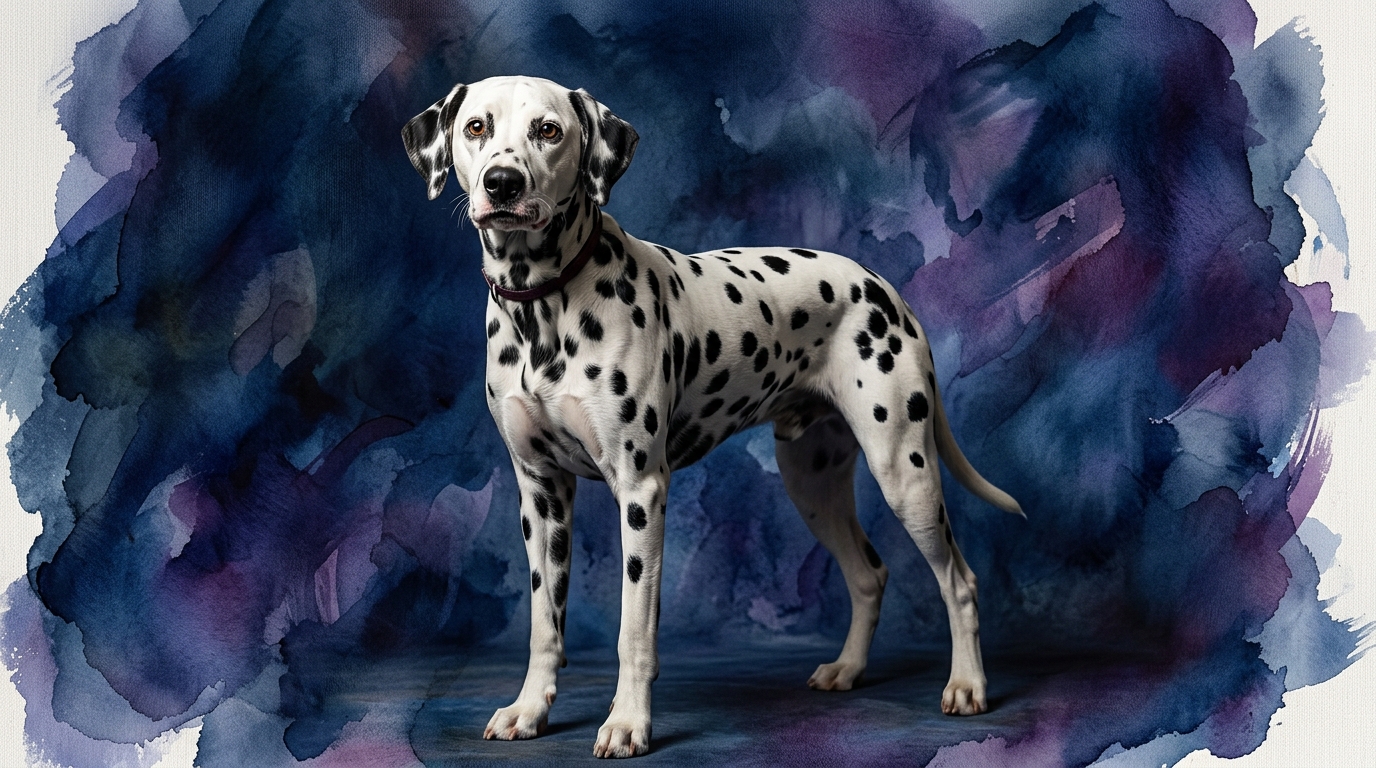

Side-by-Side IQ Profile: Dalmatians vs. Briards
The Cosmic Pet Pet IQ Lab evaluates canine cognition across five crucial dimensions, offering a nuanced understanding beyond simple rankings. We're looking at specific strengths and how they shape a breed's interaction with the world and its human companions.
The Dalmatian, classified in the Non-Sporting group, holds a Coren rank of #39. Their IQ breakdown shows Problem Solving at 3/5, Training Speed at 3/5, Social Intelligence at a robust 4/5, Instinctive Drive also at a strong 4/5, and Memory at 4/5. This profile suggests a dog with a keen awareness of its social environment and a powerful underlying motivation for engagement, reflecting their history as coach dogs and firehouse mascots who needed to work closely with people and horses.
In contrast, the Briard, a proud member of the Herding group, boasts a Coren rank of #30. Their IQ scores paint a different picture: Problem Solving at 4/5, Training Speed at 4/5, Social Intelligence at 3/5, Instinctive Drive at 3/5, and Memory matching the Dalmatian at 4/5. This suggests a dog with a strong capacity for independent thought and quick learning, aligning perfectly with their historical role as a versatile flock guardian and drover, requiring them to make decisions without constant human direction.
While both breeds exhibit excellent memory, their foundational cognitive approaches diverge significantly. The Dalmatian leans into social connection and persistent energy, whereas the Briard emphasizes independent intellectual application and rapid skill acquisition.
Where the Dalmatian Wins Cognitively
The Dalmatian's cognitive strengths truly shine in the realms of Social Intelligence and Instinctive Drive. With a 4/5 in Social Intelligence compared to the Briard's 3/5, Dalmatians often demonstrate a more acute understanding of human emotions and social cues. They can be remarkably attuned to their family's moods, often seeking out interaction and comfort, making them highly responsive companions in social settings. This heightened social awareness contributes to their charming and sometimes clownish personalities, as they actively engage with their environment and the people within it.
Furthermore, the Dalmatian's Instinctive Drive, also rated at 4/5 against the Briard's 3/5, indicates a profound and persistent internal motivation. This isn't just about physical energy; it's a deep-seated desire to engage, to move, and to fulfill a purpose. Historically, this drive powered them to run alongside carriages for miles, and today it translates into a need for consistent activity, mental challenges, and a role within the family unit. This strong drive means Dalmatians are often eager participants in activities, displaying remarkable stamina and tenacity once they are invested in a task, whether it's agility, long-distance running, or simply a vigorous game of fetch.
Where the Briard Wins Cognitively
The Briard's cognitive advantages are evident in their superior Problem Solving and Training Speed. Scoring 4/5 in Problem Solving compared to the Dalmatian's 3/5, Briards exhibit a more pronounced capacity for independent thought and navigating complex situations. This trait is a direct legacy of their herding and guarding roles, where they frequently had to assess threats, manage livestock, and protect their charges without direct human intervention. This means a Briard is often adept at figuring out how to open gates, retrieve objects from challenging spots, or devise strategies to get what they want, often employing a thoughtful, methodical approach rather than brute force.
Accompanying this is their 4/5 rating in Training Speed, surpassing the Dalmatian's 3/5. Briards tend to grasp new commands and concepts with fewer repetitions, processing information and associating actions with cues more rapidly. Their ability to quickly understand and execute complex sequences makes them proficient in advanced obedience, protection work, and other canine sports where quick learning and precise execution are paramount. While they possess a strong will, a common trait in herding breeds, their cognitive agility means that once they commit to learning, they absorb and apply information with impressive efficiency.
Which is Easier to Train and Why
Determining which breed is 'easier' to train depends significantly on the type of training and the owner's approach. Based on the IQ scores, the Briard, with a Training Speed of 4/5 and Problem Solving of 4/5, generally learns new commands and complex tasks more quickly than the Dalmatian (Training Speed 3/5, Problem Solving 3/5). A Briard's cognitive architecture allows them to make connections between commands and actions with fewer repetitions, and their capacity for independent problem-solving means they can often generalize learned behaviors to new situations with less direct guidance.
However, the Dalmatian's training experience is shaped by different strengths. While they might require more repetitions to master a new command due to their 3/5 Training Speed, their 4/5 Social Intelligence makes them highly motivated by positive reinforcement, praise, and social interaction with their handler. Their 4/5 Instinctive Drive means that once they understand the purpose of a task, they can apply persistent energy to achieve it. The challenge with Dalmatians often lies in harnessing their independent spirit and ensuring their high drive is channeled productively, rather than allowing them to become easily distracted or bored.
Both breeds share a 4/5 Memory score, meaning that once a behavior is learned, it is retained effectively. For the Briard, the initial learning phase is often quicker, but their herding instincts can sometimes manifest as stubbornness or a desire to do things their own way, requiring a firm yet fair handler. For the Dalmatian, patience and creative engagement during the initial learning stages are key, leveraging their social bond and inherent drive to create a highly responsive and enthusiastic partner. Neither is a 'hands-off' training prospect; both demand consistent, thoughtful engagement from their owners.
Which Suits Active Owners vs. Relaxed Owners
When considering suitability for active versus relaxed owners, both the Dalmatian and the Briard lean heavily towards the active end of the spectrum, though with different nuances in their activity requirements. The Dalmatian, with its 4/5 Instinctive Drive, possesses a deep-seated need for consistent physical exertion and mental engagement. Their historical role as coach dogs demanded incredible stamina, and this translates into a modern dog that thrives on long runs, vigorous play sessions, and participation in dog sports like agility or canicross. An owner who doesn't provide sufficient outlets for this drive will likely find their Dalmatian inventing its own, potentially destructive, entertainment. They are certainly not a match for a truly relaxed, sedentary lifestyle, requiring an owner committed to daily, substantial activity.
The Briard, while also an active working breed, has an Instinctive Drive rating of 3/5. This is still a significant need for activity, but perhaps a slightly less relentless push than the Dalmatian. Briards require regular exercise and mental stimulation to prevent boredom, given their problem-solving abilities. Long walks, hiking, and opportunities to engage their herding instincts, even if just through structured play, are crucial. However, they might be content with slightly less intense or continuous physical output compared to a Dalmatian, provided their mental needs are met. Neither breed is suitable for a truly 'relaxed' owner who prefers minimal daily commitment to exercise and engagement; both demand a considerable investment of time and energy to ensure their well-being and prevent behavioral issues. However, the Dalmatian’s drive is more pervasive, requiring constant channels, whereas the Briard, while equally needing activity, might be more amenable to periods of calm once their needs are satisfied.
The Verdict
Choose a Dalmatian if you are an active, social individual seeking a highly engaged companion who thrives on human connection and persistent activity, and you are prepared for consistent training to channel their considerable drive.
Opt for a Briard if you appreciate a thoughtful, quick-learning dog with strong problem-solving skills, are committed to providing ample mental and physical challenges, and can manage a breed with a confident, independent streak.
🧠 Find Your Pet's IQ Score
Our Pet IQ Lab assessment covers 25+ tests across 5 cognitive dimensions — personalized to your breed.
Take the Full IQ Test →Frequently Asked Questions
Do Dalmatians require a lot of grooming?
Dalmatians have a short, dense coat that requires relatively minimal grooming. Regular brushing, perhaps once or twice a week, is usually sufficient to manage shedding and keep their coat healthy. They are generally considered low-maintenance in terms of grooming needs.
Are Briards good with children and other pets?
Briards can be excellent family dogs and get along well with children and other pets, especially if raised with them and properly socialized from a young age. Their protective instincts, stemming from their herding background, mean they often form strong bonds with their family, though supervision with very young children is always advisable due to their size and herding tendencies.
What kind of mental stimulation do these breeds need?
Both Dalmatians and Briards require significant mental stimulation to prevent boredom and destructive behaviors. Dalmatians benefit from puzzle toys, scent work, and training that leverages their social intelligence, while Briards thrive on problem-solving games, obedience training, and activities that engage their independent thinking, such as advanced trick training or agility.