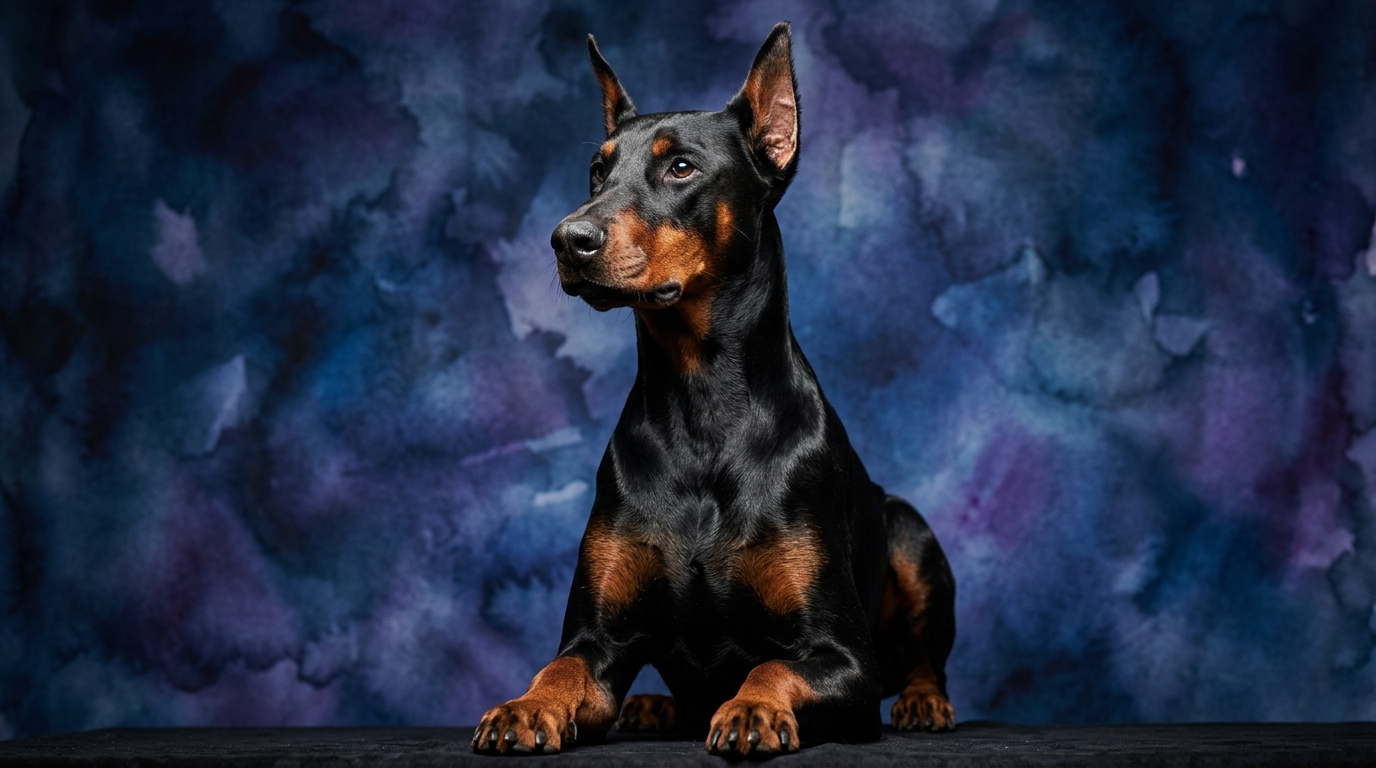

Side-by-Side IQ Profile: Doberman Pinscher vs. German Shorthaired Pointer
The Cosmic Pet Pet IQ Lab provides a detailed breakdown of canine cognitive abilities across five dimensions, offering a nuanced perspective beyond simple rankings. For the Doberman Pinscher, a distinguished Working breed ranking #5 on the Coren scale, its profile reveals a remarkable mental aptitude tailored for precision and protection. Its Problem Solving is rated 5/5, indicating an exceptional capacity to analyze and navigate complex situations, a trait vital for its demanding roles. Training Speed also stands at 5/5, meaning Dobermans grasp new commands and routines with extraordinary swiftness, often requiring minimal repetitions. Social Intelligence is 4/5, reflecting a deep understanding of its human family's cues and intentions, particularly within its established protective sphere. An Instinctive Drive of 5/5 underscores its powerful protective impulses and unwavering dedication, channeling its energy into purposeful action. Finally, its Memory is 5/5, signifying an outstanding ability to recall learned behaviors and past experiences with high fidelity.
In contrast, the German Shorthaired Pointer, a Sporting breed with a Coren rank of #17, presents a cognitive profile finely tuned for endurance, cooperation, and instinctive field work. Its Problem Solving matches the Doberman at 5/5, demonstrating a robust capacity for real-time decision-making, particularly in dynamic outdoor environments such as tracking game or adapting to varied terrain. Training Speed is rated 4/5, indicating that GSPs learn new tasks and commands efficiently, though perhaps not with the instantaneous absorption of a Doberman, still making them highly capable pupils. Social Intelligence is 4/5, geared towards forming strong, cooperative partnerships with handlers, understanding subtle signals during shared activities in the field. Its Instinctive Drive is also 5/5, profoundly expressed through an intense prey drive, keen scenting abilities, and an unyielding desire to hunt, point, and retrieve. Its Memory is 4/5, denoting a strong capacity for retaining commands and routines, especially those pertinent to its sporting functions, though it might benefit from more consistent reinforcement than a breed with a 5/5 rating.
Where the Doberman Pinscher Wins Cognitively
The Doberman Pinscher demonstrates clear cognitive advantages in areas crucial for rapid, precise learning and consistent performance across a broad spectrum of tasks. With a Training Speed rating of 5/5 compared to the GSP's 4/5, the Doberman absorbs new information and commands with remarkable efficiency, making it exceptionally adept at mastering intricate obedience routines, complex protection work, or specialized service tasks. This breed's superior Memory at 5/5 (versus the GSP's 4/5) ensures that once a behavior is learned, it is retained with outstanding fidelity over extended periods, requiring less refresher training for established skills. This potent combination of swift learning and robust retention directly contributes to its higher Coren rank (#5), signifying its capacity for consistent, high-level performance across a broader array of learned tasks and environmental adaptations, showcasing greater mental plasticity beyond its core instinctive drives.
Where the German Shorthaired Pointer Wins Cognitively
While the GSP doesn't outscore the Doberman in direct cognitive metrics, its cognitive profile is uniquely optimized for its specific, demanding role as a versatile sporting dog, excelling where sustained focus and physical prowess meet mental acumen. The GSP's 5/5 Problem Solving and 5/5 Instinctive Drive, coupled with its 4/5 Training Speed and Memory, create a mental athlete perfectly suited for the field. Its problem-solving acumen is honed for real-time decision-making in vast, unpredictable outdoor environments, such as independently navigating complex scent trails or adapting to changing wind conditions to locate game. The GSP's instinctive drive is not just powerful but also exceptionally focused, allowing it to maintain unwavering attention on a task, like quartering a field for hours, without succumbing to distraction. This specialized cognitive focus, while perhaps less generalized for abstract learning than the Doberman, allows the GSP to achieve unparalleled excellence and endurance in its primary sporting functions, where sustained mental and physical effort are paramount.
Which is Easier to Train and Why
The Doberman Pinscher generally presents as the more straightforward breed to train for a wide range of commands and behaviors, primarily due to its 5/5 Training Speed and 5/5 Memory. These attributes mean Dobermans tend to grasp new commands and concepts with astonishing speed, often requiring only a few repetitions before demonstrating proficiency. Their exceptional memory ensures that once a behavior is learned, it is deeply ingrained and reliably recalled, even after long periods without practice. This makes them ideal candidates for advanced obedience, complex multi-step tasks, and specialized roles where precision and consistent performance are paramount. In contrast, while the German Shorthaired Pointer's 4/5 Training Speed and 4/5 Memory are still commendable, they indicate that GSPs might require more consistent repetition and varied training approaches to solidify new behaviors. Their powerful instinctive drive, while a tremendous asset in the field, can sometimes present a challenge in a structured training environment, requiring a handler who can channel that focus effectively and manage potential distractions from their strong prey drive.
Which Suits Active Owners vs. Relaxed Owners
Neither the Doberman Pinscher nor the German Shorthaired Pointer is suited for owners seeking a relaxed, low-activity companion; both breeds demand a significant commitment to vigorous physical exercise and consistent mental stimulation. The Doberman Pinscher thrives with owners who can provide consistent, structured exercise, such as daily vigorous walks, runs, or participation in dog sports like agility, obedience, or protection work. Their cognitive capacity also necessitates mental challenges, including puzzle toys, advanced training sessions, and engaging problem-solving games to prevent boredom and destructive behaviors. The German Shorthaired Pointer, on the other hand, requires an even more expansive and enduring form of activity. They are built for sustained, high-energy output, excelling with owners who can offer extensive off-leash running in open spaces, hiking, swimming, or active participation in field trials and hunting. Their immense stamina and relentless drive mean that a GSP will quickly become restless and potentially mischievous if not provided with ample opportunities to burn energy in ways that satisfy their sporting instincts.
The Verdict
Choose the Doberman Pinscher if you seek a highly trainable, protective companion capable of mastering complex commands and excelling in precision-based dog sports, valuing rapid learning and reliable recall.
Choose the German Shorthaired Pointer if your lifestyle embraces extensive outdoor adventures and you desire a tireless, focused partner for hunting, field work, or endurance activities, appreciating a breed whose cognitive strengths are perfectly aligned with sustained physical and mental effort in dynamic environments.
🧠 Find Your Pet's IQ Score
Our Pet IQ Lab assessment covers 25+ tests across 5 cognitive dimensions — personalized to your breed.
Take the Full IQ Test →Frequently Asked Questions
Does the Coren rank accurately reflect the practical intelligence difference between these breeds?
David Coren's ranking primarily assesses "working and obedience intelligence," focusing on trainability and command comprehension. The Doberman's higher rank (#5) compared to the GSP (#17) reflects its superior scores in training speed and memory, indicating a generally faster and more reliable response to learned commands in a structured setting.
How does their social intelligence impact their family life?
Both breeds score 4/5 in social intelligence, meaning they are capable of forming strong bonds and understanding human cues. The Doberman's social intelligence is often directed towards discerning threats and protecting its family, while the GSP's is geared towards cooperative partnership with its handler in active pursuits, both translating to devoted family members within their respective contexts.
Can a German Shorthaired Pointer be trained for protection, or a Doberman Pinscher for hunting?
While a GSP possesses a strong instinctive drive and problem-solving skills, its cognitive profile and physical build are less suited for the specific nuances of protection work, which the Doberman excels at due to its rapid training speed, memory, and inherent guarding instincts. Conversely, a Doberman could be trained for some hunting tasks, but it would likely lack the GSP's specialized scenting ability, endurance for extensive field work, and innate pointing instinct, making the GSP the superior choice for traditional hunting roles.