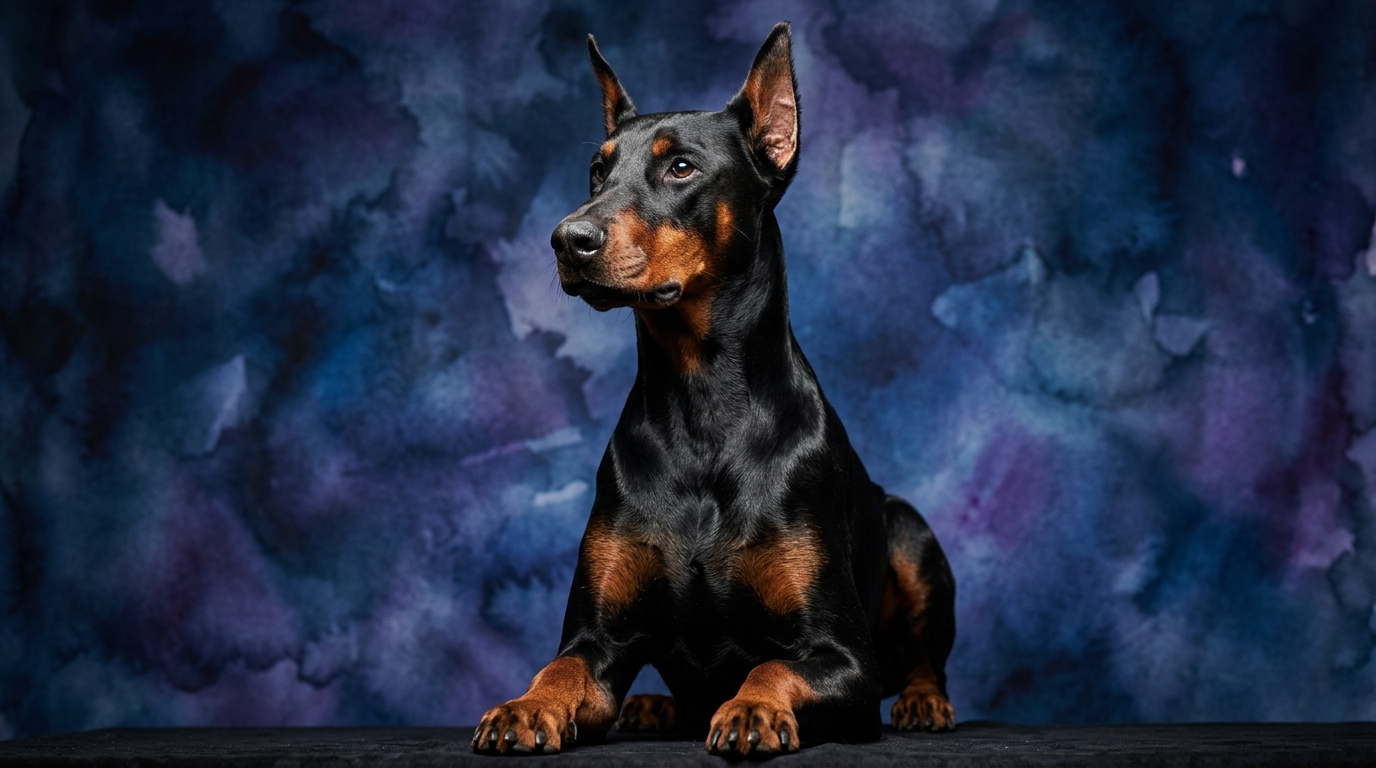
Doberman Pinscher at a glance
| IQ Rank / Score | #5 |
|---|---|
| Trainability | ★★★★★ (5/5) |
| Social Intelligence | ★★★★☆ (4/5) |
| Lifespan | 10-12 years |
| Shedding | Moderate to high |
| Exercise Needs | High (60+ min/day + training) |
| Origin | Germany |
The Doberman Pinscher's Blueprint for Brainpower
The Doberman Pinscher, a breed forged in the crucible of 19th-century Germany, stands as an extraordinary example of intentional canine design focused squarely on intellect. Its very genesis traces back to Louis Dobermann, a local tax collector and night watchman who urgently required a canine companion capable of both protection and sophisticated judgment during his hazardous rounds. He didn't just select for temperament; he meticulously bred for a keen, analytical mind, designing a dog from scratch that possessed unparalleled intelligence to anticipate threats and secure his safety on collections. This unique origin story underscores the Doberman's inherent capacity for strategic thought.
This foundational purpose indelibly etched a distinct strategic intelligence into the Doberman's genetic makeup, a hallmark that defines their breed to this day. They possess an exceptional faculty for threat-assessment and maintain profound situational awareness, skills meticulously honed over generations to accurately discern friend from potential foe and navigate complex social dynamics with a calculated precision. This isn't merely about rapid recall of commands; it's an innate, deeply embedded capacity for understanding nuanced contexts and acting with decisive, purposeful intent, often before a situation fully unfolds.
Their comprehensive cognitive profile consistently places them among the most adept canine thinkers. In various problem-solving scenarios, Dobermans frequently achieve top-tier results, exhibiting an inventive and often surprising approach to overcoming obstacles, whether it's figuring out a complex puzzle toy or an escape route. Their training speed is equally remarkable, as they often grasp new commands, intricate routines, and advanced obedience sequences with minimal repetition, driven by an inherent desire to learn and engage. Furthermore, their social intelligence, while acutely tuned for identifying external intentions, allows for the formation of profoundly strong, often surprisingly tender bonds with their chosen human families, challenging common misconceptions about their nature.
Unpacking Their Unique Cognitive Edge
The Doberman's instinctive drive is a powerful engine, fueled by an almost relentless desire to work, understand, and excel, making them exceptionally receptive to advanced and specialized training methodologies. Complementing this drive is their remarkably robust memory, enabling them to retain vast amounts of information, from the most complex multi-step command sequences to the specific behavioral patterns and nuances of individuals they encounter regularly. This potent combination of instinct, drive, and superior memory forms the bedrock of their effectiveness as formidable protectors and deeply dedicated companions, capable of adapting to a wide array of demanding roles.
While frequently categorized alongside other esteemed working breeds, the Doberman's strategic intelligence introduces distinct and fascinating nuances. For instance, a German Shepherd might process a direct command with lightning-fast execution, but a Doberman often adds an interpretive layer, swiftly analyzing the surrounding environment and the intent behind the command before acting, sometimes with a brief, intelligent pause. When compared to the unwavering, tenacious problem-solving approach of a Rottweiler, the Doberman frequently demonstrates a more fluid, anticipatory form of intelligence, allowing them to adapt with remarkable agility and foresight in dynamic or unpredictable situations, often predicting the next move.
Their intelligence extends far beyond mere intellectual capacity; it is profoundly about practical application and strategic foresight. Dobermans possess an inherent, sophisticated internal mapping system, enabling them to construct a detailed understanding of their immediate environment and the potential challenges or opportunities within it. This manifests as a deep, intuitive grasp of cause and effect, empowering them to predict outcomes with unusual accuracy and make choices that effectively serve their objectives, whether that involves safeguarding their family and home, navigating a complex agility course, or cleverly obtaining a coveted treat. Their mental processes are not reactive, but often proactively analytical.
Training for the Strategic Doberman Mind
Harnessing the Doberman's profound strategic intelligence requires an equally thoughtful and consistent approach to training. They thrive on structure and clear communication, not just rote commands. Early and consistent socialization is paramount, introducing them to a variety of people, places, and situations to help them properly channel their discerning judgment rather than defaulting to suspicion. A well-socialized Doberman learns to distinguish between true threats and normal environmental stimuli, utilizing their innate threat-assessment skills constructively.
Given their impressive memory and problem-solving skills, Dobermans excel in advanced obedience, agility, tracking, and protection sports. These activities provide the vital mental stimulation their minds crave, preventing boredom and potential behavioral issues. Incorporate puzzle toys, scent work, and complex command sequences into their daily routine. Remember, a bored Doberman isn't necessarily a destructive Doberman, but rather one seeking an intellectual challenge, often devising their own 'problems' to solve if not properly engaged.
Consistency is key; these dogs are intelligent enough to spot inconsistencies in training or boundaries, and they will test them. Positive reinforcement methods work best, as they foster a strong bond and encourage their natural eagerness to please. Never underestimate their capacity for understanding; they are often several steps ahead, evaluating your intentions and the environment around them. Providing them with a 'job' or purpose, even if it's just being a well-mannered family protector, aligns perfectly with their deeply ingrained working dog heritage.
Comparing Canine Cognition: Doberman vs. Peers
When juxtaposed against other highly capable and revered working breeds, the Doberman's distinct brand of strategic intelligence truly comes into sharp focus. Take the Belgian Malinois, for example, a breed celebrated for its unparalleled intensity, explosive drive, and extraordinary physical prowess, excelling in rapid-fire obedience drills and highly specialized detection work. In contrast, the Doberman, while equally capable, often displays a more measured and calculated approach to problem-solving, methodically weighing various options and outcomes before executing a plan. This subtle yet significant difference highlights the diverse manifestations of intelligence even within similar working categories, emphasizing the Doberman's preference for thoughtful action.
A key aspect that truly sets the Doberman apart is their uncanny ability to read and react to the most subtle cues within their environment, a trait that goes beyond mere learned behavior. This is an ingrained, almost intuitive sensitivity that allows them to pick up on minute shifts in human demeanor, changes in ambient sounds, or even imperceptible environmental alterations with remarkable, often unsettling, accuracy. This exceptional capacity for nuanced perception and interpretation contributes profoundly to their effectiveness in roles that demand not just vigilance, but also discretion, keen insight, and precise judgment, making them exceptional companions for those who understand their depth.
3 At-Home Tests to Measure Your Doberman Pinscher's IQ
These tests are adapted from peer-reviewed ethology research. No equipment is needed beyond items you have at home. Run each test 5–10 times for reliable results.
The Myth: "Dobermans are dangerous loners who can turn on their owners without warning."
✅ Doberman Pinschers are, in reality, deeply loyal, sensitive, and family-oriented dogs when properly socialized and trained. Their protective nature is a carefully channeled instinct, not random aggression, and they thrive on close companionship, often forming strong, affectionate bonds with their chosen families, making them watchful but gentle guardians.
Doberman Pinscher vs. Similar Breeds
🧠 What's Your Dog's IQ Score?
Our full Pet IQ Lab assessment includes 12+ tests across 5 cognitive dimensions, calibrated for Doberman Pinschers specifically.
Take the Full IQ Test →Frequently Asked Questions
How smart is a Doberman Pinscher?
Our Pet IQ Lab framework scores cognition across five dimensions (max 25). The Doberman Pinscher totals 24/25 — exceptionally high for a domestic dog. The full article breaks down each dimension with at-home tests.
Are Doberman Pinschers easy to train?
Doberman Pinschers learn new cues very quickly — often in 5-15 repetitions. They score 5/5 on Training Speed in our breed profile.
Are Doberman Pinschers good with children and other pets?
Yes — their Social Intelligence rates 4/5 in our Pet IQ Lab framework. With early socialization and supervised play, most Doberman Pinschers integrate well into families with respectful children and other pets.
Do Doberman Pinschers need a lot of mental stimulation?
Absolutely. With Problem Solving 5/5 and Instinctive Drive 5/5, Doberman Pinschers need daily mental work — puzzle feeders, scent games, training sessions, or nose-work — to avoid boredom.
How much exercise does a Doberman Pinscher need?
Doberman Pinschers need active engagement. Plan for 45-60 minutes of exercise and training per day, plus mental stimulation.
How good is a Doberman Pinscher's memory?
Doberman Pinschers score 5/5 on memory. They remember routines, hiding spots, and learned cues for months, sometimes years.
What is the typical lifespan of a Doberman Pinscher?
Typical lifespan is 10-12 years for a large dog like the Doberman Pinscher.
The Doberman Pinscher is far more than just a powerful guardian; they are a marvel of strategic canine intelligence, bred for discerning thought and action. Understanding their unique mental landscape reveals a loyal, adaptable companion ready for life's most intriguing challenges and deepest bonds.