
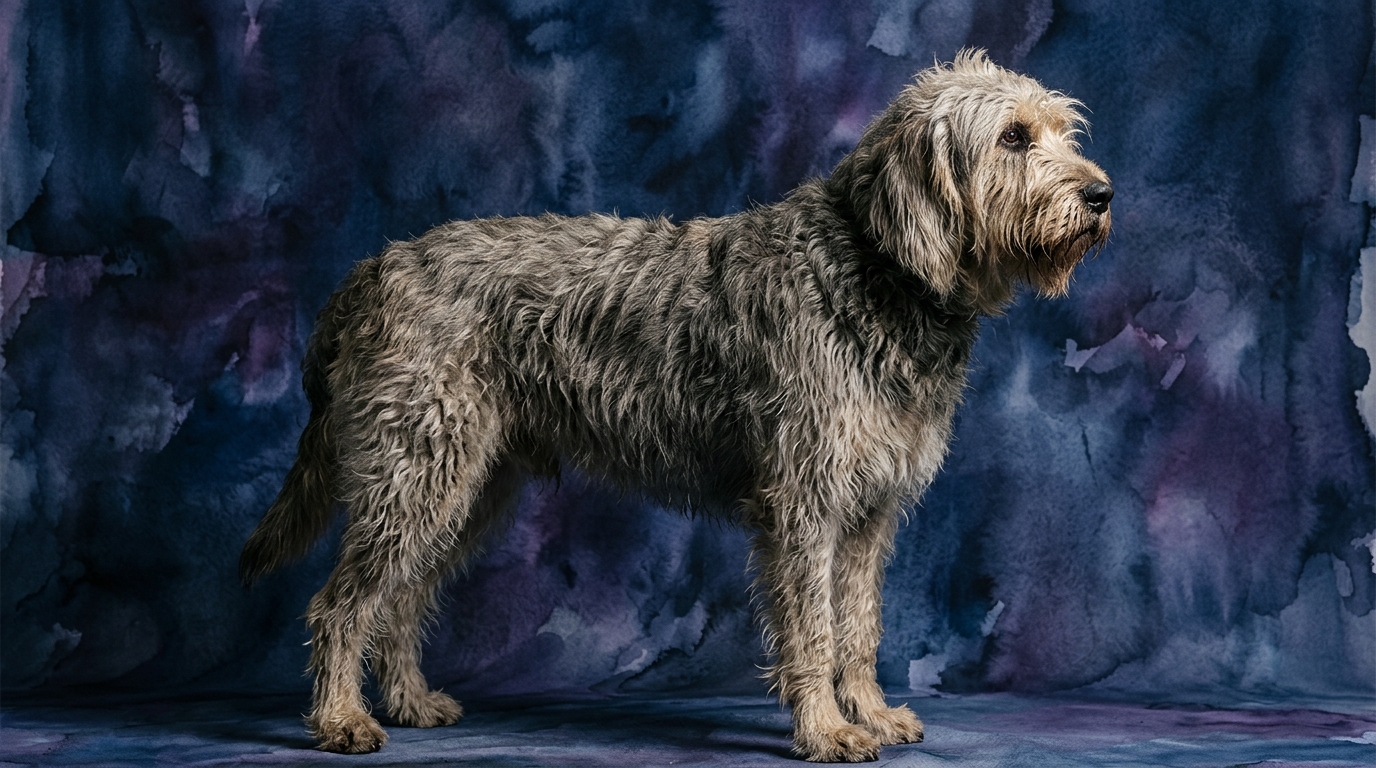
Side-by-Side IQ Profile
At The Cosmic Pet Pet IQ Lab, we analyze canine intelligence across five key dimensions, providing a granular view of each breed’s cognitive makeup. For the English Cocker Spaniel, a Sporting group dog, and the Otterhound, a member of the Hound group, their scores illuminate their distinct aptitudes.
The English Cocker Spaniel (Coren rank #18) demonstrates a robust cognitive profile: Problem Solving 4/5, Training Speed 4/5, Social Intelligence 3/5, Instinctive Drive 3/5, and Memory 5/5. This breed’s scores suggest a dog adept at learning, retaining information, and engaging with its environment in a purposeful manner, reflecting its heritage as a close working gundog.
The Otterhound, while not Coren-ranked, presents a consistent set of scores: Problem Solving 3/5, Training Speed 3/5, Social Intelligence 3/5, Instinctive Drive 3/5, and Memory 3/5. These scores point to a dog whose cognitive strengths are rooted in its ancient role as a dedicated scent tracker, valuing independence and perseverance over rapid human-directed learning.
Specifically, the English Cocker Spaniel's Problem Solving at 4/5 indicates a strong capacity for figuring out novel tasks, like navigating complex retrieving scenarios. Their Training Speed of 4/5 means they acquire new commands efficiently, often with eagerness. A Social Intelligence of 3/5 suggests they understand human cues well enough for companionship, while their Instinctive Drive of 3/5 is focused on flushing and retrieving. Their Memory, an exceptional 5/5, underpins their ability to recall intricate sequences and past experiences.
In contrast, the Otterhound's Problem Solving at 3/5 is more practical, centered on overcoming physical obstacles during a scent chase rather than abstract puzzles. Their Training Speed of 3/5 signifies a steady, rather than rapid, learning pace, often requiring more repetition. With Social Intelligence at 3/5, they form good bonds, but can be more independent. Their Instinctive Drive, also 3/5, is intensely focused on tracking scent, a relentless pursuit. Finally, their Memory at 3/5 is functional for routines, but perhaps less for nuanced command recall.
Where English Cocker Spaniel Wins Cognitively
The English Cocker Spaniel clearly excels in cognitive domains demanding close partnership and rapid adaptation. Their superior Memory, rated an outstanding 5/5 compared to the Otterhound’s 3/5, means they effortlessly recall a vast repertoire of commands, complex retrieve patterns, and even specific locations where items were dropped, making them exceptionally reliable in tasks requiring precise execution. This memory capacity allows for building upon a rich foundation of learned behaviors without constant re-teaching, fostering a highly responsive relationship with their handler.
Furthermore, their Problem Solving (4/5) and Training Speed (4/5) work in tandem, offering a distinct advantage. English Cockers not only grasp new concepts quickly but also actively engage in figuring out how to succeed, often showing initiative in novel situations. This cognitive agility allows them to excel in diverse dog sports, quickly learn intricate routines, and adapt to varying environments with minimal stress, a clear edge over breeds that rely more on rote learning or singular instincts. Their capacity for quick learning and retention translates to a companion eager to engage in mental challenges presented by their owner, making them highly versatile.
Where Otterhound Wins Cognitively
While the Otterhound's raw scores might appear modest compared to the English Cocker Spaniel, their cognitive strengths are uniquely tailored to their historical purpose, offering a different kind of 'win' in specific contexts. Their Instinctive Drive, rated 3/5 like the Cocker, is singularly focused on scent work, embodying a relentless, single-minded pursuit that few breeds can match. This isn't about complex problem-solving for a handler, but an unwavering, deep-seated dedication to a natural task, making them peerless in specific tracking endeavors where pure, sustained focus on a trail is paramount.
The Otterhound's Problem Solving (3/5) is highly practical and applied, revolving around navigating terrain and overcoming physical obstacles to follow a scent trail, rather than abstract puzzles or handler-directed tricks. This practical intelligence, combined with their robust Social Intelligence (3/5) within a pack context, means they thrive on cooperative, yet independent, work. They are less prone to overthinking or emotional sensitivity in the face of a compelling scent, demonstrating a steadfast resilience. An Otterhound's 'win' is in their unwavering commitment to a specific, instinct-driven task, making them supremely effective where sheer, independent perseverance in scent-tracking is paramount, and where a less handler-dependent approach is valued.
Which is Easier to Train and Why
The English Cocker Spaniel is demonstrably easier to train due to its higher Training Speed (4/5) and Problem Solving (4/5) scores, coupled with its historical role working in close cooperation with human handlers. These dogs possess an innate eagerness to please and a natural inclination to focus on their human companions, making them highly receptive to instruction. They quickly connect actions with consequences, grasping new commands with fewer repetitions and showing a keen interest in learning. Their superior Memory (5/5) also means that once a behavior is learned, it is retained effectively, reducing the need for constant refreshers and allowing for more advanced training.
In contrast, the Otterhound, with Training Speed (3/5) and Problem Solving (3/5), presents a greater challenge. Their strong Instinctive Drive (3/5) for scent work means they are often more motivated by the call of a compelling smell than by a handler's command. This inherent independence, while valuable for their original purpose, translates to a more deliberate and sometimes stubborn approach to obedience training. They require significant patience, consistency, and creative motivation to keep them engaged, as their focus is often external rather than handler-centric. Training an Otterhound demands an understanding of their deep-seated instinctual motivations and a willingness to work with their nose, rather than against it, making it a more involved process.
Which Suits Active Owners vs Relaxed Owners
Active owners who enjoy engaging in structured activities and mental challenges with their dog will find the English Cocker Spaniel a more fitting companion. Their cognitive profile, marked by high Memory (5/5), Problem Solving (4/5), and Training Speed (4/5), means they thrive on interactive play, obedience training, agility, or scent work that involves close handler collaboration. They are eager participants in family adventures and require consistent mental stimulation to prevent boredom and undesirable behaviors. These owners appreciate a dog that is highly responsive and keen to work alongside them, transforming shared activities into rewarding experiences.
Conversely, the Otterhound is better suited for owners who appreciate a more independent spirit and have a robust, active lifestyle centered around outdoor exploration, particularly activities that leverage their profound Instinctive Drive (3/5) for scent. While they enjoy companionship, their cognitive focus is less on continuous handler engagement and more on their environment, especially scent trails. They need owners prepared for long, exploratory walks where their nose leads the way, and who understand that their Training Speed (3/5) requires patience and consistency rather than rapid results. Relaxed owners seeking a low-maintenance, perfectly obedient companion might find the Otterhound's independent nature and strong scent drive a significant challenge. However, active owners who value a rugged, unique companion and are prepared to accommodate their natural instincts will find a loyal, albeit sometimes headstrong, friend.
The Verdict
Choose the English Cocker Spaniel if you seek a highly trainable, responsive companion eager for interactive mental challenges and a close working partnership in activities like obedience or dog sports. Their exceptional memory and quick problem-solving make them a joy to train and an adaptable family member.
Opt for the Otterhound if you appreciate an independent, resilient dog with an unparalleled drive for scent work, ideal for a home that embraces long, exploratory outdoor adventures and values a robust, unique companion over instant obedience. Their steadfast nature suits patient owners ready to work with their strong natural instincts.
🧠 Find Your Pet's IQ Score
Our Pet IQ Lab assessment covers 25+ tests across 5 cognitive dimensions — personalized to your breed.
Take the Full IQ Test →Frequently Asked Questions
Do English Cocker Spaniels require a lot of mental stimulation?
Yes, English Cocker Spaniels benefit significantly from consistent mental engagement. Their high Problem Solving (4/5) and Memory (5/5) mean they thrive on learning new tasks, puzzle toys, and interactive games, which helps prevent boredom and channel their energy constructively.
Is the Otterhound a good choice for first-time dog owners?
The Otterhound's independent nature and strong Instinctive Drive (3/5) for scent work can make them challenging for first-time owners. They require consistent, patient training and an understanding of their unique motivations, so prior dog ownership experience, especially with hounds, is often beneficial.
How do the social intelligence scores compare between the two breeds?
Both breeds share a Social Intelligence (3/5) score, indicating they are capable of forming bonds and understanding social cues. For the English Cocker Spaniel, this often translates to strong family ties and responsiveness to handler moods, while for the Otterhound, it often manifests as robust pack camaraderie, capable of independent work yet enjoying companionship within their human 'pack'.