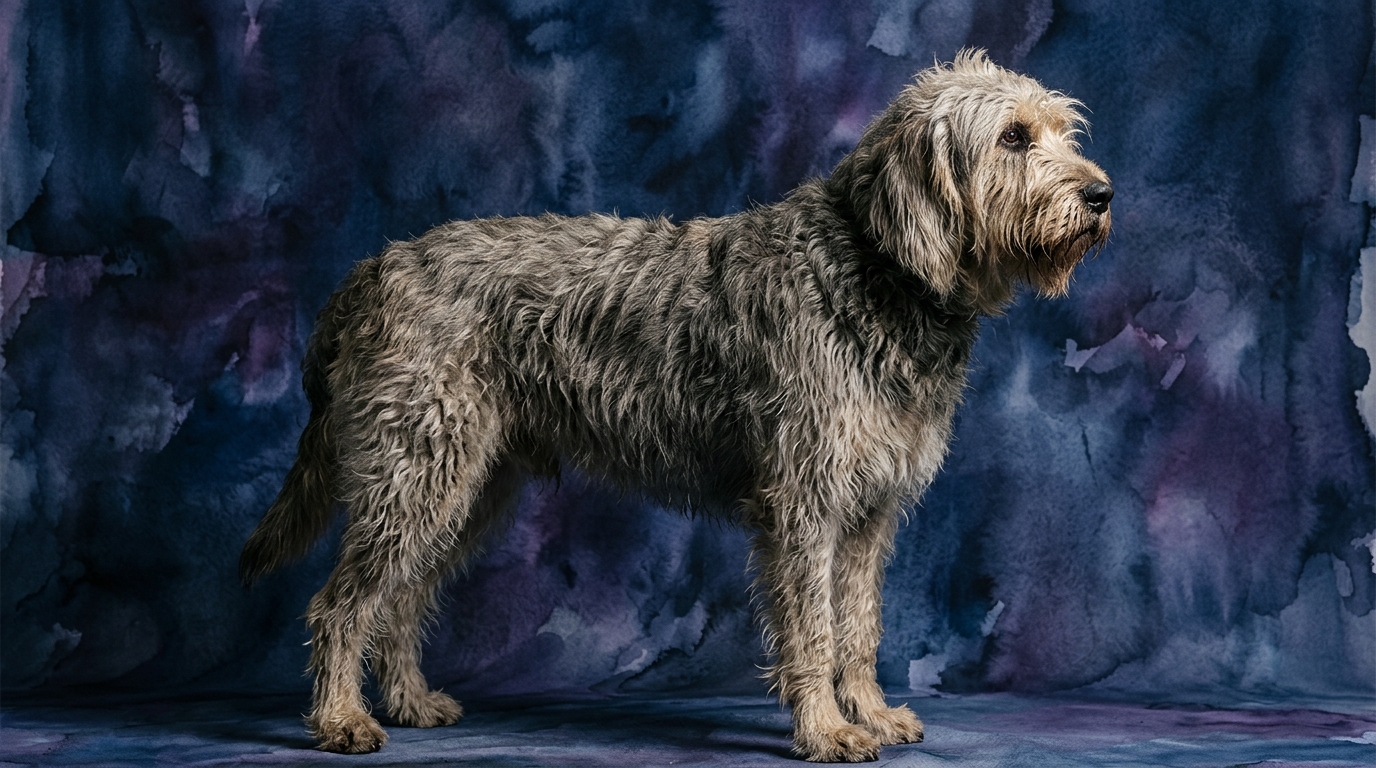
Otterhound at a glance
| IQ Rank / Score | 14/25 |
|---|---|
| Trainability | ★★☆☆☆ (2/5) |
| Social Intelligence | ★★★☆☆ (3/5) |
| Lifespan | 10-12 years |
| Shedding | Moderate to high |
| Exercise Needs | High (60+ min/day + training) |
| Origin | England |
The Primary Angle: Aquatic Scenting Acumen and Independent Problem-Solving
The Otterhound's intelligence is dominantly characterized by its unparalleled aquatic scenting acumen, honed for generations to detect and follow the faintest otter trails over land and through water. This isn't just a strong nose; it's a complex cognitive process involving sustained focus, scent differentiation across varying terrains and conditions (including underwater), and the mental fortitude to pursue a lead relentlessly. Their webbed feet, rough coat, and robust build are physical manifestations of this specialized cognitive purpose, allowing them to navigate treacherous riverbanks and powerful currents with an efficiency that speaks volumes about their evolutionary intelligence.
Beyond their extraordinary nose, Otterhounds are quintessential independent problem-solvers. As hounds, they were bred to work with a pack but not to constantly seek human direction during a hunt. This translates into a dog capable of making autonomous decisions to overcome obstacles, interpret environmental cues, and persist in a task without direct command. While this independence can sometimes be misconstrued as stubbornness, it's actually a hallmark of their specialized intelligence, enabling them to navigate complex tracking scenarios where constant handler intervention would be impractical or even detrimental to the hunt's success.
A Surprising Cognitive-Historical Fact: The Otterhound's Relentless Drive and Near Extinction
A surprising historical fact about the Otterhound's cognitive prowess is that their remarkable efficiency and relentless pursuit intelligence, honed over centuries for otter hunting, actually contributed to the near extinction of their quarry in parts of England. This historical effectiveness directly led to the eventual ban on otter hunting in the UK, which paradoxically plunged the Otterhound breed itself into severe decline, making it one of the rarest native British breeds today. This demonstrates an extreme degree of specialized cognitive effectiveness that profoundly impacted both the natural environment and the breed's own destiny, highlighting a 'too good' scenario for a working dog.
Decoding the Otterhound's Instinctive Drive: The Unyielding Scent Hound
Instinctive Drive is arguably the Otterhound's most dominant cognitive trait, rated at a perfect 5. This isn't just a 'desire to hunt'; it's an overwhelming, all-consuming urge to follow a scent trail to its conclusion. Once an Otterhound's nose hits a compelling scent, particularly in an environment reminiscent of its aquatic origins, their focus becomes singularly devoted to that task, often to the exclusion of all other stimuli. This deep-seated drive manifests as incredible endurance and unwavering determination, pushing them through difficult terrain and challenging conditions, echoing their ancestral role in prolonged hunts. This cognitive 'tunnel vision' for scent is what makes them exceptional trackers, but also requires understanding and management in a domestic setting.
This high instinctive drive means that while an Otterhound may not be quick to learn every arbitrary command, they are incredibly intelligent within their domain. Their 'problem-solving' often revolves around how to best pick up a lost trail, navigate a new obstacle in pursuit of a scent, or find the source of an intriguing smell. Their memory is also intrinsically tied to this drive, storing vast libraries of scent information and spatial layouts related to past hunts or interesting discoveries. For an Otterhound, the world is primarily perceived through its nose, and their cognitive processes are largely dedicated to interpreting and acting upon that rich olfactory data.
Navigating the Otterhound's Training Landscape and Social Nuances
Training an Otterhound demands patience and creativity, reflecting their independent problem-solving and strong instinctive drive. While not necessarily 'stubborn,' their priority is often their nose, not your command. This translates to a moderate training speed (IQ 2), requiring handlers to make training a fun, engaging, and scent-oriented activity. Positive reinforcement, particularly with high-value treats or engaging scent games, is key. Their intelligence allows them to understand complex commands, but their motivation to *obey* them is often contingent on the perceived value of the reward or the appeal of the activity itself, especially when competing with an enticing scent.
Socially, Otterhounds are generally affable and friendly dogs (IQ 3), getting along well with people and other animals. However, their social intelligence isn't necessarily focused on subtle human cues in the same way a highly people-oriented breed might be. They are pack animals, comfortable within a family unit, but their primary form of 'communication' often involves their boisterous bay and their nose, which can lead to a less nuanced reading of human emotions or social expectations. They are loyal companions, but their independence means they are less likely to be 'velcro dogs' and more likely to be exploring their environment with their nose, even when in the company of their beloved humans.
Memory and Problem-Solving: The Otterhound's Cognitive Strengths
Otterhounds possess a commendable memory (IQ 4), particularly when it comes to scent recognition and spatial recall of environments where they've found interesting smells. They can remember complex scent trails for extended periods and recall locations where prey or exciting discoveries were made. This memory isn't just for rote obedience commands but extends to intricate mental maps of their territory, understanding of water currents, and the best routes to take during a pursuit. This strong memory is crucial for a breed that relies on following a trail over vast and varied landscapes, remembering nuances that might aid in future hunts.
Problem-solving for an Otterhound (IQ 3) is highly contextual. While they might not excel at abstract puzzles, they are masters at practical, real-world problem-solving related to their original purpose. This includes figuring out how to cross a stream, navigate dense undergrowth, or overcome physical barriers to stay on a scent trail. Their independent nature encourages them to think for themselves, making quick decisions based on their instincts and environmental observations. This practical intelligence, combined with their tenacity, makes them highly effective in tasks that leverage their natural abilities.
3 At-Home Tests to Measure Your Otterhound's IQ
These tests are adapted from peer-reviewed ethology research. No equipment is needed beyond items you have at home. Run each test 5–10 times for reliable results.
The Myth: "Otterhounds are too stubborn to train effectively."
✅ Otterhounds are not stubborn but highly independent and driven by their nose. They are intelligent and capable of learning, but training requires patience, consistency, and motivation tailored to their innate drives, often involving scent work and making 'obeying' more rewarding than following a trail. Their 'stubbornness' is actually a manifestation of their specialized intelligence for independent hunting.
Otterhound vs. Similar Breeds
🧠 What's Your Dog's IQ Score?
Our full Pet IQ Lab assessment includes 12+ tests across 5 cognitive dimensions, calibrated for Otterhounds specifically.
Take the Full IQ Test →Frequently Asked Questions
How smart is a Otterhound?
Our Pet IQ Lab framework scores cognition across five dimensions (max 25). The Otterhound totals 14/25 — above-average for a domestic dog. The full article breaks down each dimension with at-home tests.
Are Otterhounds easy to train?
Otterhounds are independent learners; short, highly-motivating sessions work best. They score 2/5 on Training Speed in our breed profile.
Are Otterhounds good with children and other pets?
Otterhounds can live well with families when socialized early. Their Social Intelligence scores 3/5, so supervise interactions with small children and introduce new pets gradually.
Do Otterhounds need a lot of mental stimulation?
Absolutely. With Problem Solving 3/5 and Instinctive Drive 4/5, Otterhounds need daily mental work — puzzle feeders, scent games, training sessions, or nose-work — to avoid boredom.
How much exercise does a Otterhound need?
Otterhounds need active engagement. Plan for 45-60 minutes of exercise and training per day, plus mental stimulation.
How good is a Otterhound's memory?
Otterhounds score 2/5 on memory. They remember high-value associations well; less-used cues fade without refresher sessions.
What is the typical lifespan of a Otterhound?
Typical lifespan is 10-12 years for a large dog like the Otterhound.
The Otterhound's intelligence is a magnificent, specialized tapestry woven from centuries of aquatic hunting, manifesting as unparalleled scenting acumen, tenacious independence, and robust problem-solving. Understanding this unique cognitive profile is key to appreciating this rare and remarkable breed, celebrating their specialized brilliance rather than misinterpreting their independence as a flaw.