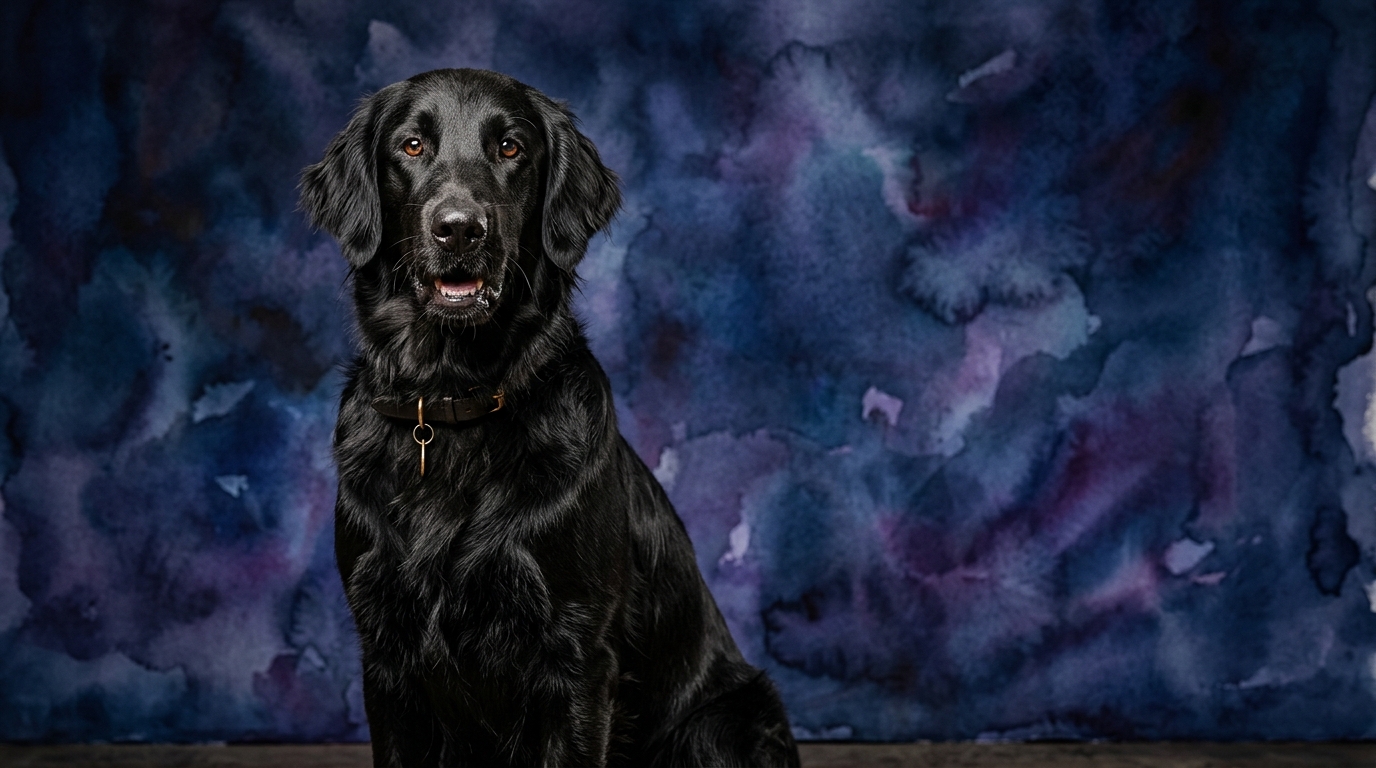
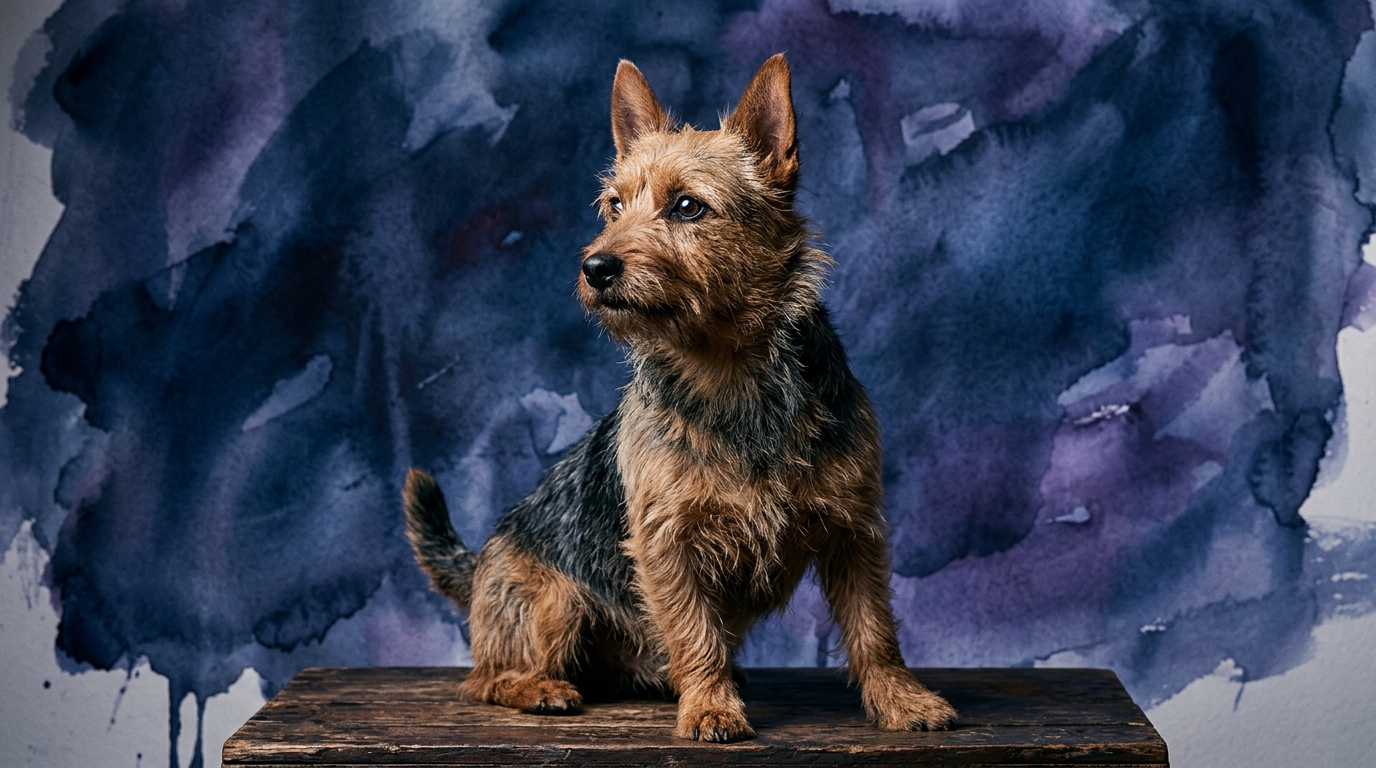
Side-by-Side Cognitive Profiles
The Flat-Coated Retriever, a Coren-ranked #17 breed, exhibits a robust cognitive profile tailored for cooperative work and complex tasks. Its Problem Solving score of 4/5 indicates a strong capacity to strategize and navigate novel challenges, often showing initiative in finding solutions. Training Speed at 4/5 highlights its quick grasp of new commands and routines, making it a highly receptive learner. Social Intelligence, rated 3/5, suggests an average ability to interpret human cues and interact appropriately within a social context. Its Instinctive Drive, also 3/5, reflects a moderate but manageable inclination towards retrieving and typical dog behaviors, without being overly dominant. A standout feature is its Memory at 5/5, signifying an exceptional ability to retain learned information, complex sequences, and long-term associations.
In contrast, the Australian Terrier, though not Coren-ranked, presents a profile typical of its resourceful terrier heritage. Its Problem Solving ability is rated 3/5, meaning it can tackle straightforward puzzles and challenges but may require more persistence or trial-and-error compared to the Flat-Coat. Training Speed at 3/5 indicates it learns at a steady, consistent pace, requiring clear, repetitive instruction to solidify new behaviors. Social Intelligence also scores 3/5, suggesting it capably navigates social situations and understands basic human communication. Instinctive Drive, at 3/5, reflects its inherent terrier tendencies for digging, chasing, and independent exploration, which can be channeled with appropriate outlets. Its Memory, also 3/5, means it retains information adequately but may not recall intricate details or long-past events with the same precision as a breed with a higher score.
Where the Flat-Coated Retriever Excels Cognitively
The Flat-Coated Retriever’s cognitive strengths are particularly evident in its capacity for rapid learning and recall, making it an exceptional partner for structured activities. Its 4/5 Problem Solving score means it can quickly interpret complex scenarios, such as navigating an agility course or figuring out how to retrieve a specific item from a group, often with minimal guidance. For instance, a Flat-Coat might deduce the mechanism of a puzzle toy much faster than many other breeds, or understand a multi-step command sequence on fewer repetitions. This breed's exceptional 5/5 Memory further amplifies its cognitive prowess; it’s adept at remembering not just commands, but also the context in which they were learned, the faces of infrequent visitors, or the layout of places visited long ago. This superior memory allows for highly reliable performance in competitive obedience or working roles, where consistency over time is paramount. Its 4/5 Training Speed means new skills are acquired with impressive efficiency, allowing for a broader repertoire of behaviors to be taught in a shorter timeframe.
Where the Australian Terrier Shines Cognitively
While the Australian Terrier’s individual cognitive scores may be numerically lower than the Flat-Coated Retriever’s, its strengths lie in a different sphere of practical intelligence and tenacity. Its 3/5 Problem Solving, combined with a strong instinctive drive, translates into a resilient and resourceful approach to challenges within its environment. An Australian Terrier might not solve a complex puzzle box as quickly, but it will likely persist longer, employing a variety of tactics like nudging, digging, or vocalizing until it achieves its goal, especially if that goal aligns with its terrier instincts, such as unearthing a hidden treat. This breed's cognitive strength is less about speed and more about determined application of its faculties to achieve practical outcomes. Its moderate social intelligence and instinctive drive mean it possesses a balanced independence, capable of making its own decisions when necessary, a trait valuable in a working terrier that historically needed to operate autonomously. This breed's cognitive make-up fosters a spirited self-reliance, making it particularly adept at independent exploration and task completion within its own scope of interest.
Training Dynamics: Flat-Coat Responsiveness vs. Aussie Terrier Persistence
When it comes to training, the Flat-Coated Retriever generally presents a smoother, faster learning curve due to its 4/5 Training Speed and 4/5 Problem Solving. This breed tends to be eager to please and quick to form associations between commands and actions, requiring fewer repetitions to master new skills. Their excellent 5/5 Memory means once a behavior is learned, it is retained effectively over time, reducing the need for constant refreshers. This makes them ideal for intricate obedience work, advanced tricks, or roles requiring a vast array of learned behaviors.
The Australian Terrier, with a 3/5 Training Speed and 3/5 Problem Solving, requires a more patient and consistent approach. While capable of learning, they may take longer to grasp new concepts and often benefit from shorter, more engaging training sessions to maintain focus. Their inherent terrier independence and instinctive drive (3/5) mean they can sometimes prioritize their own interests over human commands, necessitating strong motivation and positive reinforcement to keep them engaged. Training an Australian Terrier often involves channeling their natural persistence and curiosity into desired behaviors, rather than expecting immediate, eager compliance. Their moderate memory also means consistent practice is key to solidifying learned behaviors.
Matching Breeds to Lifestyles: Active Engagement vs. Spirited Companionship
The Flat-Coated Retriever, with its higher scores in Problem Solving, Training Speed, and Memory, is exceptionally well-suited for active owners who relish engaging their dog in various cognitive and physical pursuits. Owners who enjoy activities like competitive obedience, agility, field trials, or even complex trick training will find the Flat-Coat to be an eager and capable partner. Their cognitive profile thrives on consistent mental stimulation and the opportunity to learn and apply new skills. This breed flourishes in environments where their intelligence is regularly challenged, making them a superb fit for individuals or families committed to an interactive and enriching lifestyle.
The Australian Terrier, while also requiring activity, suits owners who appreciate a spirited, self-possessed companion, perhaps in a slightly less structured context. Their cognitive strengths lend themselves to owners who value a dog with a robust personality and a degree of independent thought. While they can excel in some dog sports, their 3/5 Problem Solving and Training Speed suggest they might prefer a varied routine that taps into their instinctive drives, such as exploring new walking routes or engaging in scent games, rather than repetitive, high-level obedience. They are an excellent choice for owners seeking a lively, tenacious companion who is content with regular walks, interactive play, and a comfortable home environment, without necessarily demanding constant, rigorous training.
The Verdict: When to Choose Each Breed
For owners seeking a highly responsive, easily trainable, and consistently performing canine partner for advanced training, competitive activities, or cooperative work, the Flat-Coated Retriever is the ideal choice. Its superior memory, problem-solving, and training speed make it a joy to teach and an exceptionally reliable companion.
Conversely, if you appreciate a tenacious, spirited, and independently-minded companion who offers robust personality and a moderate but persistent approach to learning, the Australian Terrier could be your perfect match. This breed thrives with owners who respect its terrier spirit and provide engaging, varied mental outlets.
The Verdict
Choose the Flat-Coated Retriever if you desire a highly trainable, intelligent partner for complex activities and consistent performance, thriving on cooperative engagement. Its exceptional memory and quick learning make it a standout for advanced training.
Opt for the Australian Terrier if you prefer a spirited, independent companion who is persistent, resourceful, and brings a lively personality to the home, enjoying varied mental challenges over constant structured training.
🧠 Find Your Pet's IQ Score
Our Pet IQ Lab assessment covers 25+ tests across 5 cognitive dimensions — personalized to your breed.
Take the Full IQ Test →Frequently Asked Questions
How does the Coren ranking relate to these breeds?
The Flat-Coated Retriever's Coren rank of #17 signifies its high capacity for working and obedience intelligence, placing it among the most responsive breeds. The Australian Terrier is not Coren-ranked, which simply means it wasn't included in that specific study, not that it lacks intelligence, but rather that its cognitive strengths might lean more towards independent problem-solving than immediate obedience.
Do Flat-Coated Retrievers require more mental stimulation?
Yes, Flat-Coated Retrievers generally require substantial mental stimulation due to their high Problem Solving (4/5) and Memory (5/5) scores. They thrive on learning new tasks, puzzle toys, and engaging in activities that challenge their intellect, otherwise they can become bored and potentially destructive. Their cognitive profile demands an outlet for their sharp minds.
Is an Australian Terrier difficult to train because of its independence?
An Australian Terrier's independence (part of its 3/5 Instinctive Drive) means training requires consistency, patience, and strong motivation, but it is certainly not 'difficult' in an insurmountable way. They learn at a steady pace (3/5 Training Speed) and respond well to positive reinforcement, though they may not be as eager to please or as quick to grasp complex multi-step commands as a Flat-Coated Retriever.