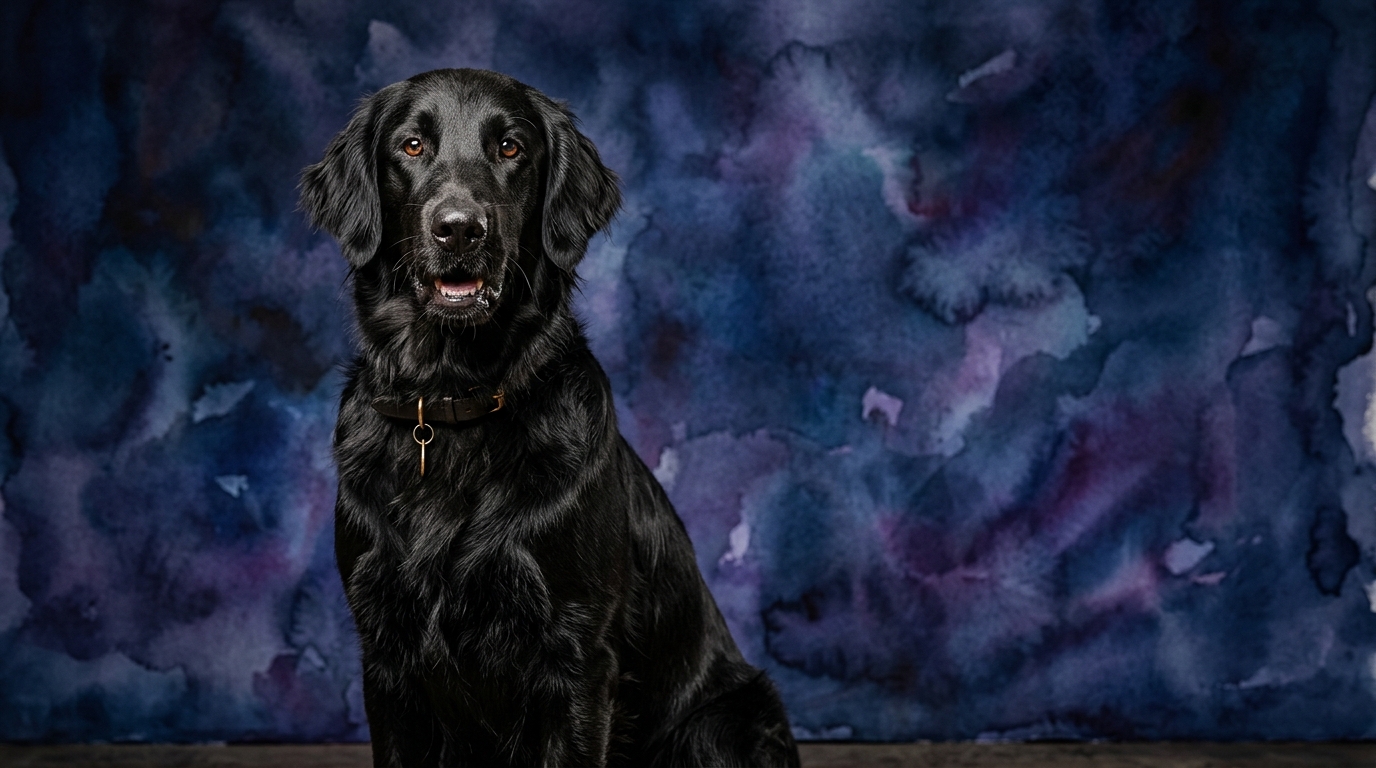
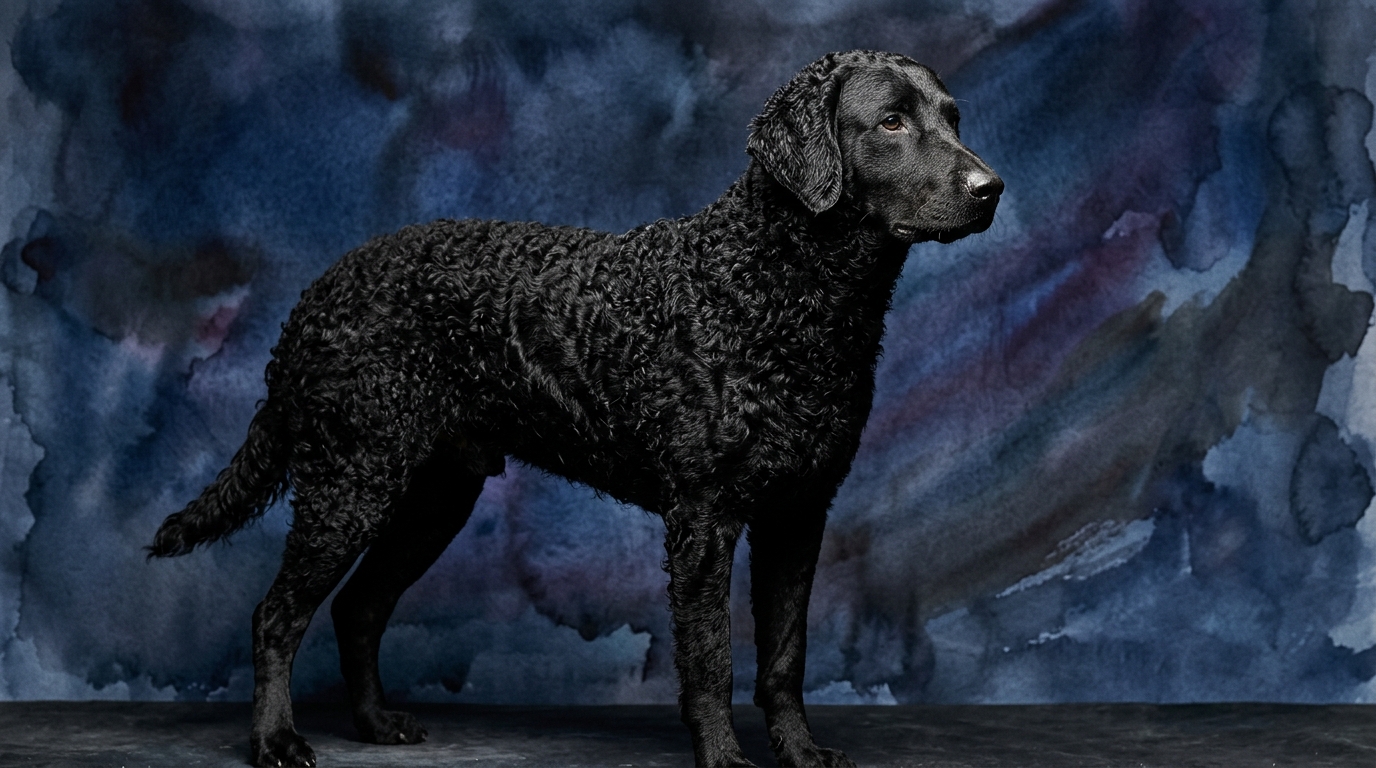
Side-by-Side Cognitive Profiles
The Cosmic Pet Pet IQ Lab employs five key dimensions to assess a breed's cognitive landscape, providing a nuanced view of their intellectual strengths. Let's examine how the Flat-Coated Retriever and Curly-Coated Retriever measure up.
The Flat-Coated Retriever, holding a respectable Coren rank of #17, demonstrates a robust cognitive makeup. Its Problem Solving is rated at 4/5, indicating a strong capacity for figuring out novel challenges and adapting to new situations. Training Speed also sits at 4/5, suggesting a quick grasp of new commands and a keenness for learning. Social Intelligence is 3/5, meaning they form strong bonds and understand human cues adequately, though perhaps not with profound intuitive insight into strangers. Their Instinctive Drive is 3/5, reflecting a moderate, purposeful drive for retrieving without being overly intense. A standout attribute is their Memory, scoring a perfect 5/5, which points to exceptional retention of learned behaviors and experiences.
The Curly-Coated Retriever, with a Coren rank of #41, presents a steady and capable cognitive profile. In Problem Solving, they score 3/5, indicating an ability to tackle straightforward issues, though potentially requiring more guidance for complex puzzles. Their Training Speed is 3/5, suggesting a consistent learning pace that benefits from patient, clear instruction. Social Intelligence matches the Flat-Coat at 3/5, highlighting their capacity for deep family bonds while potentially showing reservation with new acquaintances. Instinctive Drive is also 3/5, signifying a reliable drive for their working heritage, balanced and not overwhelming. Their Memory is a strong 4/5, showing good recall for routines and commands, though perhaps not with the same depth as their Flat-Coated counterparts.
Where the Flat-Coated Retriever Wins Cognitively
The Flat-Coated Retriever showcases distinct cognitive advantages, particularly in areas demanding rapid processing and recall. Its superior Problem Solving score of 4/5 means these dogs are often quicker to independently assess and navigate new environments or challenges, such as figuring out how to access a hidden toy or bypass an unexpected obstacle. This reflects a more flexible and proactive approach to their surroundings.
Memory is another significant win for the Flat-Coat, boasting a perfect 5/5. This exceptional recall translates into a greater capacity for retaining a vast array of commands, remembering complex sequences of behaviors, and recalling past training sessions with impressive accuracy over extended periods. For owners interested in advanced obedience or intricate dog sports, this memory capacity significantly streamlines the learning process and solidifies long-term skill retention.
Furthermore, their Training Speed of 4/5, one point higher than the Curly-Coat, means Flat-Coats generally connect actions with desired outcomes more rapidly. They tend to pick up new tasks, cues, and routines with fewer repetitions, making initial training periods feel more dynamic and rewarding. This cognitive nimbleness allows for a quicker progression through various levels of training complexity, favoring a companion who thrives on constant mental engagement and learning new things quickly.
Where the Curly-Coated Retriever Offers Unique Cognitive Strengths
While the Curly-Coated Retriever doesn't outscore the Flat-Coat in direct comparison across the five dimensions, its cognitive profile offers a consistent and robust foundation that appeals to owners seeking a different kind of companion. The Curly-Coat's steady 3/5 in Problem Solving and Training Speed, coupled with a solid 4/5 in Memory, points to a reliable and deliberate learner.
Their cognitive strength lies in a consistent, rather than lightning-fast, approach to learning and problem-solving. This steady pace can translate into behaviors that are deeply ingrained once learned, potentially leading to a highly dependable working partner who performs with unflappable consistency. Owners often find that while a Curly-Coat might take a few more repetitions to master a task, the knowledge sticks with remarkable tenacity, making them less prone to forgetting learned commands under pressure.
Moreover, the Curly-Coat's equal Social Intelligence (3/5) and Instinctive Drive (3/5) scores compared to the Flat-Coat indicate a shared capacity for forming profound bonds and engaging in purposeful work. Their slightly more reserved nature, a characteristic often observed, can be interpreted as a cognitive strength for owners who appreciate a dog that is discerning and forms deep, trusting relationships over time, rather than being universally effusive. This reservedness can foster a unique partnership where trust and mutual understanding are built methodically.
Which Is Easier to Train and Why
Based on their respective IQ scores, the Flat-Coated Retriever generally presents as the easier breed to train. Their higher Training Speed (4/5) means they assimilate new commands and concepts more quickly, often requiring fewer repetitions to achieve proficiency. This cognitive agility is complemented by their exceptional Memory (5/5), ensuring that once a behavior is learned, it is retained with remarkable clarity over time. A Flat-Coat's higher Problem Solving (4/5) also contributes to easier training, as they are more likely to generalize learned behaviors to new contexts and adapt to slight variations in commands or environments without extensive re-teaching.
Conversely, the Curly-Coated Retriever, with a Training Speed of 3/5 and Memory of 4/5, benefits from a more patient and consistent training methodology. They are capable learners, but they may require more repetitions and a clearer, more structured approach to fully grasp and solidify new commands. For instance, in a complex agility sequence, a Flat-Coat might anticipate the next obstacle based on prior experience, while a Curly-Coat might prefer explicit cues for each step. This isn't a deficit in ability, but rather a difference in cognitive processing speed and learning style. Owners of Curly-Coats often report that while the initial learning curve might be slower, once a command is truly understood, it becomes deeply embedded and reliably executed, showcasing their dependable nature.
Which Suits Active Owners vs. Relaxed Owners
Both Flat-Coated and Curly-Coated Retrievers are members of the Sporting Group, meaning neither is suited for a truly sedentary lifestyle. However, their cognitive profiles suggest different nuances in what constitutes an 'active' owner.
The Flat-Coated Retriever, with its higher scores in Problem Solving (4/5), Training Speed (4/5), and Memory (5/5), thrives with owners who embrace dynamic and varied activities. They are excellent candidates for competitive dog sports like agility, obedience, rally, and advanced field work that demand quick thinking, rapid learning, and the retention of complex sequences. An ideal owner for a Flat-Coat is someone who enjoys constantly engaging their dog's mind with new challenges, diversified training sessions, and varied outdoor adventures where their quick wit can shine. They are often described as having an 'ever-optimistic' outlook, keen to participate in whatever their owner suggests.
The Curly-Coated Retriever, while equally active, suits owners who appreciate a more consistent and purposeful approach to engagement. Their steady cognitive scores across the board (3/5 for Problem Solving, Training Speed, Social Intelligence, Instinctive Drive, and 4/5 for Memory) indicate a reliable and enduring companion for activities like long, consistent hikes, traditional retrieving tasks, or structured field work. They might not seek the constant novelty that a Flat-Coat does, preferring a predictable routine of physical and mental engagement. An active owner for a Curly-Coat might be someone who enjoys daily vigorous exercise, consistent training that builds on established skills, and a partnership built on mutual respect and a steady rhythm, rather than constant, spontaneous brilliance. They offer a dignified and robust presence for those who value steadfast companionship in their active pursuits.
The Verdict: When to Choose Each
Choosing between these two distinct Retriever breeds comes down to aligning their cognitive make-up with your lifestyle and training aspirations. Both are loyal companions, but their intellectual nuances guide them toward different kinds of partnerships.
If you are an owner seeking a highly adaptable, quick-thinking companion who thrives on diverse mental challenges and picks up new skills with impressive speed and recall, the Flat-Coated Retriever is likely your ideal match. Their zest for learning and ability to retain complex information makes them excellent for competitive sports and varied, engaging activities.
Conversely, if you value a steady, reliable learner with a deep, discerning bond, appreciating a consistent approach to training and a less frantic pace of cognitive engagement, the Curly-Coated Retriever might be the perfect fit. Their robust, consistent intellect ensures they become a dependable and enduring partner in shared activities, building trust through methodical interaction.
The Verdict
For owners seeking a highly adaptable, quick-thinking companion who thrives on diverse challenges and picks up new skills with impressive speed and recall, the Flat-Coated Retriever is likely your ideal match.
For owners who value a steady, reliable learner with a deep, discerning bond, appreciating a consistent approach to training and a less frantic pace of cognitive engagement, the Curly-Coated Retriever might be the perfect fit.
🧠 Find Your Pet's IQ Score
Our Pet IQ Lab assessment covers 25+ tests across 5 cognitive dimensions — personalized to your breed.
Take the Full IQ Test →Frequently Asked Questions
Are Flat-Coated Retrievers better at learning new tricks?
Yes, the Flat-Coated Retriever's higher training speed (4/5) and superior memory (5/5) generally mean they grasp new tricks and commands faster than the Curly-Coated Retriever (3/5 training speed, 4/5 memory). They tend to pick up on new behaviors with fewer repetitions and retain them more readily.
Do Curly-Coated Retrievers require more patience in training?
Yes, due to their slightly lower training speed (3/5) compared to the Flat-Coated Retriever (4/5), Curly-Coated Retrievers benefit from a more patient and consistent training approach. While they learn effectively, they may require more repetitions to solidify new commands.
Which retriever is more independent in problem-solving?
The Flat-Coated Retriever, with a problem-solving score of 4/5, generally exhibits more independent thought when faced with new challenges compared to the Curly-Coated Retriever at 3/5. Flat-Coats are often quicker to devise solutions without direct human intervention.