
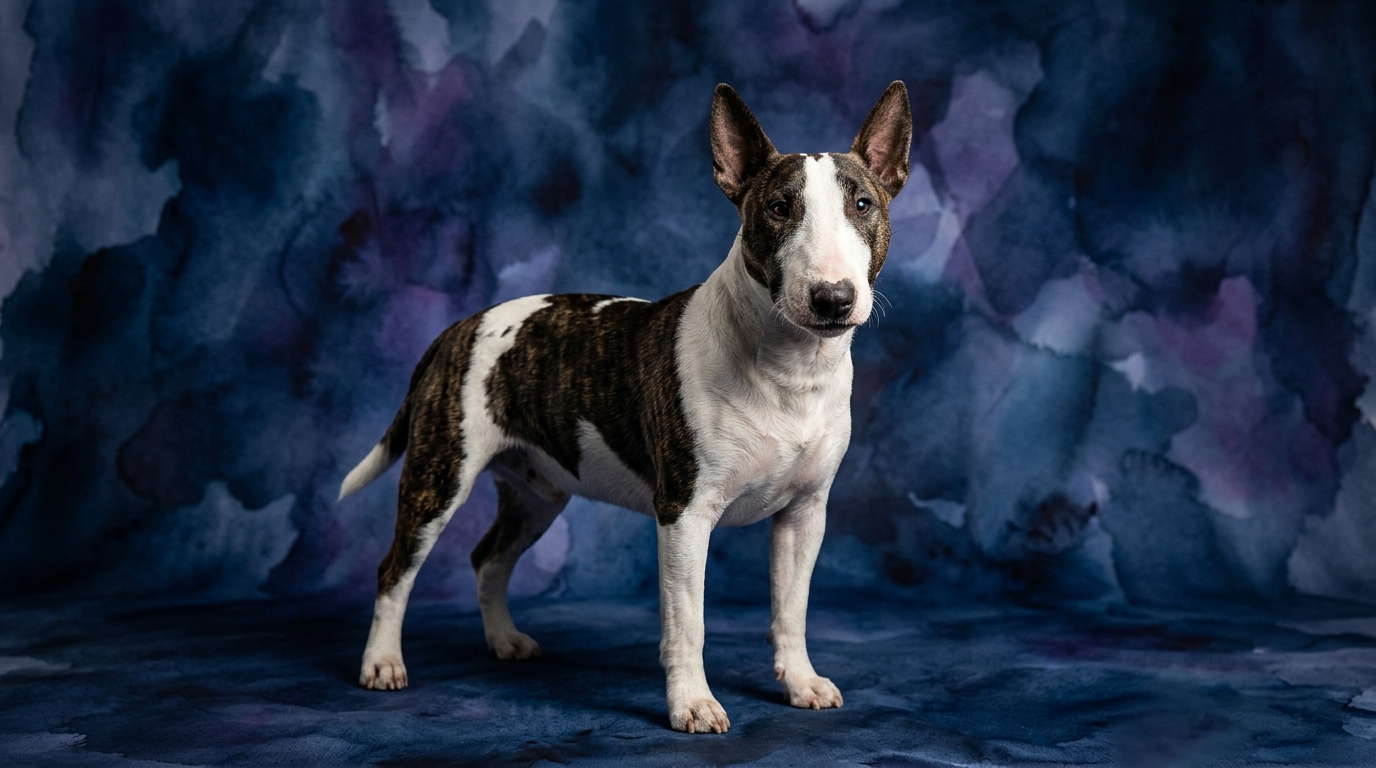
Side-by-Side IQ Profile: Flat-Coated Retriever vs. Miniature Bull Terrier
The Flat-Coated Retriever, a member of the Sporting group, carries a notable Coren rank of #17, indicating a strong aptitude for working and obedience intelligence. Their cognitive profile is characterized by a problem-solving ability of 4/5, signifying a keen capacity to understand and navigate new situations. Their training speed is also rated 4/5, meaning they quickly make associations between commands and actions. Social intelligence stands at 3/5, suggesting a good, but not exceptional, ability to interpret human cues, while their instinctive drive, primarily for retrieving, is 3/5. A standout trait for the Flat-Coat is their exceptional memory, scoring a perfect 5/5, which is crucial for retaining complex sequences and commands over time.
In contrast, the Miniature Bull Terrier, a spirited Terrier breed, is not Coren-ranked, which often points to a different cognitive focus rather than a lack of mental capacity. Their IQ dimensions present a more uniform picture: problem-solving is rated 3/5, indicating a steady ability to work through challenges, though perhaps with more trial and error. Their training speed also sits at 3/5, meaning they learn at a consistent pace but may require more repetition than their retriever counterpart. Social intelligence is 3/5, similar to the Flat-Coat, and their instinctive drive, typical of terriers, is also 3/5. Their memory is rated 3/5, suggesting they retain information adequately but may not excel at intricate, long-term recall to the same extent as a Flat-Coat.
Where the Flat-Coated Retriever Excels Cognitively
The Flat-Coated Retriever's cognitive strengths distinctly position them as adept learners and problem-solvers. Their superior memory (5/5) is a significant asset, enabling them to master and retain multi-step commands, complex agility courses, or intricate scent discrimination tasks with remarkable precision. This exceptional recall means they build a vast repertoire of learned behaviors and can apply them consistently, even after periods of inactivity.
Furthermore, their higher problem-solving (4/5) combined with a faster training speed (4/5) allows Flat-Coats to quickly grasp novel concepts and adapt to new environments or training challenges. They often demonstrate resourcefulness in figuring out how to achieve a goal, whether it's navigating an obstacle or understanding a new puzzle toy. Their Coren rank #17 underscores their readiness and capacity for structured learning, making them highly responsive to guidance and eager to engage in mentally stimulating activities that require applying their cognitive skills.
Cognitive Advantages of the Miniature Bull Terrier
While the Miniature Bull Terrier's individual cognitive scores may appear modest compared to the Flat-Coat, their consistent 3/5 across most dimensions translates into a unique set of cognitive advantages, particularly for certain lifestyles. Their balanced instinctive drive (3/5) combined with average social intelligence means they often possess a robust independence. This allows them to be content with their own company or with less demanding social interactions, which can be a distinct benefit for owners who appreciate a dog with a strong, self-contained personality.
The Miniature Bull Terrier's problem-solving at 3/5, though not the highest, often manifests as tenacious and persistent thinking, a hallmark trait of the terrier group. They might not solve problems with lightning speed, but they will typically approach challenges with a determined attitude, often trying various methods until a solution is found. This cognitive resilience, coupled with their consistent learning speed and memory, means they are predictable and reliable companions who, while not always seeking to impress with rapid obedience, offer steadfastness and a distinct, charming character that stems from their cognitive independence.
Trainability: Flat-Coated Retriever vs. Miniature Bull Terrier
When it comes to trainability, the Flat-Coated Retriever generally presents a smoother and faster learning curve. Their training speed of 4/5 means they pick up new commands and behaviors with relative ease, often requiring fewer repetitions to solidify a concept. This, coupled with their exceptional memory (5/5), ensures that once a lesson is learned, it is retained for the long term, making them consistent performers in obedience and various dog sports. Their natural desire to work cooperatively, typical of a Sporting breed, further enhances their responsiveness to positive reinforcement methods.
The Miniature Bull Terrier, on the other hand, can be a more involved training project. With a training speed of 3/5 and memory at 3/5, they require more patience and consistency from their owner. Their independent terrier spirit means they can sometimes be selective about when they choose to obey, especially if a command doesn't immediately align with their interests. Training a Miniature Bull Terrier thrives on engaging, fun-based methods and requires an owner who understands the importance of consistent boundaries and positive reinforcement to channel their tenacity effectively. They will learn, but the process may demand more creativity and perseverance.
Matching Breeds to Owner Lifestyles: Active vs. Relaxed
The Flat-Coated Retriever is an ideal companion for active owners who can provide ample mental stimulation and physical exercise. Their cognitive profile, with high problem-solving and memory, means they thrive on engaging activities like advanced obedience, agility, retrieving games, and long, exploratory hikes. A Flat-Coat needs a lifestyle that consistently challenges both their body and their mind; an owner seeking a highly interactive and intellectually engaged partner will find them a perfect match. Without sufficient outlets for their cognitive and physical energy, they can become bored and potentially develop undesirable behaviors.
The Miniature Bull Terrier, while possessing energy, can be a suitable choice for moderately active owners. Their consistent 3/5 scores across cognitive dimensions suggest they don't demand the same level of complex, structured mental engagement as a Flat-Coat. They enjoy regular walks, playtime, and short bursts of activity, but their independence means they are often content to relax afterward. Owners who appreciate a dog with a distinct personality and are prepared for fun, less formal activities rather than constant structured training might find the Miniature Bull Terrier a delightful fit. They require consistent exercise but may be less prone to anxiety if a day is slightly less active, provided their fundamental needs are met.
The Verdict
Choose the Flat-Coated Retriever if you seek a highly trainable, cognitively agile companion adept at complex tasks, consistent obedience, and if you can provide ample mental and physical engagement for a dog with exceptional memory.
Opt for the Miniature Bull Terrier if you appreciate a spirited, independent companion with a steady cognitive profile, are prepared for patient, creative training, and enjoy a dog that offers affection without constant demands for structured activity.
🧠 Find Your Pet's IQ Score
Our Pet IQ Lab assessment covers 25+ tests across 5 cognitive dimensions — personalized to your breed.
Take the Full IQ Test →Frequently Asked Questions
Does a lower Coren rank mean a dog is less intelligent?
Not necessarily. Coren's ranking primarily assesses 'working and obedience intelligence,' reflecting a dog's ability to understand and execute human commands. Breeds not on the list, or lower on it, often possess different forms of intelligence, such as problem-solving for specific tasks, social acuity, or independent thinking, which aren't captured by that specific metric.
Are Miniature Bull Terriers difficult to train?
Miniature Bull Terriers can be more challenging to train compared to breeds like the Flat-Coated Retriever due to their independent nature and average training speed. They require consistent, positive reinforcement, engaging methods, and patience to maintain focus and ensure commands are learned and retained.
How important is memory in a dog?
Memory is crucial for a dog's ability to learn and retain commands, understand routines, and navigate their environment safely. A strong memory, like that of the Flat-Coated Retriever, facilitates faster learning and the execution of complex sequences, while an average memory means more repetition might be needed for lasting results.