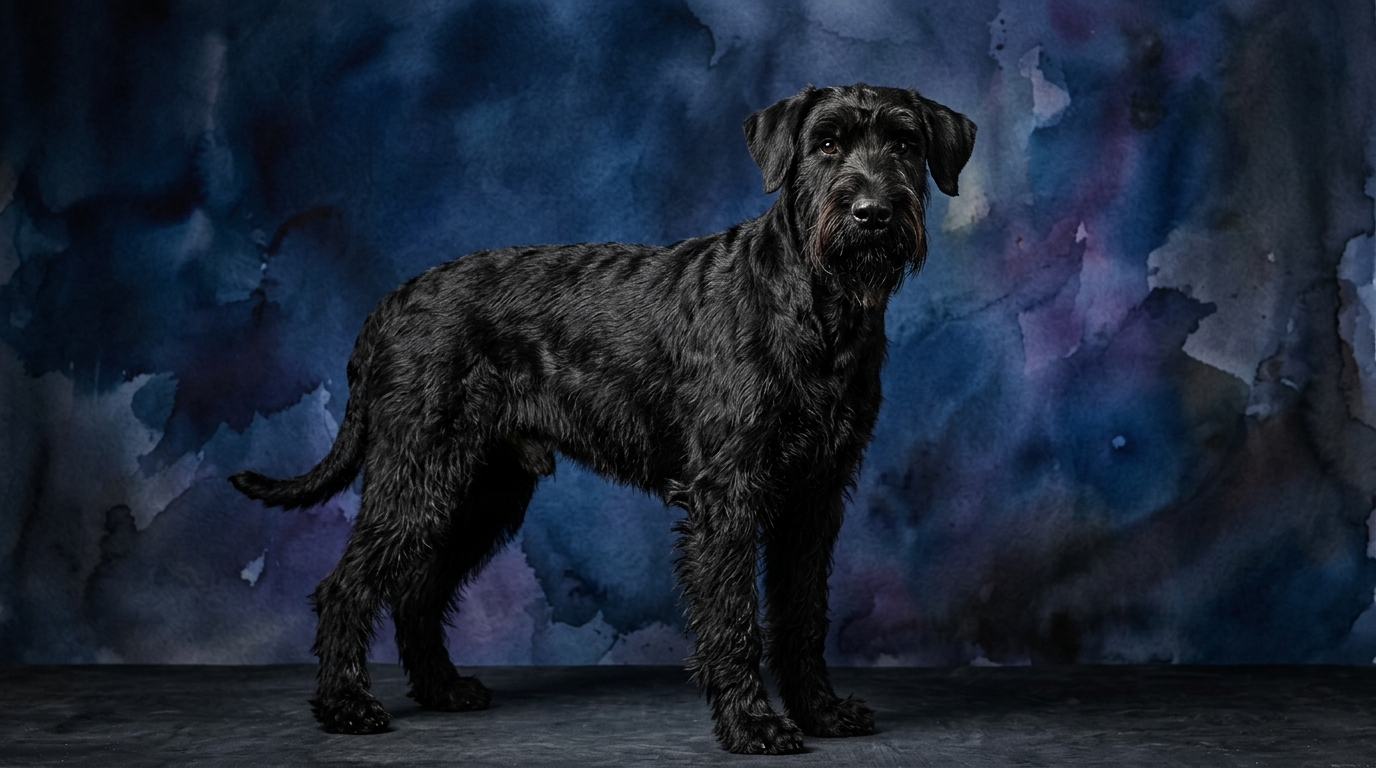
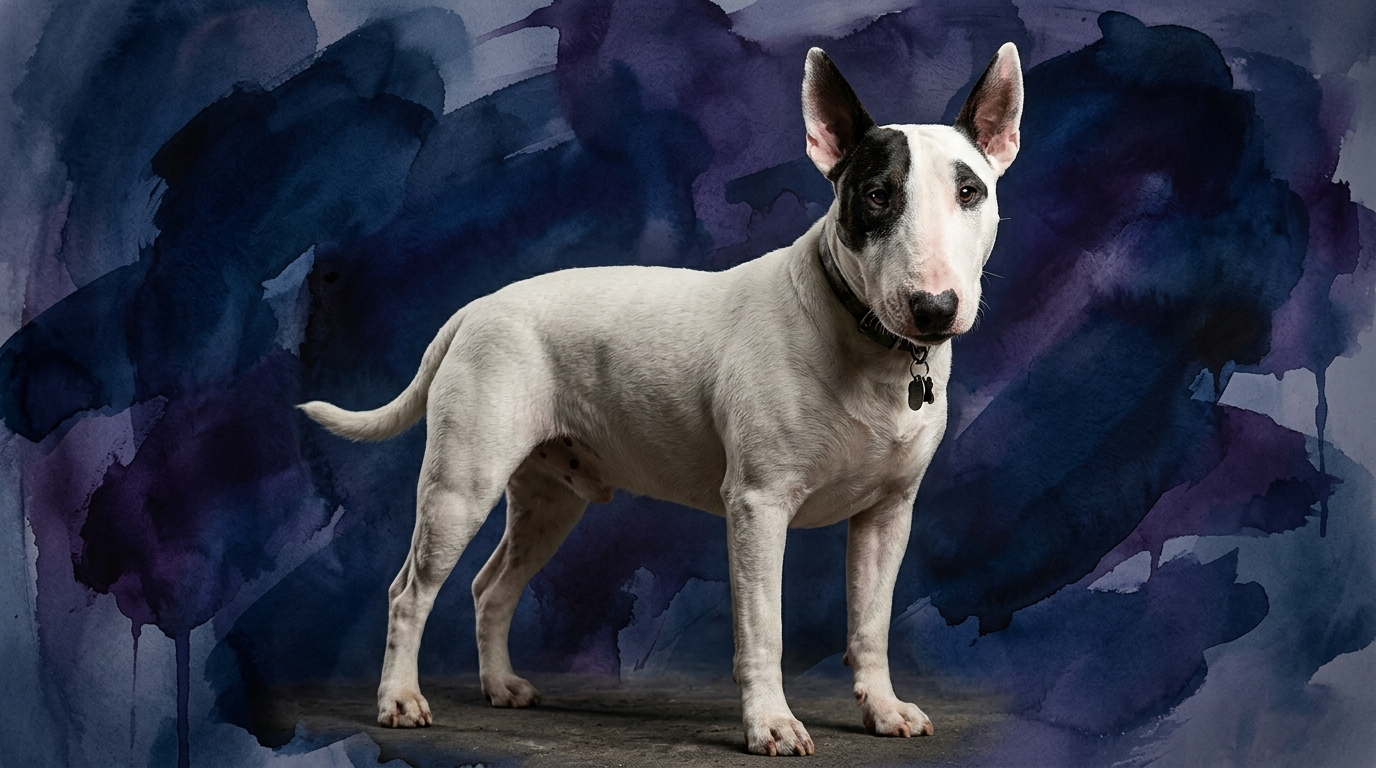
Side-by-Side IQ Profile
The Giant Schnauzer, a Working group dog, holds a Coren rank of #28, indicating a breed with a keen aptitude for understanding and executing commands. Our Pet IQ Lab scores reveal its Problem Solving ability at 4/5, suggesting a capacity for navigating complex scenarios and devising solutions. Its Training Speed, also 4/5, points to a strong willingness and quick uptake of new instructions, making it highly responsive to consistent guidance. Social Intelligence is rated 3/5, meaning it can interpret human cues and social dynamics adequately, while its Instinctive Drive at 3/5 points to a moderate but present inclination towards inherent breed behaviors like guarding or herding. Memory, at 4/5, highlights its impressive ability to retain information and learned behaviors over time.
The Bull Terrier, hailing from the Terrier group, holds a Coren rank of #66, positioning it as a breed with respectable working intelligence, though perhaps requiring more repetition for mastery. Its Problem Solving score of 3/5 suggests it can tackle challenges, albeit potentially with less innovation or speed than some counterparts. A Training Speed of 3/5 indicates a steady learning curve, but one that may be influenced by its independent nature, requiring patience and engaging methods. Social Intelligence is also 3/5, showing it can connect with its human companions and understand social cues effectively. Its Instinctive Drive, rated 3/5, reflects its terrier heritage of determination and prey drive, while a Memory score of 3/5 implies it retains information well, but perhaps not with the same depth or longevity as breeds with higher scores.
Where Giant Schnauzer Wins Cognitively
The Giant Schnauzer’s cognitive strengths are particularly evident in its superior Problem Solving (4/5) and Training Speed (4/5). This breed often displays a strategic approach to novel situations, capable of assessing environmental cues and formulating effective responses. For instance, a Giant Schnauzer might quickly figure out how to open a complex crate latch or navigate an agility course with minimal guidance after initial exposure. Its exceptional Memory (4/5) further amplifies this, allowing it to recall intricate sequences of commands or problem-solving strategies learned long ago, making it a reliable partner in tasks requiring consistency and precision.
This cognitive profile means the Giant Schnauzer generally requires fewer repetitions to master a new skill and is more likely to generalize learned behaviors to new contexts without extensive retraining. Their mental agility allows them to adapt to varied roles and learn complex multi-step tasks, making them adept at activities that demand both physical execution and a thoughtful, analytical approach.
Where Bull Terrier Wins Cognitively
While the Bull Terrier's individual IQ scores are generally a point lower than the Giant Schnauzer's, its cognitive profile shines in areas emphasizing tenacity and singular focus, particularly within its Instinctive Drive (3/5) which, when channeled, can be a formidable asset. Unlike the Giant Schnauzer's multi-faceted problem-solving, the Bull Terrier often approaches challenges with a determined, relentless pursuit, leveraging its physical and mental stamina to overcome obstacles through sheer persistence rather than intricate strategy.
Its Social Intelligence (3/5), matching the Giant Schnauzer, means it forms strong, loyal bonds and is adept at reading its owner's moods, often displaying a charming, clownish personality that speaks to its emotional perceptiveness. This breed excels when a task requires unwavering dedication and a straightforward, robust approach, rather than nuanced, multi-step thought processes, making them formidable companions in scenarios demanding endurance and a concentrated effort.
Which is Easier to Train and Why
Based on our Pet IQ Lab scores, the Giant Schnauzer (Training Speed 4/5) is generally easier to train than the Bull Terrier (Training Speed 3/5). The Giant Schnauzer's inherent responsiveness stems from its working background, where understanding and executing complex commands efficiently was paramount. They often possess a strong desire to please and a quick grasp of new concepts, which translates into faster acquisition of obedience cues and advanced tasks.
Conversely, the Bull Terrier's training speed is tempered by its strong independent streak and characteristic terrier stubbornness. While capable of learning, a Bull Terrier might require more creative motivation, consistent repetition, and a patient handler who can transform training into an engaging game, rather than a rigid command-and-response session. Their focus can be intense, but redirecting that focus from a self-chosen activity to a desired command requires more finesse and understanding of their unique drive.
Which Suits Active Owners vs. Relaxed Owners
The Giant Schnauzer, with its high Problem Solving and Memory scores, thrives with active owners who enjoy engaging in structured activities and mental challenges. This breed needs more than just physical exercise; it requires a "job" or consistent mental stimulation through advanced obedience, dog sports like agility orschutzhund, or complex puzzle toys to prevent boredom and destructive behaviors. They are best suited for individuals or families committed to daily training sessions and providing a sense of purpose.
The Bull Terrier, while also an energetic breed, can be more adaptable to a range of owner lifestyles, though "relaxed" might be misleading. They need regular physical exercise and robust play, but their mental stimulation often revolves around companionship, consistent routines, and less emphasis on intricate command sequences. They can be content with long walks, interactive games, and being an integral part of family life, rather than requiring a dedicated "working" role, making them suitable for active owners who prioritize companionship and energetic play over complex training regimens.
The Verdict
Choose the Giant Schnauzer if you are an experienced owner seeking a highly trainable, mentally agile partner for advanced obedience, dog sports, or a dedicated working role.
Opt for the Bull Terrier if you desire a robust, loyal, and charming companion who thrives on consistent routine, energetic play, and a strong bond, and you are prepared for a more independent training journey.
🧠 Find Your Pet's IQ Score
Our Pet IQ Lab assessment covers 25+ tests across 5 cognitive dimensions — personalized to your breed.
Take the Full IQ Test →Frequently Asked Questions
Does the Bull Terrier's lower IQ score mean it's not a smart dog?
Not at all. The Bull Terrier's scores reflect a different cognitive approach, emphasizing tenacity and independent thought over quick obedience. Their intelligence manifests in their problem-solving through persistence and their remarkable social perceptiveness, making them highly capable and engaging companions in their own right.
Are Giant Schnauzers good for first-time dog owners?
Giant Schnauzers, with their high training speed and need for mental engagement, can be a significant commitment for first-time owners. They require consistent, firm, and positive training from an early age to channel their intelligence and drive effectively, making them better suited for those prepared for a dedicated training journey.
How do their social intelligence scores (both 3/5) translate to their family dynamics?
Both breeds, with a 3/5 Social Intelligence score, are capable of forming deep bonds and understanding family dynamics. The Giant Schnauzer might be more reserved initially but loyal to its inner circle, while the Bull Terrier often displays a more effusive, clownish affection, making them both excellent, perceptive family members once integrated.