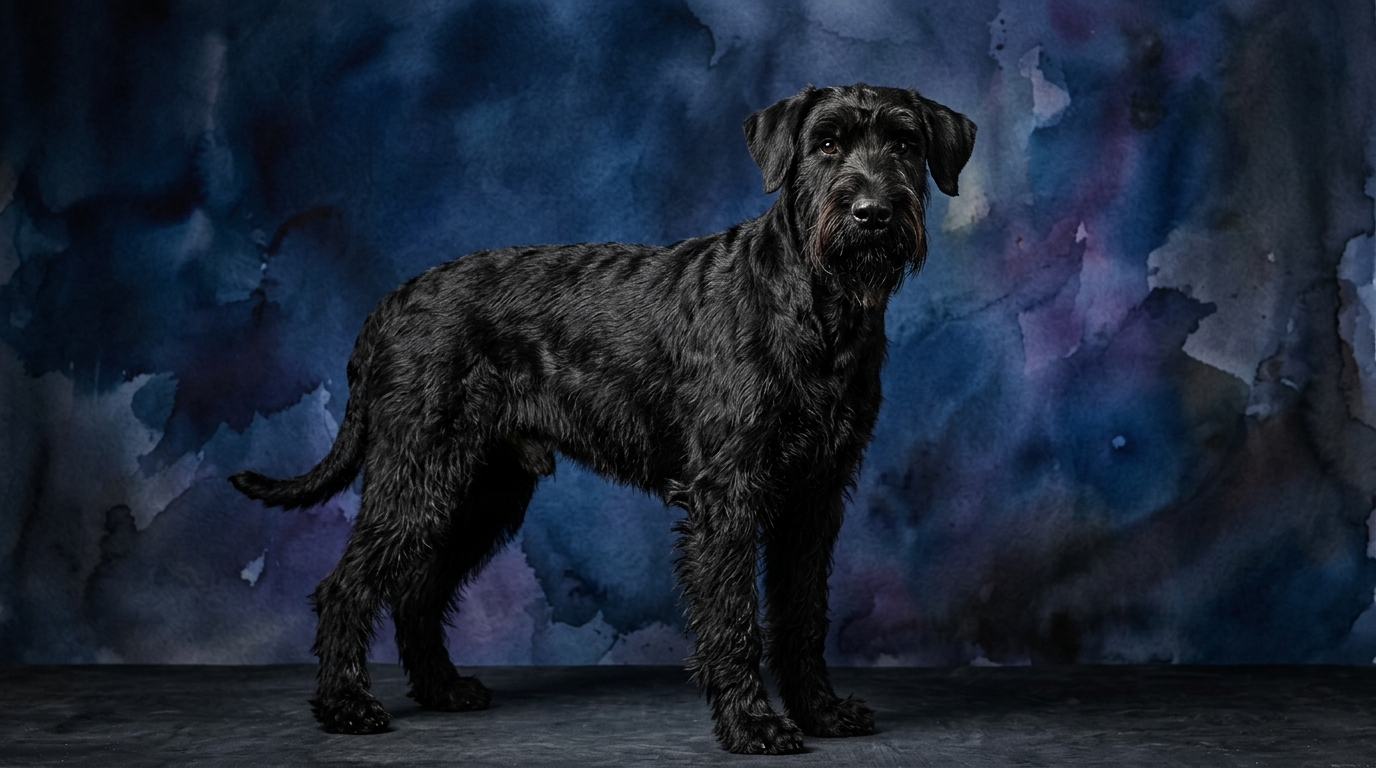

Side-by-Side Cognitive Profiles: Giant Schnauzer vs. Russian Toy
The Giant Schnauzer, a robust working breed, presents a cognitive profile indicating a strong capacity for complex tasks and retention. Ranked #28 by Coren for working obedience and intelligence, this breed demonstrates a Problem Solving score of 4 out of 5, signifying a notable ability to analyze novel situations and devise strategic solutions. Their Training Speed is also rated at 4 out of 5, highlighting a rapid grasp of new commands and sequences. When it comes to Social Intelligence, they score 3 out of 5, indicating a solid understanding of human cues and pack dynamics, often geared towards a working partnership. Their Instinctive Drive, at 3 out of 5, is present but balanced, channeling impulses towards specific tasks like guarding or herding. Finally, their Memory is rated 4 out of 5, reflecting an excellent recall of learned behaviors and environmental details.
In contrast, the Russian Toy, a delicate toy breed, possesses a cognitive makeup perfectly suited for companionship, though not formally Coren-ranked. Their Problem Solving score of 3 out of 5 suggests an aptitude for practical, everyday puzzles, such as navigating a home environment or finding a hidden treat, rather than abstract challenges. Their Training Speed also stands at 3 out of 5, indicating a steady learning pace where positive reinforcement yields consistent results, though perhaps with more repetition than a working breed. Social Intelligence is rated 3 out of 5, underscoring a strong attunement to their human family's emotions and intentions, fostering deep personal bonds. An Instinctive Drive of 3 out of 5 reflects typical companion breed urges for play and companionship without intense working demands. Their Memory, at 3 out of 5, ensures reliable retention of routines, commands, and social interactions within their familiar sphere.
These scores paint a picture of two breeds whose cognitive abilities, while varying in intensity, are both well-adapted to their respective historical roles and modern lifestyles. The Giant Schnauzer's profile emphasizes utility, problem-solving, and efficient learning for demanding occupations, while the Russian Toy's attributes focus on harmonious integration into a family unit, offering responsive and affectionate companionship. Understanding these distinctions is key to appreciating their individual mental prowess.
Where the Giant Schnauzer Wins Cognitively
The Giant Schnauzer's cognitive strengths are most pronounced in areas demanding analytical thought, rapid assimilation of information, and enduring recall. Their superior Problem Solving score of 4/5 means they are not merely reactive but proactive in their environment. These dogs excel at tasks requiring strategic thinking, such as navigating complex agility courses, deciphering multi-stage puzzle toys, or even outmaneuvering perceived threats. This capacity for independent reasoning makes them formidable partners in roles requiring more than rote obedience, enabling them to adapt and innovate when faced with novel challenges.
Furthermore, their higher scores in Training Speed (4/5) and Memory (4/5) collectively contribute to a distinct cognitive advantage for specific applications. A Giant Schnauzer can grasp new commands and sequences with impressive efficiency, often requiring fewer repetitions to achieve mastery. This rapid learning is bolstered by their excellent memory, allowing them to retain vast repertoires of commands, intricate routines, and successful strategies over long periods. This combination makes them highly reliable in scenarios where precision, consistency, and the ability to recall complex instructions are paramount, whether in advanced obedience, protection work, or canine sports.
Where the Russian Toy Wins Cognitively
While the Russian Toy doesn't boast higher numerical scores in comparison, its cognitive profile represents a distinct 'win' in terms of perfectly calibrated abilities for its primary role: devoted companionship. Their 3/5 Social Intelligence is not merely adequate; it's intensely focused and finely tuned to the nuances of human emotional states and needs. This means they excel at forming profound, responsive bonds, often anticipating their owner's mood or desires with an intuitive understanding that is deeply valued in a companion animal. Their cognitive efforts are primarily directed towards maintaining social harmony and closeness within their family unit.
The Russian Toy's consistent 3/5 scores across Problem Solving, Training Speed, Instinctive Drive, and Memory signify a cognitive balance that aligns precisely with a comfortable domestic existence. They possess sufficient problem-solving skills to navigate household challenges, learn new behaviors at a steady pace, and remember routines without requiring the intense mental exertion of a working breed. Their instinctive drives are perfectly scaled for a companion dog, favoring interaction and vigilance over complex tasks. This means their cognitive needs are readily met through daily interactions and play, leading to a contented dog that is easy to integrate into various home environments, without the potential for frustration that a more cognitively demanding breed might experience in a less stimulating setting.
Which is Easier to Train and Why
Determining which breed is 'easier' to train depends heavily on the owner's experience and expectations. The Giant Schnauzer, with a Training Speed of 4/5, generally grasps new commands and concepts more quickly than the Russian Toy. Their inherent drive to work and their capacity for complex problem-solving mean they are often eager to engage in structured training and excel at mastering advanced obedience. However, their strong will and independent nature, characteristic of a working breed, necessitate a confident, consistent, and experienced handler who can channel their substantial mental and physical energies effectively. An inconsistent approach can lead to a dog that leverages its intelligence to outsmart its owner.
The Russian Toy, rated 3/5 in Training Speed, learns at a steady, reliable pace. While they may require more repetitions than a Giant Schnauzer for certain tasks, their desire to please and their strong bond with their owners make them highly responsive to positive reinforcement and gentle methods. Their smaller size and less intense working drives mean that managing their behavior is generally less physically demanding, making them potentially 'easier' for a novice owner to handle, provided consistency and patience are maintained. Their social intelligence ensures they are highly attuned to their trainer's feedback, fostering a cooperative learning environment focused on companionship rather than complex performance.
Which Suits Active Owners vs. Relaxed Owners
For active owners seeking a canine partner for demanding pursuits, the Giant Schnauzer stands out as the ideal choice. Their 4/5 problem-solving and memory scores, coupled with a 3/5 instinctive drive, indicate a profound need for mental and physical engagement. These dogs thrive when given a 'job,' whether it involves competitive sports like agility, advanced obedience, protection work, or simply long, challenging hikes that require navigating varied terrain. An owner who can provide consistent, stimulating activities will find a Giant Schnauzer to be an incredibly rewarding and capable companion, preventing boredom that could otherwise manifest as undesirable behaviors.
Conversely, the Russian Toy is exceptionally well-suited for more relaxed owners who prioritize companionship and a manageable presence. Their consistent 3/5 scores across the cognitive dimensions mean their needs for mental stimulation are met through routine daily interactions, moderate play, and short walks, rather than intense intellectual challenges. They are content to be close to their human family, participating in household activities and offering affectionate presence. While they enjoy play, their cognitive and physical demands are scaled to fit a more tranquil lifestyle, making them perfect for individuals or families seeking a devoted lapdog and attentive companion without the extensive exercise and training commitments of a high-drive working breed.
The Verdict
Choose the Giant Schnauzer if you are an experienced, active owner seeking a highly capable, problem-solving partner for demanding training, canine sports, or protective roles, thriving on consistent mental and physical challenges.
Opt for the Russian Toy if you desire a devoted, emotionally attuned companion who thrives on close interaction, consistent routines, and moderate activity, offering a manageable and affectionate presence in a relaxed home environment.
🧠 Find Your Pet's IQ Score
Our Pet IQ Lab assessment covers 25+ tests across 5 cognitive dimensions — personalized to your breed.
Take the Full IQ Test →Frequently Asked Questions
Is the Russian Toy difficult to train?
No, Russian Toys are trainable and eager to please, though they may require more repetition than some working breeds due to their 3/5 training speed. Their social intelligence helps them respond well to positive reinforcement from their beloved owners, making training a bonding experience.
Do Giant Schnauzers need a lot of mental stimulation?
Absolutely. With high scores in problem-solving (4/5) and memory (4/5), Giant Schnauzers thrive on complex training, puzzle toys, and engaging activities to prevent boredom and channel their working drive constructively. Consistent mental challenges are crucial for their well-being.
How does Coren ranking relate to these breeds?
The Giant Schnauzer's #28 Coren rank signifies its exceptional readiness for formal obedience work and its capacity for complex learning, reflecting its working heritage. The Russian Toy, as a dedicated companion breed, is not Coren-ranked, which simply reflects its primary role as a beloved family member rather than a competitive working dog, not a lack of cognitive ability for its purpose.