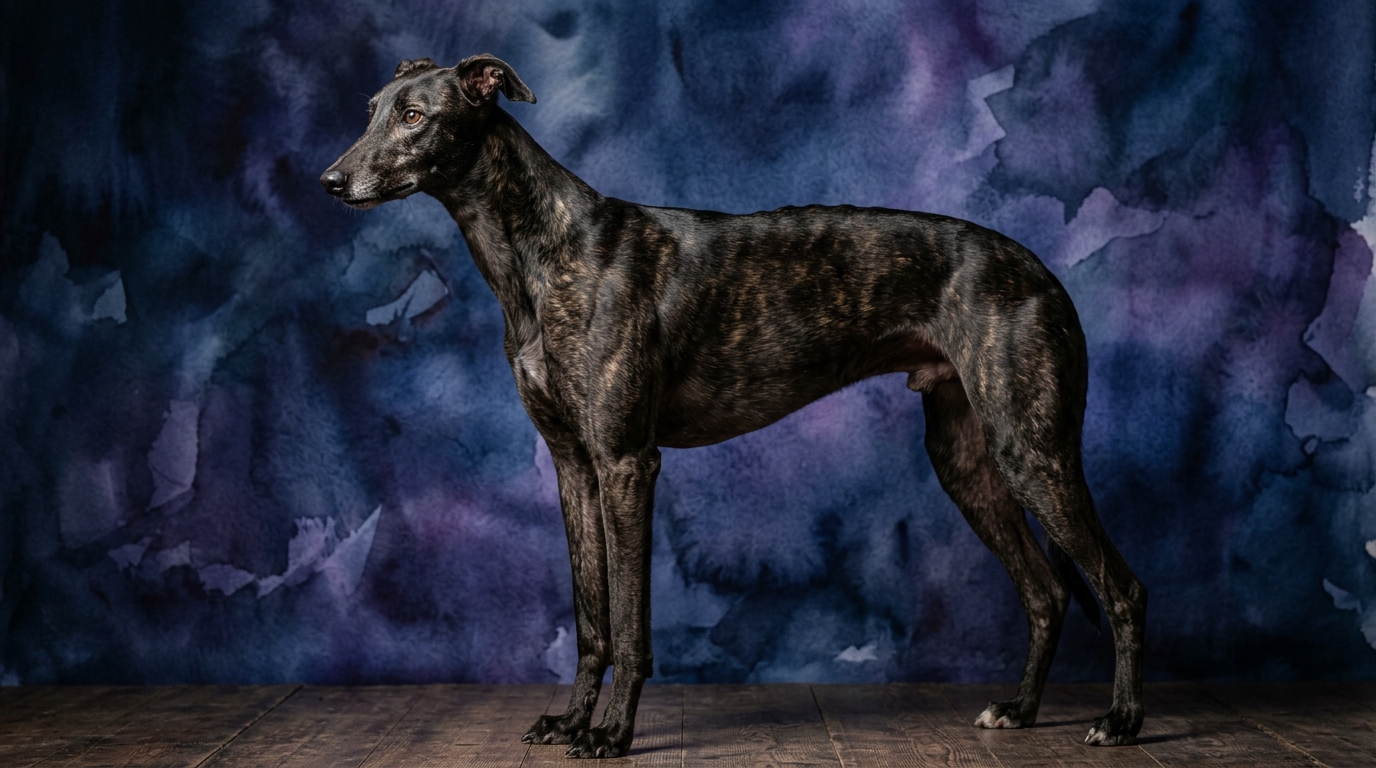

Side-by-Side IQ Profile: Greyhound vs. Old English Sheepdog
While both breeds hover around the mid-range of canine intelligence, with the Old English Sheepdog at Coren rank #44 and the Greyhound at #46, their cognitive strengths and challenges diverge significantly across The Cosmic Pet Pet IQ Lab's five dimensions. Understanding these nuances moves beyond simple ranking to reveal the intricate workings of each breed's mind.
For Problem Solving, both breeds score 3/5, indicating a moderate capacity for independent thought and figuring out novel situations. This suggests neither is a master strategist, but they possess enough cognitive flexibility to navigate common environmental challenges without constant human intervention. They can learn to open simple latches or navigate familiar obstacles but might not excel at complex puzzle toys without guidance.
Training Speed reveals a distinct difference: the Greyhound scores 2/5, while the Old English Sheepdog achieves 3/5. This metric reflects how quickly a dog grasps and retains new commands and routines. A lower score for the Greyhound implies they may require more repetition and patience during training sessions, while the Old English Sheepdog is likely to pick up new behaviors with slightly fewer repetitions.
Social Intelligence is rated 3/5 for both breeds, suggesting they possess an average ability to interpret human cues, canine body language, and social structures. They are generally capable of fitting into a household and understanding basic social dynamics, but they may not exhibit the nuanced empathy or manipulative cunning sometimes observed in breeds with higher social intelligence scores.
The most striking difference emerges in Instinctive Drive: the Greyhound scores a powerful 5/5, whereas the Old English Sheepdog rates 3/5. This dimension quantifies the strength of a breed's innate, hardwired behaviors. For the Greyhound, this is their formidable prey drive, an overwhelming compulsion to chase anything that moves quickly. For the Old English Sheepdog, it represents their herding instincts, which are present but typically less overwhelming in daily life compared to the Greyhound's chase response. This difference profoundly impacts their behavior and training needs.
Finally, Memory also shows a disparity: the Greyhound scores 3/5, and the Old English Sheepdog scores 4/5. A higher memory score for the Old English Sheepdog suggests a greater capacity to recall learned commands, routines, and past experiences over time. This can be a significant advantage in training and daily consistency, while the Greyhound's average memory might mean occasional 'forgetfulness' of less frequently practiced commands.
Where the Greyhound's Cognition Shines Brightest
The Greyhound's cognitive profile is intrinsically linked to its historical purpose: the pursuit of fast-moving prey. Their unparalleled Instinctive Drive of 5/5 means they are masters of the chase, demonstrating incredible focus and determination when their prey drive is engaged. This isn't just about physical speed; it's a cognitive specialization in identifying, tracking, and executing a pursuit. While challenging for owners in modern environments, this drive is a testament to their focused, single-minded dedication to their primary instinct.
Their Problem Solving at 3/5, while not exceptional, is often applied with great efficiency within the context of their instinctive drive. A Greyhound might not strategize to open a complex gate, but it will instinctively find the fastest, most direct route to an object of interest, navigating obstacles with an almost primal efficiency. This manifests as an ability to quickly assess and react to dynamic situations during a chase, making split-second decisions about trajectory and speed.
Furthermore, their social intelligence, while 3/5, allows them to form strong bonds with their human companions. While not overtly demonstrative, they understand and respond to the subtleties of their owner's presence, often forming quiet, devoted attachments. Their cognitive strengths are less about complex manipulation or abstract reasoning and more about refined, efficient execution of their core drives and a comfortable integration into their chosen social unit.
Old English Sheepdog: Cognitive Strengths in Memory and Trainability
The Old English Sheepdog's cognitive profile showcases a different set of strengths, primarily geared towards cooperative work and retention. Their superior Memory, rated at 4/5 compared to the Greyhound's 3/5, is a significant advantage. This means an Old English Sheepdog is more likely to remember commands, routines, and boundaries consistently over longer periods, making training efforts more enduring and less prone to requiring constant refreshers. They build a robust internal library of experiences and learned behaviors.
This enhanced memory directly contributes to their higher Training Speed of 3/5 (compared to the Greyhound's 2/5). An Old English Sheepdog can form associations between commands and actions more readily and internalize those lessons faster. This makes them more amenable to learning complex sequences of commands, such as those required in obedience competitions or advanced trick training, as their cognitive framework is better equipped for rapid absorption and recall of instruction.
Their Instinctive Drive of 3/5, while present as herding tendencies, is generally more manageable than the Greyhound's intense prey drive. This moderate drive means their natural instincts are less likely to override learned behaviors during training or in daily life. Combined with their problem-solving ability (3/5) and social intelligence (3/5), their cognitive makeup allows for a more balanced approach to learning and interaction, enabling them to adapt to diverse roles beyond their original herding purpose with greater ease.
Training Dynamics: Which Breed Learns with More Ease?
Based on The Cosmic Pet Pet IQ Lab's metrics, the Old English Sheepdog generally presents as the easier breed to train for a typical household setting. Their Training Speed of 3/5 means they catch on to new commands and routines more quickly, requiring fewer repetitions from their human trainers. This is further supported by their superior Memory (4/5), ensuring that once a behavior is learned, it is retained more reliably over time. An Old English Sheepdog is likely to be a more consistent performer of learned commands, making the training process feel more rewarding and less of an ongoing battle.
Conversely, the Greyhound's Training Speed of 2/5 suggests a need for greater patience and consistency. They may take longer to form associations and require more frequent reinforcement to solidify new behaviors. The most significant factor impacting Greyhound training, however, is their overwhelming Instinctive Drive of 5/5. Their hardwired prey drive means that in the presence of a moving object (a squirrel, a blown leaf, a distant cat), all learned commands can be momentarily overridden by the primal urge to chase. This requires extensive recall training in controlled environments and a deep understanding of their innate motivations.
While both breeds possess similar Problem Solving and Social Intelligence, the combination of higher Training Speed and Memory, coupled with a less dominant Instinctive Drive, makes the Old English Sheepdog more adaptable to standard obedience training and general household rules. Greyhounds, while capable of learning, demand a trainer who respects and understands their powerful chase instinct, implementing management strategies alongside positive reinforcement to ensure their safety and compliance.
Matching Cognitive Profiles to Owner Lifestyles
The distinct cognitive profiles of the Greyhound and the Old English Sheepdog mean they thrive in different types of home environments and with owners who have varying expectations. For the active owner who enjoys regular, intense bursts of physical activity followed by long periods of relaxed companionship, the Greyhound can be an excellent fit. Despite their reputation for speed, Greyhounds are often described as '45 mph couch potatoes.' They require secure, fenced areas for safe, unfettered running to satisfy their high Instinctive Drive. However, once that drive is expressed, they are typically calm, quiet, and content indoors, often seeking soft places to nap. Their moderate social intelligence means they appreciate companionship without demanding constant, complex interaction, making them suitable for owners who prefer a more independent canine presence indoors.
In contrast, the Old English Sheepdog is better suited for owners who are prepared for consistent, moderate-to-high levels of daily engagement, both physically and mentally. Their higher Training Speed and Memory mean they benefit greatly from ongoing training, puzzle toys, and activities that challenge their intellect. Their herding background often translates into a desire for purpose and activity, making them ideal for owners interested in dog sports like agility, obedience, or even therapy work. They need more than just a short walk; they need mental stimulation to prevent boredom, which can manifest as undesirable behaviors. Their moderate instinctive drive means their energy is more consistently applied throughout the day, rather than in intense bursts like the Greyhound.
Therefore, an owner seeking a dog that is quiet, independent indoors after a good sprint, and whose primary 'work' is a focused chase, might find a Greyhound appealing. An owner looking for a more consistently engaged, trainable companion who enjoys learning and participating in various activities will likely find the Old English Sheepdog's cognitive makeup more aligned with their lifestyle.
The Verdict
Choose a Greyhound if you appreciate a dog with an intense, specialized instinctive drive that requires dedicated management for safe, exhilarating exercise, balanced by a calm, independent demeanor indoors, and you are prepared for more patient, consistent training.
Opt for an Old English Sheepdog if you seek a consistently engaged companion with a higher capacity for retaining learned behaviors, who thrives on varied mental and physical stimulation, and whose moderate instinctive drive makes them readily adaptable to diverse training goals.
🧠 Find Your Pet's IQ Score
Our Pet IQ Lab assessment covers 25+ tests across 5 cognitive dimensions — personalized to your breed.
Take the Full IQ Test →Frequently Asked Questions
Are Greyhounds difficult to train?
Greyhounds can be more challenging to train due to their lower Training Speed (2/5) and powerful Instinctive Drive (5/5), which means their innate urge to chase can sometimes override learned commands. Patience, positive reinforcement, and understanding their prey drive are key for successful training, especially for recall.
Do Old English Sheepdogs need a lot of mental stimulation?
Yes, Old English Sheepdogs benefit significantly from mental stimulation due to their higher Memory (4/5) and Training Speed (3/5), which makes them eager learners. Without adequate mental engagement through training, puzzle toys, or structured activities, they can become bored and potentially develop undesirable behaviors.
What does 'Instinctive Drive' mean for these breeds?
Instinctive Drive refers to the strength of a breed's innate, hardwired behaviors. For Greyhounds (5/5), this is a powerful prey drive, an overwhelming urge to chase. For Old English Sheepdogs (3/5), it's their herding instinct, which is present but generally less intense and more manageable in daily life compared to the Greyhound's chase response.