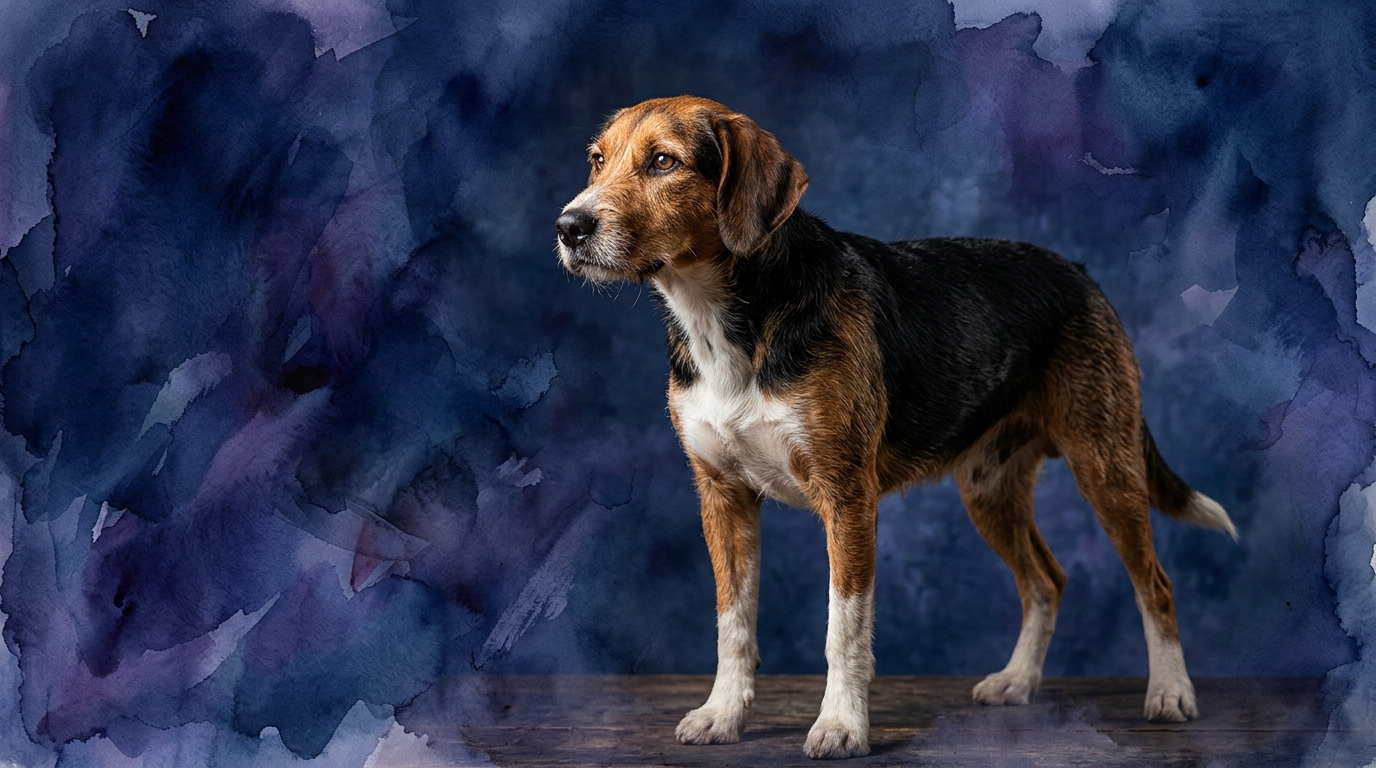

Side-by-Side Cognitive Profiles: Harrier vs. Russian Toy
Despite their divergent appearances and origins, both the Harrier and the Russian Toy register a 3/5 across the Cosmic Pet Pet IQ Lab's five cognitive dimensions, suggesting a foundational level of adaptability and learning capacity, yet manifesting uniquely in each breed's context.
For the Harrier, a scent hound, Problem Solving (3/5) often manifests as persistent, independent navigation through varied terrains to follow a scent trail, requiring sustained focus and decision-making in complex environments. Training Speed (3/5) indicates they absorb commands but may prioritize their powerful olfactory instincts over immediate obedience, requiring patient, consistent reinforcement. Social Intelligence (3/5) typically reflects their pack-oriented nature, understanding hierarchy and cooperation within a group, though they might not always seek human approval above their innate drives. Instinctive Drive (3/5) is pronounced in their relentless pursuit of scent and prey, a core aspect of their being. Memory (3/5) is strong for scent pathways, routines, and the locations of known resources, crucial for their working tasks.
The Russian Toy, a delicate companion breed, also scores 3/5 in Problem Solving, which for them often involves clever strategies to achieve comfort, secure attention, or navigate household dynamics, such as finding the softest blanket or the quickest route to their owner's lap. Their Training Speed (3/5) suggests they can learn quickly with positive reinforcement, but might also exhibit selective hearing if a task seems unrewarding or if distractions are present, sometimes leveraging their charm. Social Intelligence (3/5) is evident in their deep emotional attunement to their primary caregivers, often anticipating moods and seeking connection, though they can be reserved or wary with strangers. Instinctive Drive (3/5) is less about large-scale hunting but can manifest as a spirited chase for small toys or insects, and a surprising alertness as a tiny watchdog. Memory (3/5) is robust for routines, specific people, and the location of favored spots or hidden treats, contributing to their adaptability in a domestic setting.
Where the Harrier Excels Cognitively
The Harrier's cognitive strengths are deeply rooted in its heritage as a working scent hound. Its 3/5 problem-solving score, while numerically equivalent to the Russian Toy's, translates into a superior capacity for sustained, independent task engagement in outdoor environments. A Harrier can methodically work through a complex scent puzzle for hours, demonstrating impressive mental stamina and a singular focus that few other breeds can match when their instincts are engaged. This isn't just about physical endurance; it's a cognitive persistence to track and resolve a sensory challenge, making them particularly adept at activities like advanced scent work or tracking trials.
Furthermore, their instinctive drive, also rated 3/5, provides an unparalleled internal motivation for specific tasks. While this can sometimes make them appear less biddable, it means they possess an innate drive to perform certain functions, requiring less external prompting once engaged in a task aligned with their nature. Their memory (3/5) in this context allows them to recall intricate scent patterns and routes over long distances, a cognitive skill critical for their original purpose and a significant advantage in field-based activities.
Where the Russian Toy Exhibits Unique Cognitive Strengths
The Russian Toy's cognitive advantages, also rated 3/5 across the board, shine in their adaptability to human-centric environments and their nuanced social interactions. Their problem-solving (3/5) often involves a cleverness in domestic settings, figuring out how to gain attention, secure comfort, or subtly communicate their desires to their owners. This isn't about tracking, but about understanding and manipulating their immediate social and physical environment to their benefit, often with an endearing charm.
Their social intelligence (3/5) is a particular standout in the realm of companion animals. Russian Toys are often described as highly attuned to their owners' emotional states, demonstrating a capacity for subtle communication and forming profoundly deep, almost intuitive bonds. This sensitivity allows them to seamlessly integrate into family life, often becoming an emotional barometer for their humans. Their memory (3/5) reinforces this, as they quickly learn individual family members' habits, preferences, and the daily rhythms of the household, contributing to their role as a perceptive and responsive companion.
Training Dynamics: Harrier vs. Russian Toy
When considering ease of training, both breeds present unique challenges and rewards, despite their identical 3/5 training speed rating. A Harrier's independent nature and potent scent drive mean that while they are capable of learning commands, their motivation often lies in following a compelling scent. Training a Harrier typically requires consistent, patient, and highly engaging methods, often incorporating their natural drives into the training process. Their focus can be easily diverted by environmental stimuli, meaning owners must work diligently to maintain attention and establish a strong recall, especially in open areas. Ignoring a tempting scent for a human command requires significant repetition and high-value rewards.
The Russian Toy, conversely, often learns new commands quickly, particularly with positive reinforcement and a reward-based system. Their strong desire for human companionship and attention can be a powerful motivator. However, their small size and sometimes delicate nature can lead to owners inadvertently allowing undesirable behaviors, such as barking or house-training lapses, which then become harder to correct. They can also be prone to 'selective hearing' if not properly motivated or if they perceive a task as boring. Consistency is key with Russian Toys to prevent them from developing stubborn habits, and early socialization is crucial to temper any potential wariness towards strangers or new situations.
Matching Cognitive Profiles to Owner Lifestyles
The cognitive makeup of the Harrier makes it an ideal match for active owners who relish outdoor adventures and are prepared to engage with a dog's profound instinctive drives. Owners who enjoy activities like hiking, scent work, or even competitive tracking will find a Harrier's persistent problem-solving and robust memory for trails to be highly rewarding. These dogs thrive when given a 'job' that allows them to utilize their olfactory prowess and physical stamina, requiring owners who can provide consistent, stimulating mental and physical outlets, often daily. A Harrier's cognitive needs are best met by an environment that respects and channels its hound heritage.
The Russian Toy, with its acute social intelligence and clever problem-solving in domestic contexts, is better suited for owners who enjoy a close, interactive bond within a home environment. While they benefit from regular walks and play, their cognitive fulfillment often comes from engaging with their family, learning tricks, or participating in agility designed for small breeds. They are well-suited for relaxed owners who appreciate a perceptive companion that thrives on interaction and can adapt to varied living situations, provided they receive consistent attention and mental engagement through games and training. Their cognitive needs are met through companionship and mental stimulation that doesn't necessarily demand vast outdoor spaces or prolonged independent work.
The Verdict
Choose a Harrier if you are an active, outdoors-oriented individual or family, prepared to channel a powerful scent drive and independent problem-solving into structured activities. You'll appreciate a dog with remarkable stamina and a singular focus when on a trail.
Opt for a Russian Toy if you seek a highly perceptive, charming companion who thrives on close family interaction and demonstrates clever adaptability within a home setting. You'll enjoy a dog that forms deep emotional bonds and engages readily in domestic play and training.
🧠 Find Your Pet's IQ Score
Our Pet IQ Lab assessment covers 25+ tests across 5 cognitive dimensions — personalized to your breed.
Take the Full IQ Test →Frequently Asked Questions
Do Harriers make good family pets given their strong instinctive drive?
Harriers can be affectionate family pets, particularly with active families who understand their need for consistent exercise and mental stimulation. Their strong instinctive drive means they require secure environments and training to manage their scent-following tendencies, ensuring they remain engaged and well-behaved.
How does the Russian Toy's social intelligence manifest in a multi-pet household?
The Russian Toy's social intelligence allows them to often integrate well into multi-pet households, though early socialization is beneficial. They typically form strong bonds with their human family members and can coexist peacefully with other pets, often adapting their communication to suit the dynamics of the group.
Are both breeds suitable for first-time dog owners?
Both breeds can be suitable for first-time owners who are committed to understanding their specific needs and training requirements. A Harrier requires an owner prepared for significant exercise demands and consistent training to manage their hound instincts, while a Russian Toy thrives with consistent positive reinforcement and socialization to prevent small dog behaviors.