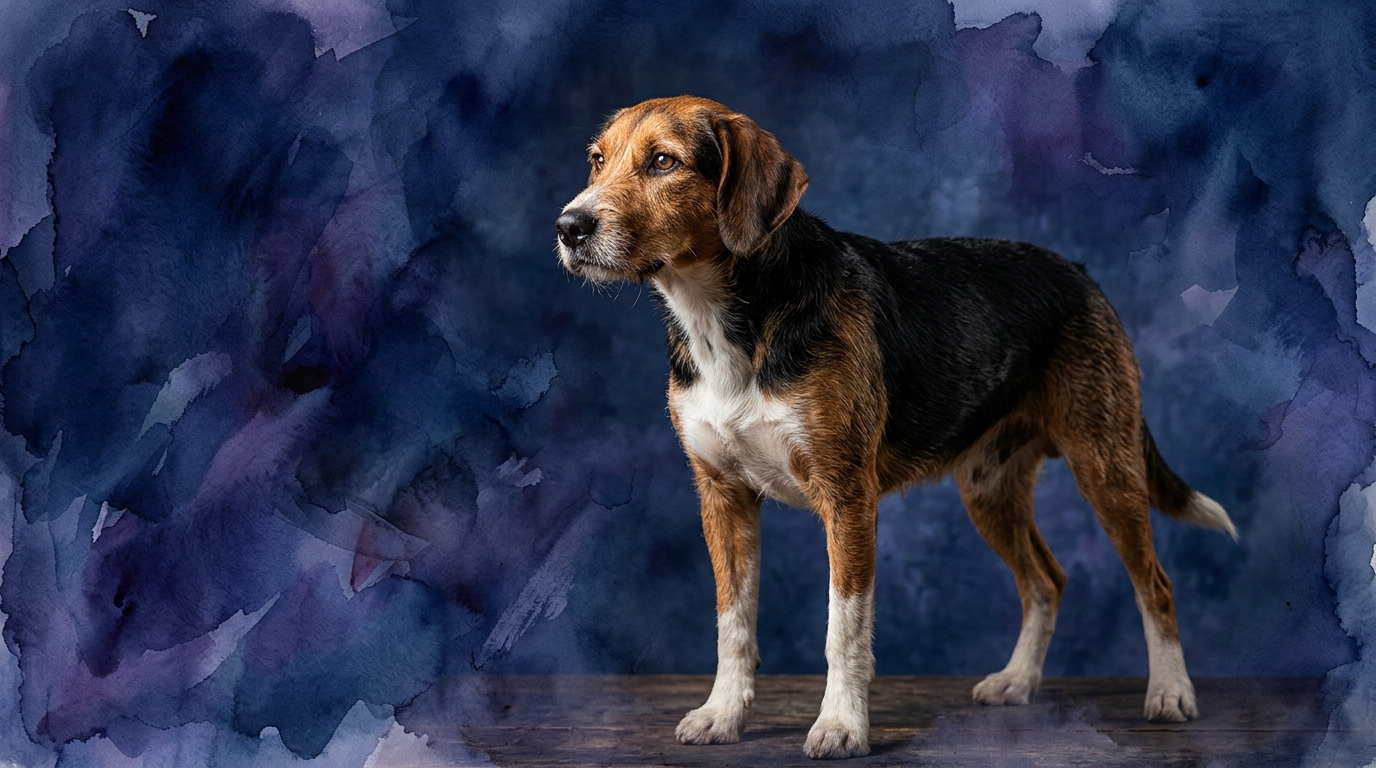
Harrier at a glance
| IQ Rank / Score | 17/25 |
|---|---|
| Trainability | ★★★☆☆ (3/5) |
| Social Intelligence | ★★★★☆ (4/5) |
| Lifespan | 11-14 years |
| Shedding | Low to moderate |
| Exercise Needs | High (60+ min/day + training) |
| Origin | England |
Understanding the Harrier Mind: Endurance-Driven Scent Intelligence
The Harrier's primary intelligence angle is its 'Endurance-Driven Scent Intelligence,' a highly specialized cognitive framework honed over centuries for hunting hare. Unlike breeds designed for complex abstract problem-solving or rapid obedience, the Harrier's mind excels at sustained, meticulous tracking. This involves processing an immense amount of olfactory data, filtering out irrelevant smells, and maintaining unwavering focus on a specific, often faint, scent trail for hours.
Their cognitive processes are geared towards persistence and independence. A Harrier must mentally map intricate scent paths, anticipate prey movements, and navigate varied terrain, all while exhibiting incredible physical and mental stamina. This isn't just about having a good nose; it's about the cognitive machinery to interpret, follow, and commit to a scent challenge with relentless determination, often operating with minimal direct human guidance once on a trail. Their intelligence is less about quick tricks and more about profound, practical, and relentless deduction through scent.
The Harrier's Unique Cognitive Strengths
A Harrier's strengths lie in its exceptional olfactory discrimination and mental fortitude. They possess an almost unparalleled ability to differentiate between similar scents, identifying their target's specific odor signature even amidst a cacophony of other environmental smells. This 'selective attention' to scent is a core cognitive asset, allowing them to tune out distractions that would overwhelm other breeds.
Furthermore, their stamina isn't just physical; it's a cognitive strength. The mental endurance required to maintain focus on a single scent for extended periods, through changing weather, over diverse landscapes, and without immediate gratification, showcases their robust problem-solving capabilities within their specialized domain. Their practical intelligence shines in real-world scenarios requiring sustained investigative effort, rather than abstract puzzle-solving.
Training a Trailblazer: Harrier Trainability
Harriers are often mistakenly labeled as stubborn, but their perceived 'difficulty' in training stems from their powerful, innate drives, not a lack of intelligence. Their primary directive is to follow a scent, and this instinct can powerfully override human commands, especially outdoors. Training a Harrier requires immense patience, consistency, and a deep understanding of their motivational triggers.
Effective training harnesses their natural inclinations. Positive reinforcement, particularly with high-value, scent-based rewards or opportunities for controlled 'tracking' games, yields far better results than punitive methods. Rather than fighting their scent drive, smart training integrates it, teaching them to respond to commands even when a tempting trail is present, or using their nose as a reward for compliance. This makes them highly trainable for tasks that align with their hunting heritage, such as scent work, rather than just rote obedience.
Social Dynamics and Pack Intelligence
As traditional pack hounds, Harriers possess a well-developed social intelligence. They typically thrive in multi-dog households and enjoy the company of other canines, exhibiting clear communication within a group. Their history of working cooperatively in a pack means they understand social hierarchies and cues, making them generally adaptable and amiable companions for other dogs.
While they demonstrate strong social bonds, their working intelligence, when on a scent, is often more independently focused. A Harrier might work seamlessly alongside its pack mates, but when an individual scent trail becomes compelling, it can become singularly focused, demonstrating an independent drive that complements, rather than detracts from, their pack mentality. They can be both collaborative and self-reliant, a testament to their balanced social cognition.
The Harrier's Memory: A Scented Map
The Harrier's memory is robustly specialized for its primary purpose: tracking. They possess an excellent capacity for remembering scent trails, routes, and the locations of various scent markers. This isn't merely rote memorization but an intricate cognitive mapping ability, allowing them to recall and re-navigate complex pathways based on olfactory information. Their 'spatial memory' is heavily intertwined with their 'scent memory.'
However, their memory for abstract commands or infrequent requests might not be as sharp as their scent-related recall. They can certainly learn and remember commands, but the strength of their instinctive drive means these memories can be temporarily overridden by a more primal impulse. Consistency in training is key to embedding command memory firmly within their active cognitive framework.
Unlocking Potential: Cognitive Stimulation for Harriers
To truly engage a Harrier's intelligence, owners must provide outlets that cater to their innate drives. Daily, vigorous exercise is crucial, not just for physical health but for mental well-being. Long, meandering walks in safe, varied environments allow them to engage their powerful noses, offering natural cognitive enrichment.
Scent-based games like 'hide and seek' with treats, formal tracking exercises, or participating in nose work classes are ideal for mental stimulation. Puzzle feeders that require sniffing and problem-solving, rather than just abstract manipulation, also appeal to their cognitive strengths. Providing these breed-specific challenges prevents boredom, reduces undesirable behaviors, and allows the Harrier to feel fulfilled and mentally engaged.
3 At-Home Tests to Measure Your Harrier's IQ
These tests are adapted from peer-reviewed ethology research. No equipment is needed beyond items you have at home. Run each test 5–10 times for reliable results.
The Myth: "Harriers are stubborn and difficult to train, often depicted as less intelligent than other breeds."
✅ Harriers are highly intelligent, but their intelligence is primarily oriented towards scent work and independent problem-solving in the field. Training requires patience, consistency, and methods that tap into their natural drives, making them incredibly capable partners for tasks that align with their innate abilities rather than suppressing them.
Harrier vs. Similar Breeds
🧠 What's Your Dog's IQ Score?
Our full Pet IQ Lab assessment includes 12+ tests across 5 cognitive dimensions, calibrated for Harriers specifically.
Take the Full IQ Test →Frequently Asked Questions
How smart is a Harrier?
Our Pet IQ Lab framework scores cognition across five dimensions (max 25). The Harrier totals 17/25 — high for a domestic dog. The full article breaks down each dimension with at-home tests.
Are Harriers easy to train?
Harriers can learn most cues, but expect to repeat lessons and keep sessions short. They score 3/5 on Training Speed in our breed profile.
Are Harriers good with children and other pets?
Yes — their Social Intelligence rates 4/5 in our Pet IQ Lab framework. With early socialization and supervised play, most Harriers integrate well into families with respectful children and other pets.
Do Harriers need a lot of mental stimulation?
Absolutely. With Problem Solving 3/5 and Instinctive Drive 5/5, Harriers need daily mental work — puzzle feeders, scent games, training sessions, or nose-work — to avoid boredom.
How much exercise does a Harrier need?
Harriers need active engagement. Plan for 45-60 minutes of exercise and training per day, plus mental stimulation.
How good is a Harrier's memory?
Harriers score 2/5 on memory. They remember high-value associations well; less-used cues fade without refresher sessions.
What is the typical lifespan of a Harrier?
Expect a lifespan of 11-14 years for a healthy Harrier.
The Harrier's intelligence is a testament to purposeful breeding, showcasing a mind uniquely adapted for persistent, independent scent work over long distances. Understanding and nurturing this distinct cognitive profile allows owners to truly appreciate their Harrier's profound capabilities and build a fulfilling partnership.